Wednesday, September 30, 2026

Sri Lanka and Australia continue strategic maritime dialogue

The Sixth Round of the Senior Officials Talks and the Fourth Round of the Strategic Maritime Dialogue between Sri Lanka and Australia concluded in Colombo on 21st September 2026, the Foreign Ministry said.

The text of the statement: “The meetings were co-chaired by First Assistant Secretary of South and Central Asia of the Department of Foreign Affairs and Trade of Australia, Sarah Storey and Additional Secretary of the Europe & North America, East Asia & Oceania, Southeast Asia & Central Asia, South Asia, Middle East and Legal Divisions of the Ministry of Foreign Affairs, Foreign Employment and Tourism, M.R.K. Lenagala.

The two sides explored new avenues for collaboration in areas such as bilateral political affairs, agriculture, trade, defence and education and agreed to strengthen cooperation on regional, multilateral and maritime affairs.”


from The Island https://ift.tt/TUM8KV2

Tuesday, September 29, 2026

Navy and police given seats on new fisheries committees across North and East

The government has established special district-level committees to curb illegal fishing in 15 districts, seven of them along the North-East coast, bringing the defence ministry, the navy, the coast guard and the police into the administration of fisheries in a region where fishermen have long accused the navy of selective enforcement, Tamil Guardian reported.

The committees cover Jaffna, Kilinochchi, Mullaitivu, Trincomalee, Batticaloa, Mannar and Ampara, alongside Negombo, Chilaw, Colombo, Puttalam, Kalutara, Galle, Matara and Tangalle. These are the fisheries department’s own districts rather than administrative ones, and several — Negombo, Chilaw and Tangalle among them — are coastal centres that sit inside larger administrative districts.

A progress review on the committees was held at the parliament complex on 25 September, chaired by the fisheries minister Ramalingam Chandrasekar, deputy defence minister Major General Aruna Jayasekara and the deputy fisheries minister Rathna Gamage.

The defence secretary Air Vice Marshal Sampath Thuyacontha attended, with the commander of the navy, the director general of the coast guard, the deputy inspector general of police for the nautical and tourist division, and senior officials from the fisheries department, the National Aquaculture Development Authority and local government bodies.

The committees are intended as coordination points on illegal, unreported and unregulated fishing, which the government says threatens marine ecosystems, the livelihoods of licensed fishermen and national food security, and on the use of fishing vessels for smuggling and human trafficking. Neither the defence ministry nor the fisheries ministry has set out what powers the committees hold, who chairs them at district level, or whether fishermen’s organisations are represented on them.

The structure follows a high-level meeting in parliament in November last year, co-chaired by minister Chandrasekar, justice minister Harshana Nanayakkara and deputy minister Jayasekara, which addressed poaching by local and foreign vessels, boats disabling their vessel monitoring systems, the use of unauthorised radio frequencies, drug trafficking and smuggling conducted under the guise of fishing, and delays in court cases involving seized vessels.

Fishermen in the North-East have accused the navy of selective enforcement, saying it moves against local Tamil fishermen while Indian bottom trawlers operate in northern waters largely unimpeded.

The navy has meanwhile arrested Tamil fishermen for illegal fishing in the same waters, including 13 detained at Kattaikadu in Jaffna. It has also been accused of covertly surveying fishing lands at Chundikkulam without notice to the owners.

That is alongside the occupation itself. Fishing settlements at Myliddy have been held inside the Valikamam North High Security Zone since 1990, and landowners there have now held weekly protests outside the military commander’s bungalow for 23 consecutive weeks without a government response. In July, Jayasekara told parliament that 1,661 acres inside that zone would be permanently acquired.

Jayasekara is also the minister who told parliament that cultivation inside military camps was solely for the army’s own consumption, a claim contradicted by footage showing military personnel selling vegetables grown on occupied land to a Keells collection centre in Jaffna.


from The Island https://ift.tt/JbxFA7S

Monday, September 28, 2026

CSE Annual Report 2025 ranked Sri Lanka’s No. 1 Report

The Colombo Stock Exchange’s (CSE) 2025 Annual Report has been ranked Sri Lanka’s top annual report for 2025, winning gold for the third consecutive year at the USA’s League of American Communications Professionals (LACP) 2025 Vision Awards in the Annual Report and Integrated Report categories. The CSE’s Integrated Report (IR), themed “Where Confidence Meets Capital,” was ranked Sri Lanka’s No. 1 annual report and earned a place among the Asia-Pacific region’s top 100 reports and secured the global Gold Industry Award for the third consecutive year.

The Annual Report 2025 highlighted the CSE’s strategic priorities, key achievements, and long-term vision, demonstrating its leadership in navigating evolving market conditions and embracing technological innovation. The recognition reaffirmed the CSE’s position as a leading force in Sri Lanka’s financial sector and a benchmark for reporting excellence across the region.

“Being ranked Sri Lanka’s No. 1 annual report and receiving the LACP Gold Award for the third consecutive year is a proud affirmation of the CSE’s commitment to transparent, accountable and forward-looking reporting.” Said Mr. Kusal Nissanka, Executive Vice President of Finance, Listed Entity Compliance & Sustainability as he remarked upon the success of the annual report. “Our 2025 Annual Report reflects not only our performance, but also the significant progress made in strengthening market infrastructure, expanding access, advancing digital reporting and supporting sustainable capital formation. This recognition encourages us to continue setting higher standards and building confidence among all stakeholders in Sri Lanka’s capital market.”


from The Island https://ift.tt/GaD4qTZ

Horror as woman 'drugged and gang-raped for hours after group text'


A university student was allegedly sexually assaulted after another student drugged her and invited others to join in on a group chat.

from Daily Express :: US Feed https://ift.tt/D87Vx40

Sunday, September 27, 2026

IRD enforces mandatory TIN certificate submission for specified transactions starting November 01

The Inland Revenue Department (IRD) has announced a sweeping regulatory shift, confirming that the submission of a valid Taxpayer Identification Number (TIN) Certificate will become mandatory for a wide range of essential financial, commercial, and property transactions starting November 1, 2026.

The decisive directive, enforced under the legal framework of the Inland Revenue (Amendment) Act, No. 11 of 2026, applies directly to individuals specified under Section 102(3) of the principal Inland Revenue Act.

Under the new mandate, relevant authorities and corporate entities across the island have been instructed to withhold processing or completion of key procedures unless applicants present a verified TIN document. The specified transactions include:

Financial Services: Opening any account at a bank or financial institution, and obtaining a credit card.

Property and Construction: Obtaining approval for building plans, and registering land or titles to land.

Automotive Administration: Registering a motor vehicle or renewing a motor vehicle license.

Commercial Activity: Registering a new business.

Corporate Transfers: Transferring shares of a company incorporated in Sri Lanka—a requirement binding on both the transferor and the transferee.

The IRD has reiterated that acquiring a TIN remains a statutory obligation for all resident individuals who were aged 18 or older as of December 31, 2023, as well as those who attain the age of 18 on or after January 1, 2024, upon reaching that milestone. Officials handling the designated services have been sternly directed to verify compliance before moving forward with any customer requests.

To streamline the transition and prevent administrative bottlenecks, the department has encouraged members of the public who have not yet secured their numbers to register promptly via the official IRD e-Services platform. Furthermore, recognizing potential logistical hurdles, the IRD noted that a printout of the online TIN verification result—clearly displaying the applicant’s National Identity Card (NIC) number and TIN—will be accepted as a valid alternative to the official certificate.

As the November 1 deadline approaches, citizens are urged to secure their documentation beforehand to ensure uninterrupted access to essential public, financial, and legal services.


from The Island https://ift.tt/974kERi

Saturday, September 26, 2026

Harak Kata’s father alleges plot to kill son in custody

The father of detained underworld figure Nadun Chinthaka Wickramaratne, alias “Harak Kata”, has lodged a complaint with the Human Rights Commission of Sri Lanka (HRCSL), alleging a plot to assassinate his son while in custody.

In a letter to the HRCSL Secretary, Nelson Mervyn Wickramaratne said his son was being held at a 10-cell detention facility at the Welisara Navy Camp alongside three other alleged underworld figures — Kehelbaddara Padme, Bacco Saman and Panadura Nilanga.

He alleged that the three had previously been accused of attempting to assassinate his son within court premises.

Wickramaratne also denied recent media reports of a clash between his son and Padme on September 22, claiming that the reports were being used to facilitate an attack on his son.

He said his son was suffering from a knee injury, used crutches and was being held under conditions that had adversely affected his health.

The complaint also alleged that his son faced threats after being prepared to disclose information concerning alleged corruption involving senior police officers. These allegations have not been independently established.

Wickramaratne further claimed that despite more than 36 months in detention and extensive interrogation by the CID and TID, no new cases relating to drug trafficking or major crimes had been filed against his son, apart from a 2018 drug case involving 12 grammes.

He urged the HRCSL to intervene immediately to safeguard his son’s right to life and ensure due process.


from The Island http://island.lk/harak-katas-father-alleges-plot-to-kill-son-in-custody/

Friday, September 25, 2026

Seylan Cards partners with Cinnamon City of Dreams to unveil ‘Lenny Jay’s Michael: Relive the Legend’

Seylan Cards has partnered with City of Dreams Sri Lanka, to present ‘This Is Michael: Relive the Legend’, a live tribute to the legacy, music, and energy of Michael Jackson. Held at City of Dreams Sri Lanka, from the 8th to the 9th of November 2026, the event offers Seylan Cardholders the unique opportunity to immerse themselves in premium entertainment and create extraordinary memories.

Standing as an internationally acclaimed Michael Jackson tribute production, ‘This is Michael: Relive the Legend’ has travelled across 15 countries and 25 cities. Performed by Lenny Jay, the tribute show honours the voice, costumes, and the iconic presence of Michael Jackson and his immense impact on the world, backed by an exhilarating cast of singers, dancers, and musicians.

The partnership expands Seylan Cards’ proposition, effectively opening the doors to exclusive entertainment, lifestyle, and experiential opportunities and allowing Cardholders to step into the experience of an authentic Jackson performance.


from The Island https://ift.tt/M1WjAbx

Thursday, September 24, 2026

One dead, another missing in Kitulgala drowning

One person drowned and another went missing while bathing in the Manna Kethi Ella in Kitulgala on Wednesday (23) evening.

Efforts were underway to locate the missing person. (NP)


from The Island https://ift.tt/RseiXOD

Wednesday, September 23, 2026

Planters’ Association Chairman proposes 5-point plan for industry revival at 172nd AGM

Malwatte Valley Plantations PLC Director / CEO, Shanaka Samaradiwakara was appointed as Chairman of the Planters’ Association of Ceylon (PAC), while Kahawatte Plantations PLC Director / CEO Binesh Pananwala, was appointed as Deputy Chairman at the Association’s 172nd Annual General Meeting (AGM) on 19 September at the Cinnamon Grand.

The event was graced by Central Bank of Sri Lanka Governor, Dr. Nandalal Weerasinghe and Sri Lanka Tea Board Chairman, Raj Obeyesekere as Chief Guest and Guest of Honour respectively.

In his inaugural address, Samaradiwakara outlined a five-point vision for the plantation sector, focusing on value addition, research and development, land-use and productivity, irrigation and long-term security of tenure. He emphasised that the future of commercial agriculture in Sri Lanka would hinge on how effectively all industry stakeholders could work together, while maintaining clear understanding of the ground realities faced by producers.

Value-added tea accounted for more than 50% of total tea export volumes in 2025. Samaradiwakara noted Regional Plantation Companies (RPCs) have accounted for the majority of that volume through continuous investments, including most recently in matcha, green tea and artisanal teas.

In that context, he sought the support of the Sri Lanka Tea Board and the export sector to protect this emerging high value segment, given that significant quantities of green tea and other high-value teas remain unsold at auction while similar products continue to enter the country. “We respectfully request the authorities to review this matter and introduce appropriate measures to support domestic production and value addition,” he stated.

On research and development, he observed that commercially viable alternatives to several essential crop protection products remain limited. Accordingly, he called on the Tea, Rubber and Coconut Research Institutes to lead the development of practical, scientifically proven alternatives, while stressing that disease threatening the rubber industry requires immediate attention. “We cannot afford to repeat the experience of the coffee industry, where coffee blight devastated the sector,” he added.

Turning to issues around land-use policies and productivity, he noted that RPCs have diversified for over two decades in response to changing rainfall patterns, introducing crops such as oil palm, pepper and avocado. He warned that these investments are increasingly threatened by unsupportive policy, agricultural theft and crop damage by wild animals, costing companies millions of rupees each month in security. “It is imperative that these investments are protected through strong enforcement, appropriate regulatory reforms, and effective measures to address both agricultural theft and crop damage,” he noted. On irrigation, he appealed to the Government to relax archaic restrictions on groundwater use and simplify approvals for drilling tube wells in order to enhance climate resilience.

Addressing security of tenure, he highlighted that replanting often takes more than a decade to generate meaningful revenue, and that uncertainty over lease extensions is making it harder for RPCs to attract foreign direct investment and long-term financing. “If we are to attract fresh capital, accelerate replanting, modernise our plantations and improve productivity, security and certainty of tenure are mandatory,” he added.


from The Island https://ift.tt/SpP0raZ

Tuesday, September 22, 2026

England 119/2 in 20 overs

England had moved to 119 for two at the end of 20 overs after electing to bat first in the first ODI against Sri Lanka at Chester-le-Street yesterday.

Captain Kusal Mendis returned to the side after a long injury lay off while Sri Lanka handed over debut to leg-spin bowler Sachindu Colombage.

Captain Harry Brook was unbeaten on 35 with Joe Root on 41.


from The Island https://ift.tt/F2fSpmV

Monday, September 21, 2026

Police may seek clarification from US

C’mbo Port ‘Ice’ detection:

By Shamindra Ferdinando

A senior police official said that the Special Investigation Unit (SIU), inquiring into alleged loopholes and irregularities in the August 31 raid carried out at the Colombo Port, might seek clarification from the US Embassy here.

The official said so responding to The Island query regarding the need for the SIU to get in touch with the US against the backdrop of its own admission that Senior DIG Ranmal Kodituwakku had been informed by the US Drug Enforcement Administration regarding the drug stash on 31 August.

The official said that the SIU already recorded SDIG Kodituwakku’s statement in connection with the investigation.

Earlier, the US Embassy in Colombo declined to comment on the SIU probe into the recent narcotics detection jointly made at the China-managed Colombo International Container Terminal (CICT) by the US Drug Enforcement Administration’s (DEA) New Delhi Country Office and the Sri Lanka Police.

US Embassy spokesperson said that the mission wouldn’t add to their press release, issued on 02 September, in the immediate aftermath of the raid.

Police Headquarters, on 11 September, declared that the Central Crime Investigation Bureau (CCIB) was conducting investigations into the recovery of 463 kg of Crystal Methamphetamine (‘Ice’). Police never acknowledged the role played by the US in the operation.

Among those arrested in connection with the Colombo Port narcotics detection were three Pakistani passport holders. In our previous report, regarding the Colombo Port detection, we inadvertently stated that the police didn’t acknowledge the role played by the US.

The police official said that once the IGP received the SIU report, he would take necessary action, depending on the findings.


from The Island https://ift.tt/LO8taop

Trump LIVE: Andy Burnham makes dramatic U-turn on US President ahead of first-ever meeting


Burnham will meet Trump for the first time at the UN General Assembly, having previously been critical of the US leader during his time as Mayor of Manchester.

from Daily Express :: US Feed https://ift.tt/ztqhEa9

Sunday, September 20, 2026

Three arrested with ‘Ice’ over Kotahena murder

By Norman Palihawadane

Two main suspects, wanted in connection with the murder of a man in Kotahena, and another person who allegedly aided and abetted the crime, have been arrested with 28.6 grammes of ‘Ice’ (crystal methamphetamine).

The arrests followed an investigation into the killing. The victim was hacked to death, in Kotahena, on September 14.

Acting on information gathered during the investigation, police arrested the three suspects in separate raids conducted in Grandpass, Kolonnawa and Mattakkuliya.

Police also recovered 28 grammes and 600 milligrammes of ‘Ice’ from the suspects.

The suspects, aged 19, 25 and 39, are residents of Mattakkuliya, Colombo 14, and Kolonnawa, police said.

Kotahena Police are conducting further investigations.


from The Island https://ift.tt/CV6m3rj

Saturday, September 19, 2026

In the Iran war, a tale of old American dilemmas

Japan in 1945 and Iran today are fundamentally different cases. Nor can the atomic bomb of 1945 simply be compared with today’s sophisticated nuclear arsenals.

By By Milinda Moragoda

Eight decades ago, US President Harry S Truman faced a decision that would change the nature of warfare forever.

Japan was still fighting after the surrender of Nazi Germany. The US possessed a weapon unlike anything the world had seen. Truman and his advisers had to decide how best to use America’s overwhelming military power to end the war.

Today, Donald Trump faces a different problem. Iran has suffered substantial military damage, but military success has not translated into the decisive political outcome the US seeks.

Japan in 1945 and Iran today are fundamentally different cases. Nor can the atomic bomb of 1945 simply be compared with today’s sophisticated nuclear arsenals.

Yet, there is a common strategic problem: How does a great power turn military superiority into a political outcome? If Washington were pushed into a corner — by the cost of the conflict, the inability to compel Iran’s submission or pressure to demonstrate that American power can still deliver a decisive result — the temptation to consider previously unacceptable options could arise.

What would other nuclear powers learn if the nuclear threshold were crossed? The decision-making process surrounding Truman was more complex than the familiar image of a President simply deciding whether to drop the bomb. The views of members of the administration, military leaders and the scientific community were all sought, and they were not identical. The principal US objective was to force Japan to surrender while avoiding the heavy American casualties that an invasion was expected to entail.

An atomic bomb was dropped on Hiroshima on August 6. Japan did not immediately surrender. Three days later, Nagasaki was struck. Around the same time, the Soviet Union entered the war against Japan. The sequence matters. Even unprecedented destruction does not automatically translate into political capitulation. Japan’s surrender followed a combination of factors. The decision also had consequences beyond Japan. Moscow was watching. At Potsdam, Truman informed Stalin that the US possessed a powerful new weapon. US officials understood that possession and use of the bomb could affect the emerging relationship with the Soviet Union. Some policymakers hoped that America’s nuclear monopoly might strengthen Washington’s position in dealing with Moscow.

It would be wrong to reduce Hiroshima and Nagasaki to a message to Stalin. The historical debate over “atomic diplomacy” remains contested. But it would be equally wrong to assume that the Soviet Union was absent from American strategic calculations.

We cannot know what is being said privately in the White House, nor should we invent positions for advisers whose deliberations are not public. Trump has not publicly advocated the use of nuclear weapons against Iran. But the possibility has nevertheless entered public debate as the conflict has remained unresolved.

Any American administration confronting an inconclusive conflict with Iran would have to consider not only what further military action might achieve in Iran, but also what its consequences would be elsewhere. Capitals around the world would ask whether an American action demonstrated restraint, established a new threshold or created a precedent. They would examine whether escalation produced political results or merely greater destruction.

The most consequential message may be the precedent that other States believe has been established.

For almost eight decades, nuclear weapons have occupied a peculiar place in international politics: Their paradoxical purpose has been to ensure that they are never used. If that understanding were to change, the consequences would extend far beyond the country against which a weapon was used. Other nuclear powers would examine the circumstances, the justification offered, the international response and, above all, whether nuclear use achieved its political objective. India has its own nuclear doctrine and strategic assumptions. If the circumstances in which nuclear weapons could be contemplated were to change elsewhere, New Delhi would have to examine what that meant for its own security. That would require a serious debate about deterrence, escalation and thresholds.

A great-power action can have several audiences at once. An adversary may see a warning. An ally may see reassurance. A rival may see an opportunity — or a precedent. The meaning of an action is never entirely controlled by the power that takes it. The world of 2026 is also very different from that of 1945. Information travels instantly, and every major use of force is subject to scrutiny by far more actors, each making its own calculations. Military superiority can destroy an adversary’s capacity to fight. It cannot, by itself, determine what comes after the fighting. That is the enduring problem of converting power into political order.

(Milinda Moragoda is founder of the Pathfinder Foundation, strategic affairs think tank. can be contacted via . courtesy Hindustan Times)


from The Island https://ift.tt/Onupkhy

Friday, September 18, 2026

Immigration official arrested over alleged illegal passport for criminal

By Norman Palihawadane

An Assistant Controller of the Department of Immigration and Emigration has been arrested by the CID for allegedly assisting in the preparation of an illegal passport for an organised criminal.

The suspect was arrested on Thursday (17) by officers of the CID’s Special Investigations Unit at the Department of Immigration and Emigration.

Police identified the suspect as a 42-year-old resident of Gampaha.

The CID’s Special Investigations Unit is conducting further investigations into the incident.


from The Island https://ift.tt/v9WP1HU

Thursday, September 17, 2026

Three-wheeler driver shot dead in brazen daylight killing at Dematagoda

A three-wheeler driver was shot dead in a brazen afternoon shooting beneath the Dematagoda Black Bridge yesterday (17), police said.

The investigators suspected that killing may be linked to notorious underworld figure Mohamed Najim Mohamed Imran, widely known as ‘Kanjipani Imran’ operating from overseas.

The victim, a 50-year-old resident of Udugama, Galle, was killed with a pistol, according to Police Spokesman ASP F.U. Wootler.

The victim was rushed to hospital following the incident. However, police later confirmed that the three-wheeler driver had succumbed to his injuries while undergoing treatment.

Preliminary inquiries have revealed that the deceased had previously served in the Army.

According to police, the gunman is believed to have been travelling in the rear seat of the three-wheeler before opening fire on the driver.

Police suspected that the shooting was carried out by a hireling of Kanjipani Imran – a notorious underworld figure and drug kingpin operating from out of the country.

Police said that weapons and explosives had been supplied by Kanjipani Imran for the recent bomb incident at Dehiwala, where two children were killed in a grenade attack.

According to investigators, the weapons and explosives were supplied to another underworld figure known as ‘Kosmalli’ for the Dehiwala attack. Imran had also supplied narcotics to Kosmalli’s narcotic network, police said.

Further investigations are being conducted by police.


from The Island https://ift.tt/CZtKcdP

Wednesday, September 16, 2026

Twilight of the Dons

by Prof. Rajiva Wijesinha

While on holiday last month I was lent a book by a friend, who had borrowed it in turn from my former Dean, Leslie Mitchell, into whose retirement home he too has now moved. It must have appealed to my Dean, as it did to both of us, because it was about Oxbridge dons in the latter half of the last century. Called Twilight of the Dons, by a man called Colin Kidd, it charts the decline of the prestige of dons over that period, from the high point they commanded just after the Second World War.

This was in part because of the yeoman service they rendered during the war, not only in the field where many of them won decorations but also in administration and, in particular, in intelligence work, notably at Bletchley Park, which worked out German ciphers, contributing to effective countermeasures against German aggression, notably at sea.

With prestige thus gained, dons were a notable feature on the media and developed apace in the post war years, not only delivering lectures but also participating in quiz shows which they dominated. And they were in the forefront of developing other universities as well, the red bricks which started earlier and then the many others set up in this period, sometimes characterised as plate glass.

There were some challenges to this hegemony in the first couple of decades after the war, notably a Kidd notes, by Catholics who wanted greater seriousness – a focus of criticism being the then prevalent language philosophy, which was more concerned with arguments about meaning than the world at large. But for a couple of decades there was nothing really disturbing. But then came the student movements of the late sixties which, if nothing like as dramatic as those in the United States of France, started a decline in confidence.

Before he goes on to these, Kidd has two set pieces about the United States and France though he concentrates on peripheral issues. He looks closely at responses in Britain to the Kenndy assassination, or rather what some dons, particularly the conservative Hugh Trevor Roper, saw as the cover up by the Warren Commission of a deeper conspiracy. He was opposed by his fellow conservative, John Sparrow, Warden of All Souls, and their exchanges could be acerbic.

The next chapter deals with sociology, a suspect subject at Oxbridge, and the responses of dons who found the theorising of Levi-Strauss suspect. Having helped publicise his approach, they soon despaired of his loose methods, and became increasingly critical.

This last fitted in with one of the criticisms of the students, that Oxbridge academia was too clinical, and they wanted subjects, and subject combinations, that related more clearly to the actual world. This went hand in hand with support of Marxist arguments, more precisely Trotskyists radicalism, which fundamentally challenged the elitist consensus of Oxbridge.

Until the shocks of the sixties, Oxbridge had had a laid-back approach to administration, and its finances. It had never thought about the anomaly apparent to students of a college without undergraduates, All Souls, which provided fellowships for many grandees resident in London, who lived a sybaritic existence when they came to Oxford for weekends.

All Souls was one focus of student criticism, and Warden Sparrow deeply upset, not least when there was graffiti on the walls of Balliol, the most radical of the colleges then, with a Marxist master, Christopher Hill. He demanded that the graffiti be cleaned up, and Hill obliged, to the extent only of removing Sparrow’s name, but allowing everything else to remain, which made him more furious.

Ironically, this Marxist approach fitted in with the next great shock that hit the universities, namely the rigid money for value policies of Margaret Thatcher. She had the support of many conservative dons, some of whom Kidd characterises as Tory Marxists, in opposition to the Whig grandees, who had held unchallenged sway earlier. But not a few of the Tories were overwhelmed by her rigidity, which intensified when Oxford denied her an honorary degree. She changed the funding system to create an agency that was supposed to be evenhanded between all the universities, so Oxbridge soon found itself having to compete with institutions it had previously patronised.

There was, however, another reason for the decline in prestige of the dons, which had to do with shifting priorities as new generations came to the fore. The confidence of the generation which thought it had won the war and laid the foundations for modern Britain – William Beveridge, who institutionalised the welfare state, was the Master of University College, my own – gave way to a new generation which, even if many were of the upper class, had to strive to get to the top.

Furthermore, the domination of generations of undergraduates by dons who lived in college, and entertained them, and developed wider interests through conversations over the hospitality they freely extended, passed when more and more dons lived out and had to help in looking after families. Working wives became the norm, unlike in the earlier period when wives simply supported their husbands, contributing to hospitality at home, as was the case with the epitome of supportive tutors, George Cawkwell of Univ.

He does not figure in the book, the only example given of a don who, while a considerable academic, spent much time with and on students being that of Jeremy Catto, of Oriel, whose death a few years back led to outpourings of grief. Before that he had been part of a group of historians, including Leslie Mitchell, who saw themselves as a last post of civilisation, which they celebrated at regular dinners.

But there are many vignettes of dons who were larger-than-life figures in my time, including Trevor Roper, who had a streak of mischief which led to sometimes radical comments, as when ultra-conservative fellows of Peterhouse Cambridge, where had had been elected head, found him wanting, to be described as ‘the power-house of Troglodyte thought’.

Kidd shows how all that had changed, dons in general now being largely parochial figures, concerned with their families more than with their students, and with research that advances their careers than with students to advance not just their careers but the wider thinking that would make their careers productive.

But I suppose, with now two Prime Ministers in a row who did not come from Oxford, the first such lapse since the Second World War, the shades coming down is not surprising.


from The Island https://ift.tt/OdToPsg

Tuesday, September 15, 2026

Andrew advances after fighting comeback

Andrew Wijemanne produced a determined performance to advance to the second round of the ITF J60 Tennis Tournament Week 2, being held at the Sri Lanka Tennis Association courts from September 14 to 19.

‎Wijemanne defeated Thailand’s Tachatam Srisen 7-6, 6-0, 4-0 in the first round, with Srisen retiring early in the decisive third set.

‎After edging a tight opening set, Wijemanne raised his game significantly to dominate the second 6-0. He then carried that momentum into the third set, racing into a commanding 4-0 lead before his Thai opponent was forced to retire.

‎The victory sees Wijemanne move into the next round of the international junior tournament with considerable confidence.

‎

‎Boys’ First Round Results

‎Ashling de Silva (Sri Lanka) bt. Jagruth Kasireddy (India) 7-6, 6-3

‎Aahil Kaleel (Sri Lanka) bt. Phasin Sinchalong (Thailand) 6-4, 6-3

‎Rehan Gunawardhene (Sri Lanka) bt. Darsh Khedekar (India) 6-4, 6-2

‎Damsath Peiris (Sri Lanka) bt. Jiho Park (Korea) 6-4, 6-4

‎Nevan Kannangara (Sri Lanka) bt. Abhiram Maurya (India) 6-2, 6-1


from The Island https://ift.tt/LgRdQS8

The Horror and the Slow Burn

By Lynn Ockersz

The 9/11 explosion of pent-up hate,

Has left a slow-burning sorrow,

In the hearts of the sensitive few,

Proving humanity yet has some space,

But the root causes of the savagery,

Are being given short shift,

By those who could make a change,

Signaling to the sowers of division,

That their Day of Reckoning,

May perhaps never ever come.


from The Island https://ift.tt/M7hpVjQ

Seat belts compulsory for all expressway passengers from Sept. 20

Wearing seat belts will be mandatory for all occupants of vehicles travelling on expressways from September 20, following Parliament’s approval of an Order ending the concessionary period granted for compliance with the requirement.

The Order, published in Extraordinary Gazette No. 2493/19 of June 17, 2026, was approved by Parliament following discussions at the Ministerial Consultative Committee on Transport, Highways and Urban Development, chaired by Minister Bimal Rathnayake.

The requirement was introduced through an amendment to the Motor Traffic (Expressways) Order of 2011, published in Gazette No. 2455/29 on September 25, 2025. It requires seat belts to be worn by all persons travelling in vehicles using expressways, with the aim of reducing deaths and serious injuries caused by road accidents.

A three-month grace period was initially granted to allow vehicle owners to install seat belts in seats that had not been fitted with them by manufacturers. The period ended on December 25, 2025.

Following requests from the public for additional time, the concessionary period was subsequently extended from March 20 to June 19, 2026.

Meanwhile, Parliament also approved Orders published in Extraordinary Gazette No. 2489/22 of May 19, 2026, concerning minimum technical standards for vehicles used in passenger transport services.

The standards cover vehicles operated under the National Transport Commission, Provincial Road Passenger Transport Authorities and the Sri Lanka Transport Board, including passenger, school and office transport services and vehicles hired for special tours.

The Committee noted that ensuring the roadworthiness of vehicles has become increasingly important with the rapid growth in the number of vehicles on Sri Lankan roads.

It was also noted that studies on road accidents had identified mechanical defects and poor vehicle maintenance, in addition to driver errors, as contributing factors to serious accidents.

The Chairperson urged MPs to raise public awareness among vehicle owners and the general public on the importance of vehicle safety and proper maintenance.


from The Island https://ift.tt/CHXRmto

Police on the heels of those involved in grenade attack that killed two children 

by Norman Palihawadane

Police have uncovered key information on the two main suspects allegedly involved in the hand grenade attack in Dehiwala in which two children were killed, and several teams are now working to arrest them.

The attack took place in the early hours of September 11 at a residence on Sirisangabo Mawatha, Dehiwala. Two children were killed while their father suffered serious injuries to his legs and later underwent an amputation.

The final rites of the two children were held on Monday (14).

The investigation is being conducted under the direct supervision of Western Province Senior DIG Sajeewa Medawatte on the instructions of IGP Priyantha Weerasooriya.

The Mount Lavinia Division Crimes Investigation Bureau has arrested a man suspected of handing over the three-wheeler, allegedly used in the attack, to a garage, to have its colour changed. The owner of the garage was also arrested.

Police questioning the suspects revealed that the attack had allegedly been carried out on the instructions of two individuals, known as “Kos Malli” and “Bodhiyawatte Avishka”, who are also suspected of masterminding the attack.

Several police teams are also searching for the uncle of “Kos Malli”, who is suspected of carrying out the grenade attack. Police said they had obtained important information regarding his whereabouts.

Investigators have also obtained information about the man suspected of driving the three-wheeler used in the attack. Police said he is believed to be a resident of Saranankara Road, Kalubowila.


from The Island https://ift.tt/1uCqXhW

Monday, September 14, 2026

New scene for Kay Jay

Music lovers in this part of the world know her as Kay Jay the singer, and that’s because she was very active in the local music scene, performing with the band Dreamteam, 20th Century, and Cardinal’s Outburst.

When she migrated, and settled down in Switzerland, she continued her singing, and, while keeping music lovers entertained, Kay Jay also showed an interest in cosmetics.

Her love for cosmetics grew and today she has her own manufacturing company – Kay Jay Cosmetic International.

What’s more, Kay Jay Cosmetic International will be participating in an event, Expo Beauty 2026, to be held in Zurich, on 5th November.

Says Kay Jay: “I’m getting ready for the big event on the 5th of November, in Zurich, and I’m all excited.”

On display will be her handcrafted premium skincare collection, exclusive skincare products, plus personal skincare advice, professional skin analysis, and special exhibition offers.

The scene, in Zurich, will include other big brand name cosmetic companies in Switzerland.

Kay Jay was in Sri Lanka, early this year, with her partner Sanjaya Alles, on vacation.

She hasn’t giving up singing, she says, but with her work connected with her cosmetic company, singing has been sidelined for the moment.


from The Island https://ift.tt/jA2uE9e

SSC and Tamil Union in T-20 final

SSC have been quite impressive in domestic cricket this season having already reached the finals of the one-day competition last week and this week they have reached the T-20 finals.

SSC beat a strong NCC side in the semi-final at RPS on Sunday night and will take on Tamil Union in the final on Wednesday also at RPS.

Tamil Union beat CCC in a high scoring game on Sunday at SSC. The scores were tied at the end of 20 overs sending the game to a Super Over and Tamil Union won the contest by the barest of margins.


from The Island https://ift.tt/OwuP8Wg

Correction

‘CIABOC member’s appointment: Controversy over Speaker under probe heading selection process’

in yesterday’s front page report of The Island, we inadvertently carried a picture of High Court Judge W. K. D. Kanishka D. Wijeratne, who previously served as Director General of CIABOC. He was erroneously identified as current Commissioner of CIABOC, Chethiya Goonasekara, PC.


from The Island https://ift.tt/H7qTD8W

Donald Trump’s furious 2-word reaction to AI bosses' warning it could kill us all


It came after AI leaders sounded the alarm about the technology, and called for development of it to be slowed down over safety concerns.

from Daily Express :: US Feed https://ift.tt/TvRoLaO

Sunday, September 13, 2026

Ashraff: From the SLMC towards the National Unity Alliance

By Mohammed Ismail Mohammed Sadaath

(Continued from the Sunday Island Sept. 13)

By the late 1990s, Ashraff was beginning to speak differently about his political future. Published historical accounts record that he argued a political party representing a minority community had reached certain limitations and needed to expand into national politics.

The National Unity Alliance was subsequently created and formally registered on 23 August 23, 1999.

This should not be exaggerated. The NUA had not existed long enough before Ashraff’s death for us to describe it as a completed ideological transformation. It could also be interpreted as an electoral strategy. Ashraff was ambitious, and a politician seeking influence beyond a minority constituency would naturally benefit from a wider platform.

But I came to understand the NUA differently because of a conversation I had with Ashraff at the time.

A plate of rice and a question I wanted to ask

At that period, I was attached to the Department of Political Science at the University of Colombo as a lecturer. One day, I received a telephone call asking me to come and meet the leader. I went to his ministerial bungalow in Colombo.

When I arrived, M.M. Mohideen, Sammanthurai Yaseen and several other senior SLMC leaders were there. The atmosphere was relaxed and celebratory. They were marking the registration of the National Unity Alliance and eating kiddu rice together.

Ashraff noticed me and asked that a plate be brought for me. I had already had lunch. But when the Leader himself invited me to join the meal, refusing did not seem appropriate. I therefore took a little rice and joined them.

It was a surprisingly ordinary setting for what would become one of my strongest political memories. There was no stage, no microphone and no formal political speeches. Just the Leader, senior party colleagues, food and conversation. But I had a question.

I had watched Ashraff build the Muslim Congress. I had myself worked within the movement. I knew how much political strength the SLMC had given him. He had reached Parliament and become one of the country’s most powerful Muslim Cabinet Ministers. Why, then, another political organisation?

I asked him respectfully, “Sir, may I ask you a question?” He agreed.

I asked, in substance: You have built the SLMC into a powerful political force. Through this party you have reached one of the highest positions attained by a Muslim political leader in Sri Lanka. Why, then, have you registered the National Unity Alliance? His answer has remained with me for more than two decades.

Ashraff reflected on the atmosphere that had been created during the process of building Muslim political power. He spoke about the language used in political mobilisation, including ethnic appeals and community-centered slogans that had helped mobilise and unite Muslims.

But he was worried about where such politics might eventually take the younger generation. The very political atmosphere that had helped create Muslim political consciousness, he suggested, could become volatile if it continued without change.

His concern was especially about Muslim youth. He feared that they could eventually be taken in a direction he did not want them to go. He wanted to correct that course. He wanted Muslim youth to move towards a broader national agenda.

I do not present this conversation as a verbatim transcript. I was not recording him, and more than two decades have passed. What I recount is my recollection of the substance and meaning of that exchange.

What struck me was his willingness to reflect critically on his own politics.

Re-reading the NUA

Political leaders are generally comfortable describing the mistakes of their opponents. It is much rarer for a leader to ask whether the political language that helped him acquire power may itself have produced unintended consequences.

Ashraff was not saying that Muslim political mobilisation had been unnecessary. Nor was he abandoning Muslim political rights. What he appeared to be recognising was something more complex: the politics required to awaken and organise a marginalised community may not be the same politics required to lead the next generation of that community.

The SLMC had told Muslims that they needed their own voice, that others could not decide their political future without them, and that they had to organise. That message transformed Muslim politics.

But once a community possesses political confidence, what comes next? Can young Muslims be taught to defend their identity without being politically separated from the rest of the country? Can Muslim political confidence become part of a larger Sri Lankan citizenship?

My conversation with Ashraff suggested that these questions were occupying his mind.

The NUA may therefore also have represented an element of political self-correction. Ashraff had used identity to build representation, but he appeared increasingly unwilling to allow identity to become a permanent political prison.

Once a community has been successfully mobilised around its identity, how does a leader prevent that identity from becoming a permanent boundary between that community and the nation? Ashraff never had the opportunity to answer that question fully.

Then came September 16

On September 16, 2000, Ashraff’s helicopter crashed near Aranayake. His death ended not only a political career but also an unfinished political experiment.

There would be no opportunity to see how the NUA developed. There would be no Ashraff at the negotiating table during the 2002 peace process, no Ashraff to respond to the final stages of the war, and no opportunity to see whether the man who had built the country’s strongest autonomous Muslim political movement could genuinely move beyond it towards a broader national political platform.

History stopped Ashraff at perhaps the most interesting point in his political evolution.

The party survived, but did the vision?

Ashraff’s death exposed an important weakness in the movement he had created. The SLMC possessed an exceptionally powerful leader, but it had not developed an equally strong succession system.

Leadership disputes followed. Fragmentation became a defining feature of post-Ashraff Muslim politics. There is an obvious irony here: Ashraff spent much of his political life consolidating Muslim political strength, while after his death political actors increasingly competed over different pieces of that inheritance.

The SLMC survived. Other Muslim parties emerged. Muslim politicians continued entering governments. Cabinet portfolios continued to be obtained. Coalition bargaining survived extremely well.

But the question is whether Ashraff’s method survived more strongly than Ashraff’s purpose.

Political leverage can secure ministries and appointments, but it can also create institutions, correct structural inequalities and influence national policy. Political success must eventually be measured by what remains when the politician leaves office: institutions, policies, rights, educational opportunities, administrative reforms, security, social cohesion and a stronger generation.

If bargaining repeatedly changes who holds office without changing the structural conditions affecting the community, bargaining has lost its transformative purpose.

Remembering Ashraff without making him a saint

Ashraff should not be transformed into a politician who never made mistakes. He was a political actor operating in a deeply divided country. He sought power, used powerful community-centered rhetoric, and led in a highly personalised manner. His political mobilization attracted criticism for communal and ethno-religious tendencies.

Acknowledging these contradictions does not diminish his historical importance. It makes the final stage of his political journey more interesting.

A leader who had used identity politics appeared to be asking whether identity politics had reached its limits. A leader who had taught a community how to stand separately was beginning to ask how that political confidence could be taken back into a national space.

For me, this journey is captured in two memories. The first is Maruthamunai: I was a district-level party activist, I spoke at the Masoor Moulana Grounds, Ashraff listened, and he later promoted me to a national youth role. That was Ashraff the political organiser, building a movement and strengthening Muslim political consciousness.

The second memory is Colombo. Years had passed. The NUA had been registered. I was sitting with Ashraff, M.M. Mohideen, Sammanthurai Yaseen and other senior SLMC leaders, sharing a simple celebratory meal. I asked why he needed the NUA after achieving so much through the SLMC. I heard a leader worrying about where mobilisation might eventually lead Muslim youth.

Only much later did I realise how closely those two encounters were connected. At Maruthamunai, I saw a leader determined to build a generation of politically conscious Muslim youth. Years later in Colombo, I heard the same man worrying about where that political consciousness might lead if it remained permanently tied to ethnic slogans. That change in Ashraff’s thinking has stayed with me.

More than a photograph on a September stage

Every September, commemorating Ashraff is easy. His photograph can be displayed, a stage can be decorated, speakers can call him Thalaivar, his achievements can be listed and his speeches replayed.

But political inheritance is not measured by how often a dead leader’s name is mentioned. It is measured by what later generations do with the political space he created.

Ashraff helped give Sri Lankan Muslims an independent political voice. What has that voice produced during the 26 years since his death? He demonstrated the power of coalition bargaining. How much of that bargaining has been converted into durable policy rather than temporary office? He helped build institutions. What comparable institutions will the present generation of Muslim politicians leave behind?

And if Ashraff himself became worried that communal political rhetoric could lead Muslim youth in an undesirable direction, who continued his effort to bring that generation into a broader national agenda?

These questions should not be treated as criticism of one particular Muslim political party. They concern the direction of Muslim political leadership as a whole.

From Sammanthurai to an unfinished national journey

Sri Lanka in 2026 is very different from the Sri Lanka Ashraff left behind in September 2000. The war has ended. The LTTE no longer exists. The traditional political system has undergone dramatic change. A younger generation has grown up without direct memories of much of the violence that shaped Ashraff’s political career.

Yet many underlying issues remain. Land remains sensitive in the East. Administrative boundaries remain politically contested. Tamil-Muslim relations periodically become strained. Religion can rapidly become politicized. Questions of minority representation remain unresolved.

Sri Lanka continues struggling with one of its oldest democratic challenges: how can communities maintain their identities and political dignity while simultaneously building a common citizenship?

Ashraff did not solve that problem. History should not pretend that he did.

But several times during his political life, he recognised when an existing political model had become insufficient. When traditional Muslim representation seemed inadequate, he helped create an autonomous Muslim political movement. When demographic weakness appeared to condemn Muslims to the political margin, he transformed organised votes into national bargaining power. When political representation alone seemed insufficient, he used political influence to build institutions. And when the language of identity politics itself appeared capable of producing consequences he feared for a younger generation, he began exploring a broader national political platform.

Then the helicopter fell. The leader disappeared. The SLMC survived. The tree survived. Coalition politics survived. The politics of bargaining survived. But the larger journey from identity, to representation, to political confidence, and finally towards a broader national citizenship remains unfinished.

Perhaps that is why, 26 years after his death, the most meaningful question on September 16 should no longer simply be: Who inherited M.H.M. Ashraff’s party? A far more important question is: Who understood where Ashraff was trying to go next?

(Concluded)

References

Yusoff, M.A., Sarjoon, A., Hussin, N. & Ahmad, A. (2017), “Analyzing the Contributions of the Sri Lanka Muslim Congress and its Founder–Leader to Muslim Politics and Community in Sri Lanka,” Social Sciences, 6(4), 120.

Yusoff, M.A., Sarjoon, A. & Mohd Zain, Z. (2018), “Analyzing the Fragmented Sri Lankan Muslim Politics in Post-Ashraff Era,” Journal of Politics and Law, 11(3).

Johansson, Andreas (2019), Pragmatic Muslim Politics: The Case of the Sri Lanka Muslim Congress. Palgrave Macmillan.

Parliament of Sri Lanka, official profile of M.H.M. Ashraff.

D.B.S. Jeyaraj, “Remembering SLMC Leader M.H.M. Ashraff,” Daily FT.

D.B.S. Jeyaraj, “MHM Ashraff: From Muslim Leader to National Statesman,” Daily Mirror.


from The Island https://ift.tt/PQEilrn

Saturday, September 12, 2026

Explore US higher education at the free EducationUSA University Fair 2026

The United States-Sri Lanka Fulbright Commission (US-SLFC), in partnership with the U.S. Embassy in Sri Lanka, will host the 2026 EducationUSA University Fair in Colombo, Kurunegala, and Kandy between September 14-18. The free fairs will connect Sri Lankan students directly with representatives from eleven accredited U.S. colleges and universities to discuss admissions requirements, scholarships, and academic programs. Students will have opportunities to learn about programs in high-demand fields including artificial intelligence and machine learning, computer science and cybersecurity, biotechnology, and other areas of study. EducationUSA, the US government’s official source of information on US higher education, will also provide students and families with trusted guidance and resources on studying in the United States.

 Students interested in undergraduate, postgraduate, and doctoral programs are encouraged to attend, along with parents, educators, and school administrators. US-SLFC representatives will share information about Fulbright scholarships and fellowships available to Sri Lankan citizens. Participation is free, but advance registration is required. For details and registration, visit fulbrightsrilanka.org/universityfair.

US Ambassador to Sri Lanka Eric Meyer highlighted the strength of U.S. universities and their role in advancing new technologies: “The United States is the global leader in higher education and innovation, particularly in areas like artificial intelligence, cybersecurity, and biotechnology. We look forward to showcasing that leadership through the U.S. universities participating in this fair and the American expertise they represent across these emerging fields.”

Dr. Patrick McNamara, US-SLFC Executive Director said: “These fairs connect Sri Lankan students directly with U.S. universities, opening new opportunities for study while strengthening educational ties between our two countries.”

The eleven participating institutions represent universities and colleges from across the United States. They are the University of Texas at El Paso in El Paso, Texas; North Dakota State University in Fargo, North Dakota; University of Arkansas in Fayetteville, Arkansas; University of Vermont in Burlington, Vermont; Bowling Green State University in Bowling Green, Ohio; University of Tennessee, Knoxville in Knoxville, Tennessee; Fisher College in Boston, Massachusetts; Michigan State University in East Lansing, Michigan; New York University in New York City, New York; Baylor University in Waco, Texas; and Albright College in Reading, Pennsylvania.

The fair will be held in Colombo on September 14 from 1 pm to 4 pm at the Grand Sapphire Ballroom of Courtyard by Marriott Colombo. It will then move to Kurunegala on September 16, where it will be held at Royal International School from 2.15 pm to 3.15 pm. The final event will take place in Kandy on September 17 from 1 pm to 4 pm at the Banquet Hall of Kandy City Centre.

EducationUSA provides free counselling services to prospective students in Sri Lanka who wish to pursue higher education in the United States. It is housed at the US-SLFC. EducationUSA Sri Lanka offers guidance through the EducationUSA Adviser, who helps individuals navigate the application process for over 4,000 accredited American institutions and plan their educational journey. It is the sole official source of information on U.S. higher education in Sri Lanka. For more information about EducationUSA in Sri Lanka, visit: fulbrightsrilanka.org/educationusa-advising

The US-SLFC is an autonomous, bi-national organization established in 1952 and funded by the U.S. Department of State. Over the past seven decades, Fulbright Sri Lanka has facilitated educational exchanges for more than 2,000 Sri Lankans and Americans, fostering mutual understanding between the two countries. For more information about US-SLFC, visit: fulbrightsrilanka.org


from The Island https://ift.tt/ZoJLgvb

Friday, September 11, 2026

Business council charts new SL–Canada trade drive

The Sri Lanka–Canada Business Council of The Ceylon Chamber of Commerce recently convened its 35th Annual General Meeting (AGM) at the Ceylon Chamber of Commerce, bringing together Council members, office bearers and distinguished stakeholders to review the Council’s activities during the past year and set its direction for the year ahead.

The AGM was attended by Isabelle Martin, High Commissioner of Canada to Sri Lanka and the Maldives, together with members of the Council, office bearers and distinguished invitees.

At the AGM, Mohamad Hameez, Managing Director of Spillburg Holdings (Pvt) Ltd., was re-elected as President of the Council for the 2026/2027 term. M. Irshad Razack, Managing Director of Global Academy of Further Education, was re-elected as Senior Vice President, while Pemith Paaris, Associate Vice President of Acentura Inc., was appointed Vice President. Hiran De Silva of the Asian Institute of Business and Science (Pvt) Ltd was re-elected as Treasurer.

The Executive Committee for 2026/2027 was also appointed, comprising representatives from Aitken Spence Travels (Pvt) Ltd, Aspect Trading (Pvt) Ltd, BOV Capital (Pvt) Ltd, ECD Holidays (Pvt) Ltd, Fab Foods (Pvt) Ltd, Hatton National Bank PLC, Maliban Biscuit Manufactories (Pvt) Ltd, Marlbo Trading Company, MWAY (Pvt) Ltd, and Ningbo Marketing Company (Pvt) Ltd.

In addition, a dedicated subcommittee was appointed to oversee initiatives relating to Membership Development, Women Entrepreneurship and Corporate Social Responsibility (CSR).

Recognising the valuable contributions made towards the Council’s activities, Lionel Silva and Jay Ong will continue to serve as Honorary Members of the Council. The Council also announced the appointment of Kala Amirthalingam as Honorary Goodwill Ambassador for Women & Child Development and Empowerment.

The post-business session featured an address by Isabelle Martin, who emphasised the importance of continued engagement and cooperation between the business communities of Sri Lanka and Canada.

A keynote presentation was delivered by Dr. George I.H. Cooke, Senior Lecturer, Department of International Studies, Faculty of Social Sciences, University of Kelaniya, on “Canada–Sri Lanka Economic Relations in a Changing Global Order: Opportunities for Business, Investment and Trade.” The presentation examined the evolving global economic landscape and highlighted potential opportunities for enhanced bilateral trade, investment and business cooperation between Sri Lanka and Canada.


from The Island https://ift.tt/i0nJyO9

Sri Lanka thwart Fatima Sana challenge to secure Asia Cup final spot

Sri Lanka survived an all-time all-round display from Fatima Sana to triumph over a spirited Pakistan and seal a second-straight Asia Cup final berth against India.

Sana, a rare Player of the Match from the losing side, struck 47 off 36 to drag Pakistan to 130 for 5, and then finished with figures of 4 for 38 – inclusive of two double-wicket overs – but Sri Lanka’s all-round excellence eventually overcame Sana’s bloody mindedness.

In their chase, Sri Lanka were reduced to 5 for 2, and then 33 for 4, but a match-defining partnership of 67 off 59 between Harshitha Samarawickrema (36 off 31) and Kavisha Dilhari (33 off 33) turned the tide in Sri Lanka’s favours.

Sana’s second double-wicket intervention saw the backs of both Samarawickrama and Dilhari, but Sri Lanka’s batting depth came to the fore as Nilakshi Silva and Kaushini Nuthyangana saw the game off with eight balls to spare.

As Sri Lanka’s players celebrated on the sidelines as Nilakshika ramped Sana for one final, definitive boundary, the Pakistan skipper was on her haunches, tears streaming down her face. It’s not been an uncommon sight with Sana, but it was yet another example of just how much of herself she had put into the game – just that in this instance, it was simply not enough.

Run-scoring hasn’t been easy in Dubai this Asia Cup, with spinners in particular thriving. And that narrative was not about to change as Sri Lanka put Pakistan into bat – even as the data suggested the team batting first had won nine of the previous 13 games at the venue.

It proved to be the right call as the tournament’s unlikely leading wicket-taker, Chamari Athapaththu, struck early once more, getting Shawaal Zulfiqar and Ayesha Zafar in each of her first two overs. Left-arm spinner Sugandika Kumari meanwhile had removed Muneeba Ali in her first over as well. Seventeen-year-old left-arm spinner Chamudi Prabodha continued the pattern when she completely did an advancing Sadaf Shamas in the flight to have her stumped in the 10th over.

At the halfway point of the innings, Sri Lanka’s plan was going just as envisioned. Pakistan were reeling on 52 for 4 and they would need a minor miracle to post a respectable, if not challenging, target.

The calls for Sana to bat higher up the order seem to grow with every passing day, and when you watch innings like the one she produced on Friday it’s not hard to see why.

For her first six deliveries, she sought to get her eye in – even in a semifinal where her side had nearly lost half the batting – and played out six dot deliveries. With most other players, you might assume this would build pressure. But Sana is made of sterner stuff, a ball of self-belief and willpower.

The seventh ball she faced, she drilled four down through, hard to Chamudi’s left – the youngster perhaps saved some pain by not getting a hand on it. On her 10th she swept Dilhari for four, and then on her 11th she skipped out and launched a maximum over square leg.

And just like that Sana was on her way, and the momentum was shifting.

When Gull Feroza fell at the end of the 16th over, it wasn’t ideal. Feroza had clawed her way to a 32-ball 21, but with the death overs approaching Sana would have been hoping for Feroza to finally unleash. Sana however adjusted her plans and made the most of what was on offer; after a quiet 16th over, she managed a boundary in two of the final three overs, while Tuba Hasan also chipped in with a valuable 12 off 10 to push Pakistan to 130 for 5 with 78 runs coming off the final 10 overs.

An above waist-high no-ball, a first six of her career for Kaushini Nuthyangana, the equation suddenly down to 5 needed off 11. It was cruel irony that that moment had occurred off Sana’s bowling, because up until then she had been the almost solitary barrier between Sri Lanka and a second successive Asia Cup final.

She had removed two of Sri Lanka’s top three – including Athapaththu – in her first spell, and then returned late in the chase to get rid of the set pair of Samarawickrama and Dilhari. But in between Sri Lanka had done just about enough to get across the line in a hard-fought semi-final.

Losing four wickets inside the opening 10 overs is never ideal, and there would have been a time when Sri Lanka would have folded quite easily in such a scenario. But this Sri Lanka side is one with a growing belief that there will always be someone to step up.

Samarawickrama had been the one against Bangladesh, and here she was there again – this time flanked by the always involved Dilhari. With the required rate reaching about eight an over midway through the chase, the pair took to heart the words offered by coach Jamie Siddons during the drinks break and came out with a plan.

With boundaries in front of square not forthcoming, the pair looked behind. Two quick boundaries got the ball rolling, and the indefatigable pair also ran hard between the wickets.

It was a low target, and in that sense only a few good overs were required to keep the rate within touching distance, but Pakistan were bowling well. Sri Lanka however proved once again that they have the wherewithal to weather tough in-game situations and shift pressure back on to their opponents – a skill that will likely come very handy against India on Sunday.

Scores:
Sri Lanka Women 134 for 6 in 18.4 overs (Imesha Dulani 24, Harshitha Samarawickrama 36, Kavisha Dilhari 33, Nilakshika Silva 18*, Kaushini Nuthyangana 10*; Sadia Iqbal 1-21, Fatima Sana 4-38, Umm-e-Hani 1-19) beat Pakistan Women 130 for 5 in 20 overs (Shawal Zulfiqar 24, Gull Feroza 21,  Fatima Sana 47*, Tuba Hassan 12*; Sugandika Kumari 1-20, Chamari Athapaththu 2-24, Chamudi Praboda 2-25) by four wickets

[Cricinfo]


from The Island https://ift.tt/rGKPWmE

Thursday, September 10, 2026

HFC girls set new meet record at Relay Championship

Holy Family Convent produced an impressive performance at the 4th Hiru Relay Championship 2026, with their Under-12 girls’ 4×100 metres relay team clinching the gold medal while establishing a new meet record.

The championship, held at the Diyagama Stadium on August 2 and 3, saw the HFC quartet race to victory in an impressive 56.94 seconds.

The successful squad comprised Fiona Botheju, Shenumi Fernando, Saasha Perera, Nicola Garninghe, Divinita Joel and Finoli Botheju.

The athletes were guided by HFC Athletic Head Coach Roy Samantha, Primary School Athletic Coach Thushara Fernando and Assistant Athletic Coach Ms. Lalana Iranganie.

Also supporting the team were Sports Coordinator Shavini Silva and Sports Teacher Indika Wijesekara, while the school administration was represented by Principal Rev. Sr. Charitha Thandalge and Primary School Principal Rev. Sr. Celina de Silva.


from The Island https://ift.tt/W69E8Rp

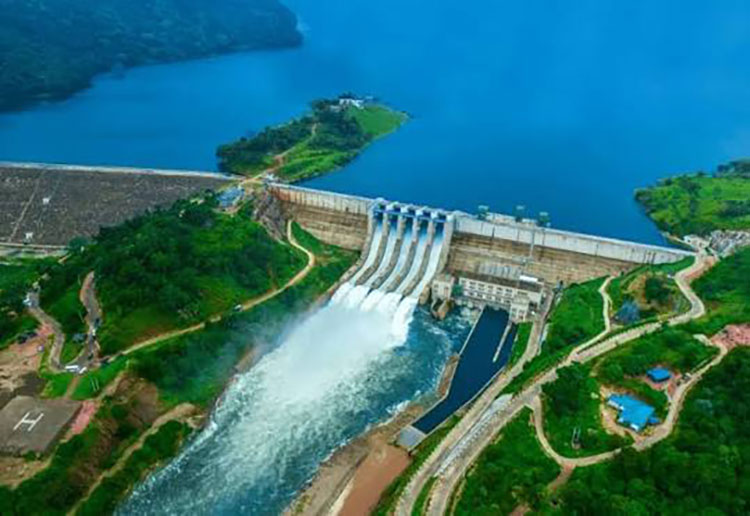
Desilt reservoirs, learn from our ancient irrigation systems

by Prof. O. A. Ileperuma

Silting of reservoirs is a major problem today affecting our hydropower production and irrigation systems. The main Mahaweli reservoirs are silted to a considerable extent reducing the water holding capacity of them. Due to poor soil management practices, floodwaters deposit large amounts of silt in these reservoirs. When the Polgolla reservoir was fully drained about two years back, one could see mountains of silt in the lower reaches of the reservoir. A rough estimate is that 50% of the total capacity of these reservoirs has been lost to siltation. This is a serious issue which affects not only power and agriculture but also flood control.

Our ancient irrigation systems ensured that desilting of reservoirs took place under royal decree where all users of the reservoirs were ordered to carry out desilting of reservoirs during the dry season. The clay thus collected was used in making bricks for the construction of great stupas which dot the landscape of our ancient kingdoms. This ensured that the reservoirs had their full capacity filled with water for the next cultivating season. Our ancient kings were clever enough not to construct reservoirs by blocking main rivers such as the Mahaweli. A classic example is the Minipe left canal where they tapped only the surface water of Mahaweli. Even the bigger tanks such as Nuwara Wewa and Parakrama Samudraya were fed with minor rivulets. There were also other ingenious features in the cascade irrigation systems built by the ancient kings, such as mud sluice canals and forest reservations between the reservoirs in the cascade system. These reservations helped trap silt and remove excess nutrients, which could otherwise contribute to increasing salinity as water flowed from one reservoir to another.

Victoria

Moragahakanda

A classic engineering marvel is the former Yoda Ela, which carries water from Kalawewa to Nuwara Wewa and Tissa Wewa. It is 87 km long although the straight distance between these points is only about 40 km. The gradient of this canal is about 10 cm per km or 6 inches per mile. Yodha Ela functions as a moving reservoir and feeds about 4,600 hectares of paddy lands. It is a winding canal with about 120 smaller reservoirs on its way. It was constructed during the reign of King Dhatusena around 459 AD and later expanded by King Parakramabahu by connecting more reservoirs to the network. Unfortunately, during the Mahaweli project our modern-day engineers constructed a concrete canal replacing the winding path of this Yoda Ela also called Jaya Ganga. This effectively removed the ability of the old Yoda Ela to remove silt and nutrients. The bank of this Ela has wet zone trees such as jak and areca nut growing well. They take up the nutrients from the flowing stream making the water suitable for irrigation later.

Ancient Mesopotamian civilisations depended on dams constructed along the two main rivers, Euphrates and Tigris. After continuous irrigation of their fields over several thousand years, salinity of the irrigated lands increased making them unsuitable for agriculture. People died due to famine and this clearly illustrates the danger of blocking main rivers for agriculture. There is scientific evidence that the salinity of paddy soils in the Mahaweli C area is increasing.

We saw the devastation caused by Cyclone Ditwah. The sluice gates of the Kotmale Reservoir were opened, and Kandy and Peradeniya were flooded. If the reservoir had had greater storage capacity, couldn’t the opening of the gates have been delayed? This may not be an argument that modern-day engineers would readily accept, and I am not an irrigation expert. These ideas may well be naïve. But most of us tend to think of reservoirs mainly in terms of hydropower generation and irrigation, while their role in flood control receives much less attention. The question therefore deserves serious consideration. Could restoring lost reservoir capacity through desilting help improve our ability to manage extreme rainfall and reduce flood risks?

Desilting our reservoirs should be considered a national priority.


from The Island https://ift.tt/RWXOPkm

Price of war keenly felt by investor community

By Hiran H. Senewiratne

The escalation of tensions in the Middle East and the surge in oil prices are continuing to negatively impacted investor sentiment, market analysts said yesterday.

The All Share Price Index went down by 93.55 points, while the S and P SL20 declined by 23.8 points.

Turnover stood at Rs 1.45 billion with five crossings. Those crossings were; Sampath Bank 3 million shares traded to the tune of Rs 428 million; its shares traded at Rs 142.50, Commercial Bank 256,000 shares crossed for Rs 49 million; its shares traded at Rs 204.50, Digital Mobility Solutions 190,000 shares crossed to the tune of Rs 30 million; its shares fetched Rs 158, Overseas Realty 493,000 shares crossed for Rs 26 million; its shares sold at Rs 53 and Royal Ceramics 469,000 shares crossed to the tune of Rs 23 million; its shares traded at Rs 48.50.

In the retail market companies that mainly contributed to the turnover were; Commercial Credit and Finance Rs 38 million (376,000 shares traded), Renuka Agri Rs 33 million (2.8 million shares traded), Sierra Cables 32 million (925,000 shares traded), Singer SriLanka Rs 31 million (359,000 shares traded), Dialog Axiata Rs 31 million (637,000 shares traded) and Access Engineering Rs 30 million (383,000 shares traded). During the day 35 million share volumes changed hands in 13380 transactions.

It is said that banking sector counters, especially Commercial Bank, led the market,which contributed close to half of the total turnover. Apart from that other sectors, including manufacturing, telecom and construction counters performed well.

Meanwhile, Melstacorp (down 1.32 percent at Rs 187.00 ), Royal Ceramics Lanka (down 1.22 percent at Rs 48.50 ), Hemas Holdings (down 1.27 percent at Rs 31.20 ), and Dipped Products (down 1.50 percent at Rs 59.00) were top negative contributors.

Yesterday the rupee was quoted at Rs 328.60/70 to the US dollar in the spot market from Rs 328.60/80 the previous day, while bond yields were quoted steady to lower, dealers said.


from The Island https://ift.tt/zCPg1vl

Wednesday, September 9, 2026

Govt. asks UNHRC to do away with country-specific mandate targeting SL

Sri Lanka has urged the Human Rights High Commissioner, Volker Türk, to end the country-specific mandate in respect of Sri Lanka where national processes demonstrated progress.

Addressing the 63rd Session of the United Nations Human Rights Council in Geneva, on 08 September, 2026, during the General Debate under the Agenda Item 2, Permanent Representative of Sri Lanka to the United Nations in Geneva, Ambassador Sumith Dassanayake emphasised that no Council mandate should be regarded as indefinite.

The written update on human rights situation in Sri Lanka was presented to the Council on 08 September and the General Debate was attended by the United Nations Human Rights High Commissioner, Volker Türk.

Dassanayake emphasised that at a time when the international community is confronted with grave and urgent human rights situations, including armed conflicts, displacement, and humanitarian crises, the Council must ensure its work and resources are directed towards the most pressing global challenges.

Dassanayake also emphasised to the High Commissioner that all mandates, particularly country-specific ones, should be subject to periodic review against clearly defined objectives and measurable outcomes. He called for sunset clauses and phase-out provisions to be explicitly incorporated into country-specific resolutions where appropriate.

Dassanayake stressed that when a country demonstrates progress through national processes, dialogue, cooperation, and technical assistance, the Council should provide a credible pathway towards concluding the relevant mandate.


from The Island https://ift.tt/2wA7kPK

Tuesday, September 8, 2026

Toronto-based fashion brand Arvénoir expands into Sri Lanka

Toronto-based fashion brand Arvénoir, founded by designer and entrepreneur Anamica Mithila, is expanding its international presence with the launch of its official e-commerce platform, www. Arvénoir.com, in Sri Lanka.

Known for contemporary design, effortless tailoring and conscious craftsmanship, Arvénoir is introducing its premium European linen collections to Sri Lankan consumers. Featuring breathable fabrics, refined silhouettes and versatile pieces suited to warm-weather living, the collection reflects the influence of Sri Lanka’s tropical lifestyle.

Although Arvénoir was founded and developed in Toronto, its design perspective is informed by a range of cultures, environments and lifestyles. For founder Anamica Mithila, the relaxed elegance and tropical character of Sri Lankan life have provided an important source of inspiration for creating collections that balance sophistication with comfort.


from The Island https://ift.tt/j7bkKHY

Monday, September 7, 2026

Further evidence on 5 Oct

Corruption case against Kumara Jayakody:

Former Chairman of Lanka Fertilizer Company, Buddhika Ruwan Madihahewa yesterday (7) told the Colombo High Court hearing corruption case against former Energy Minister Kumara Jayakody that in his capacity as the Chairman had approved an advance payment of RS. 8.8 mn to D.S. Construction on the basis of confirmation made by the Procurement and Finance Divisions that procurement procedures had been followed. Jayakody had been the Procurement Manager at that time.

Jayakody resigned in April this year following controversy over the case and the exposure of alleged irregularities in the coal procurement process.

The case was taken up before Colombo High Court Judge Rasantha Godawela, who ordered that further trial of evidence in the case filed by the Commission to Investigate Allegations of Bribery or Corruption (CIABOC) against Jayakody be taken up on 5 Oct.

Madihahewa, who testified under the direction of CIABOC Deputy Director General Asitha Anthony, told court that a procurement process had been initiated in 2014 to select a bidder to carry out the carpeting of roads at the Hunupitiya warehouse complex of Lanka Fertilizer Company.

The witness said that Jayakody, had been serving as the Procurement Manager of the company at the time.

According to him following the procurement process, a company named D.S. Construction was selected to carry out the road carpeting project. An advance payment of Rs. 8.8 million had subsequently been made to the company against an advance payment guarantee, the witness said.

The witness stated that he had approved the payment after examining documents submitted by the Procurement and Finance Divisions confirming that the relevant procurement procedures had been followed properly.

However, the witness admitted that the company had failed to carry out the carpeting work. He further revealed that some materials, had been left within the company premises.

He further testified that subsequently, only Rs. 2.2 million had been recovered under the advance payment guarantee provided by the company.

The CIABOC had filed the case against the former Minister alleging that while serving as the Procurement Manager of Lanka Fertilizer Company in 2014, he had caused a loss of Rs. 8.8 million to the government by carrying out procurement activities relating to the carpeting of the company’s warehouse premises in a manner favourable to a private company.


from The Island https://ift.tt/Gc07UFP

Sunday, September 6, 2026

Systemic questions linger over NDB fraud inquiry

By Sanath Nanayakkare

The unfolding developments surrounding the massive internal financial irregularity at the National Development Bank PLC (NDB), valued at approximately LKR 13.2 billion, continue to demand rigorous public scrutiny.

As months have passed since the initial disclosure of the fraud in early 2026, questions regarding institutional accountability, regulatory oversight, and corporate governance remain central to discussions concerning the stability and transparency of Sri Lanka’s financial sector.

First coming to light through corporate disclosures and subsequent regulatory reviews, the LKR 13.2 billion incident represents one of the largest internal fraud cases recorded within a major commercial institution in recent times. Because NDB is a systemically important institution – with major state-backed shareholding through entities such as the Employees’ Provident Fund (EPF), the Employees’ Trust Fund (ETF), Sri Lanka Insurance Corporation (SLIC), and the Bank of Ceylon (BOC) – the implications extend far beyond normal corporate missteps.

Public interest advocates and financial analysts have repeatedly emphasised that any major lapse in a bank of this magnitude warrants total transparency to maintain public confidence. Although the Central Bank of Sri Lanka (CBSL) and bank management have publicly assured stakeholders that customer deposits remain secure and day-to-day operations unaffected, the broader governance questions regarding how such significant vulnerabilities went undetected remain a subject of intense public debate.

A focal point of concern among financial analysts and governance watchdogs is the framework surrounding the independent forensic audit commissioned to investigate the transactions.

Entrusted to international expertise via Deloitte Touche Tohmatsu India LLP, the audit’s mandate includes examining the circumstances of the fraudulent operations as well as evaluating historical lapses in internal controls, oversight, and compliance.

However, critics, including public interest figures, have raised questions regarding the timeline for the finalisation and release of these findings.

Parliamentary oversight bodies, such as the Committee on Public Finance (CoPF), have previously engaged with regulatory authorities to review the matter.

Observers point out that timely public access to comprehensive audit findings – without compromising ongoing criminal investigations by entities like the Criminal Investigation Department (CID) – is vital to ensuring that systemic gaps are permanently closed.

The NDB case has also cast a sharp spotlight on broader corporate governance norms in Sri Lanka, bringing elements such as board oversight, the role of external auditors, and potential conflict-of-interest perceptions into sharper focus.

Critics argue that maintaining public trust requires strict adherence to ethical standards at every level of corporate leadership, from commercial bank directors to regulatory supervisors.

“As the country seeks to attract sustainable foreign direct investment, establishing an uncompromised standard of accountability is paramount. For the memory of this financial fraud to serve a constructive purpose, institutional watchdogs, lawmakers, and regulators must ensure that investigations are brought to a transparent, logical, and publicly accountable conclusion, ensuring that public resources and systemic financial integrity are robustly safeguarded,” keen observers of this massive brank fraud say.


from The Island https://ift.tt/ylKmkRY

Saturday, September 5, 2026

Mountains of missing guns

Hardly a day passes in this country without major drug detections and underworld killings. Inspector General of Police Priyantha Weerasooriya, speaking at this year’s Police Day ceremony in Colombo on Thursday (03), said police had seized large amounts of narcotics, including 1,416 kg of Crystal Methamphetamine, 946 kg of heroin, and 1,282 kg of cannabis and taken into custody 1,612 illegal firearms, including T-56 assault rifles and pistols, so far this year.

Sri Lanka is awash with illegal firearms, which have found their way into the underworld during the past several decades. Protracted armed conflicts led to an exponential increase in the number of lethal weapons in the wrong hands.

Immediately after the 2024 regime change, the MPs who had obtained repeater guns from the Defence Ministry were asked to return those weapons, and they readily complied for obvious reasons. But those guns account for only a fraction of the weapons issued to politicians and others over the decades. In January 2019, the then Defence Secretary Hemasiri Fernando disclosed that about 4,700 pistols and revolvers had been licensed but there was no information about those who had obtained them. Some individuals possessed as many as 15 small firearms each, he said.

One may recall that in 2023, the then State Minister Pramitha Tennakoon informed Parliament that the defence authorities had issued about 700 firearms to 154 politicians in the late 1980s, when the JVP went on a killing spree, but none of them had been returned. That figure cannot be accurate. According to anecdotal evidence, thousands of firearms were issued to politicians under threat during that period, and almost all of them have gone missing.

In the late 1980s, the JVP did not spare anyone who refused to obey its illegal orders. Its death-dealing sparrow units physically eliminated anyone who had the courage to voice dissent. Some political activists threatened by the JVP banded together to protect themselves, and the armed groups they formed, such as the PRRA (People’s Revolutionary Red Army) became as ruthless as the JVP killing squads; they eventually helped beat the JVP at its own game. Some of them switched their allegiance to the UNP, and worked as its shock troops.

The leftist parties and the SLFP, too, had to protect themselves against the JVP hit squads. The UNP set in motion a Caravan of Death, which scoured the country, killing JVP activists and suspects. What happened to the firearms used by pro-UNP vigilantes to carry out those extrajudicial killings?

Chris Smith, an expert on the proliferation of firearms, especially in South Asia has in his report, In the Shadow of a Cease-fire: The Impacts of Small Arms Availability and Misuse in Sri Lanka, has revealed that the weapons given to politicians in the late 1908s numbered more than 11,000. Many of them were not returned. The National Commission against the Proliferation of Illicit Small Arms (NCAPISA), established by President Chandrika Bandaranaike Kumaratunga in 2004, once quoted a senior police officer attached to the Police Central Armoury at the time as having said that 80% of those weapons had been returned. Even if so, going by Smith’s figure, more than 2,200 weapons have gone unaccounted for.

The proliferation of illicit firearms in Sri Lanka can be attributed to several key factors, according to researchers; they include gunrunning, illegal operations carried out by rogue elements in the police and the armed forces, local arms manufacturing, and criminals gaining access to arms caches of the LTTE. It may be recalled that the Colombo Crime Division produced 12 suspects before the Colombo Chief Magistrate on March 22, 2019, for having supplied weapons retrieved from buried LTTE arms caches in Kilinochchi to criminal gangs elsewhere. It was revealed in January 2025 that as many as 73 T-56 assault rifles had gone missing from an unnamed army camp. Soon after the decimation of the JVP’s military wing in 1989, a police sergeant sold a large stock of firearms, seized from the JVP and stored in the Kuliyapitiya police station, to underworld gangs at Rs. 15,000 each. The police could recover only some of those weapons.

The police must go all out to find the illegal firearms used by the JVP during its second uprising (1987-89). Most of the JVP’s arms caches have not been traced. SJB MP Dayasiri Jayasekara told Parliament on 27 Feb. 2025 that more than 2,000 illegal firearms looted by the JVP between 1987 and 1989 had gone missing. The JVP attacked several police stations and military camps and grabbed weapons. In April 1987, it seized the entire arsenal at the Pallekele army camp. Now that the JVP-led NPP has formed a government and launched a campaign to eliminate gun violence, the Defence Ministry may be able to ascertain information about those missing firearms, as we argued in a previous editorial comment.

The NCAPISA dealt extensively with the issue of illegal weapons in circulation in Sri Lanka. Its survey report contains valuable information, which, however, needs to be updated. Defence authorities should study this document thoroughly and commission a fresh survey on illicit firearms while carrying out operations to neutralise criminal gangs and seize lethal weapons in their possession.

The need for the police and the defence bigwigs to adopt a broader and more strategic approach to ridding the country of the scourge of illegal firearms, which snuff out lives almost daily, cannot be overstated.


from The Island https://ift.tt/qkEIFpo

Friday, September 4, 2026

Anjalie Munasinghe appointed Secretary of CIPR International

Mark and Comm, Sri Lanka’s leading boutique public relations and communications agency, today announced that Anjalie Munasinghe, its Manager, PR & Social Intelligence, has been appointed Secretary of CIPR International, the international chapter of the Chartered Institute of Public Relations (CIPR).

Munasinghe brings more than ten years of experience in PR, account management and media monitoring across some of Sri Lanka’s leading agencies. She joined Mark and Comm most recently from AdFactors PR Sri Lanka, where she served as Consultant, Digital Reputation Management, overseeing real time media intelligence and analysis for clients. Before that she was Manager, Public Relations at MullenLowe Sri Lanka.

Her career also spans Senior Public Relations Executive at HardTalk, close to eight years as Public Relations Executive at NGage Strategic Alliance, where her clients and her early training as an AV Coordinator at Ogilvy Sri Lanka. She is a specialist in social listening, crisis communications, sentiment analysis and real time media monitoring, and continues to contribute as an expert commentary or voice to the national media.

CIPR International connects public relations practitioners across five continents and is one of the largest and most diverse sectoral groups within the Chartered Institute of Public Relations, with close to 1,000 members. Mark and Comm’s Managing Director, Thanzyl Thajudeen, also sits on the CIPR International Committee, making Munasinghe’s appointment the second held by someone from the agency and from Sri Lanka.

Taazima Kala, Chair of CIPR International, said: “Anjalie brings the kind of practitioner experience and regional insight the Committee relies on. Her work across Sri Lanka’s public relations industry, particularly in crisis communications and media intelligence, speaks for itself, and we look forward to her contribution as Secretary.”


from The Island https://ift.tt/96kLRlJ