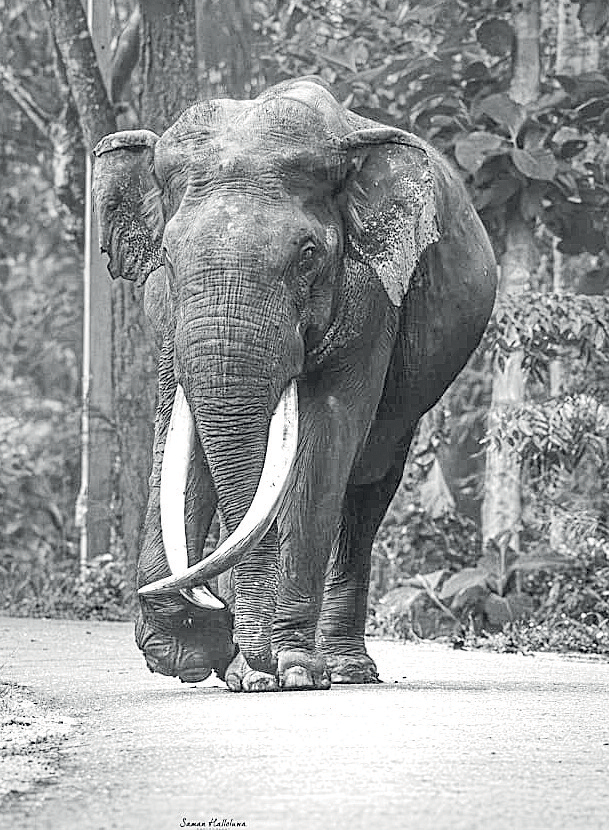
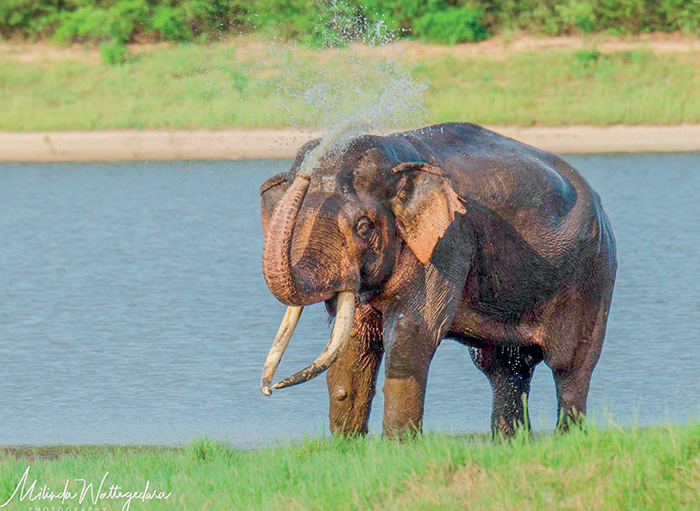
Donald Trump has shared a mock-up image of the "drone port" set to be built on the roof of the White House ballroom, as part of sweeping military enhancements.
from Daily Express :: US Feed https://ift.tt/RnQycMN

It took them 18 years to win their first title, but Royal Challengers Bengaluru (RCB) took no time in becoming only the third team to successfully defend it. Their seam bowlers made superb use of a slightly sticky surface after Rajat Patidar won the toss, restricting Gujarat Titans (GT), who were in their third final in five years of their existence, to 155, the exact same score RCB managed in the league match against the seam team in the same ground on the same pitch No. 6 bang in the middle of the square.
Josh Hazelwood who has never lost a T20 or ODI final, set the tone with the wicket of Shubman Gill in his first over. Bhuveneshwar Kumar momentarily reclaimed the purple cap with two wickets, and Rasikh Salam capped off his best IPL with three to take his tally for the year to 19. Last final’s Player of the match, Krunal Pandya, who won his fifth IPL final out of five, also chipped in with the big wicket of Jos Buttler in his analysis of 4-0-23-1. He is now behind only Rohit Sharma and Ambati Rayudu in number of titles, and is also the first player to successfully defend a title with two different teams.
Only three out of 26 scores under 190 in a full match had been defended successfully this IPL. With the ball still nibbling around, the best attack in the tournament would have thought they had a chance, but amid falling wickets, Virat Kohli chose this final to hit his fastest IPL fifty and his highest playoff score, leading a five-wicket win with two overs to spare.
Get the openers
Gill and B Sai Sudharsan came into the final as the only pair of batters from the same team to have scored 700 or more runs in the same IPL. However, they were up against bowlers that have troubled them in the past. A cagey start ensued, Gill survived the Bhuvneshwar over, but Hazlewood had him top-edging his signature short-arm pull.
GT promoted Nishant Sindhu to No. 3 to protect Buttler from Bhuvneshwar, but the wily bowler made sure Buttler had to come out as he took out Sudharsan in his second over. He first beat Sudharsan on the charge with a bouncer before continuing with another, this one taking the toe end on the ramp. Vaibhav Sooryavanshi, in attendance in Ahmedabad, was now assured of the orange cap. This was only the fourth time this IPL that both the GT owners had been dismissed inside the powerplay, three of them against RCB.
Middle-overs choke
Seeing some grip from the pitch and conventional, subdued batters at the wicket, Krunal shelved all his fancy change-ups and bowled only length. His first three overs yielded zero boundaries. Salam was equally miserly at the other end, just bowling good length and enjoying the slight variations from the surface. One of those had Sindhu caught at long-on.
When Krunal started his final over, they had gone 37 legal deliveries without a boundary. Krunal expected the frustrated Buttler to try something, saw him coming and fired in a wide yorker for a spectacular stumping by Jitesh Sharma.
Another promotion followed with Arshad Khan walking in and hitting the fourth ball of the 13th over for a six, only one ball quicker than the longest it has taken a team to hit a six in an IPL final.
No let-up from RCB
Hazlewood, Bhuvneshwar and Salam offered no freebies in the death overs. Every time GT thought they could build some momentum, one of the quicks jolted them with a wicket. Hazlewood got Arshad, Bhuvneshwar made it 28 wickets for the season with Jason Holder’s scalp, and Salam took out Rahul Tewatia and Rashid Khan in the end. Only Jacob Duffy went wicketless, but he, too, nearly had Washington Sundar, who went on from the reprieve to score a fighting 37-ball 50.
The high-octane chase
Like he did in the 2024 final with a 50 at two runs a ball, Venkatesh Iyer got the middling chase to a flying start. Not that he needed extra licence, but an injury to the inside of the knee in the first over of the chase left him no option but to hit out. He hit out against Rabada in his first over, and by the time Mohammed Siraj got him out for 32 off 16, he had set RCB on their way.
While Venkatesh might have added reason to hit out, Kohli lashed out at Rabada with ferocity that was only foretold by a season in which he has matched some of the younger, more cutting-edge T20 batters. Of the six batters to have scored 600 or more this IPL, only Sooryavanshi and Ishan Kishan have done so quicker than his 675 at 165.84.
As is often expected of Kohli, he was pumped up when he took on his great rival Rabada, hitting a spectacular six and three fours in Rabada’s second. Rattled bowlers lost their line against Kohli, whose first run on the off side was his 39th. By that time, Rabada had taken back his purple cap with Devdutt Padikkal’s wicket and Rashid Khan would soon take two in his first over, but the asking rate was already under a run a ball.
Only an injury to Kohli slowed down RCB’s march to the title, but Kohli finished it off in style with a four and a six off the last two balls of the 18th over.
Brief scores:
Royal Challengers Bengaluru 161 for 5 in 18 overs (Venkatesh Iyer 32, Virat Kohli 75*, Rajat Patidar 15, Tim David 24, Jitesh Sharma 11*; Mohammed Siraj 1-36, Kagiso Rabada 1-44, Rashid Khan 2-25, Arshad Khan 1-32) beat Gujarat Titans 155 for 8 in 20 overs (Sai Sudarshan 12, Shubman Gill 10, Nishant Sindhu 20, Jos Buttler 19, Washington Sundar 50*, Arshad Khan 15; Rasikh Salam 3-27, Bhuvneshwar Kumar 2-29, Josh Hazelwood 2-37, Krunal Pandya 1-23) by five wickets
[Cricinfo]
AFP –The International Monetary Fund’s (IMF) board approved two reviews of Sri Lanka’s loan programme, making USD695 million in additional loans immediately available to the island nation.
It is the latest tranche in the country’s four-year USD3 billion bailout, with the Fund warning of further risks due to the economic impact of the Middle East conflict.
Surging oil prices due to the conflict have heavily impacted many import-dependent Asian countries.
“Sri Lanka’s strong implementation under the EFF arrangement has continued despite challenging circumstances,” said the IMF’s Deputy Managing Director and Acting Chair Kenji Okamura.
“Gains from the economic reform programme helped preserve economic resilience and provided room to respond to cyclone Ditwah and the Middle East conflict. The latter, however, has significantly worsened Sri Lanka’s economic outlook and tilted risks to the downside.”
The IMF projects 2026 growth to slow to three per cent, with higher oil prices increasing inflation and weighing on the current account balance.
The board’s approval was contingent on Sri Lanka adjusting certain energy market subsidies issued in the wake of the conflict.
The statement said the Sri Lankan authorities had met the Fund’s requirements on fuel and electricity prices meeting cost-recovery criteria.
Criteria on ensuring no new external debts and on not imposing or intensifying import restrictions “were not observed”, however.
The Joint Opposition (JO) has submitted a petition to the Commission to Investigate Allegations of Bribery or Corruption (CIABOC), calling for the suspension of CIABOC Director General Ranga Dissanayake and a high-level probe into his allegedly arbitrary and biased conduct. It has claimed that Dissanayake is misusing his position to further the interests of the ruling NPP led by the JVP, and the integrity of the CIABOC investigations has been undermined by his political bias and arbitrary actions.
There are arguments for and against the Opposition’s campaign against the CIABOC DG. Dissanayake himself has denied the allegations against him as baseless, and it is being argued in some quarters that he is in the Opposition’s crosshairs because of the ongoing investigations into corrupt deals under the previous governments. The JO has cited in support of its petition against Dissanayake an affidavit the late SriLankan CEO Kapila Chandrasena submitted to court through his lawyers, claiming that Dissanayake intimidated him.
Allegations against Dissanayake have not been substantiated, but they have adversely impacted the image of the CIABOC. Hence the need for a thorough investigation into the charges contained in the JO’s petition, which is now in the public domain.
There are various allegations against many state officials in key positions. Some officials of the Attorney General’s Department, the police top brass and some secretaries to ministries have also been accused of misusing their authority to advance the government’s political agenda. Some public officials’ partiality and servility to the government in power severely erode public trust in the institutions they represent and make a mockery of the constitutional safeguards in place to ensure their independence. Constitutional provisions alone cannot depoliticise public institutions; state officials in key positions must assert their independence from politicians and be above reproach.
The JVP was instrumental in having the 17th Amendment to the Constitution introduced in 2001, paving the way for the establishment of the Independent Commissions to safeguard the independence of key state institutions vis-a-vis political interference. In 2015, it campaigned really hard to have the 18th Amendment replaced with the 19th Amendment to restore the 17th Amendment in all but name. In 2022, it joined forces with other Opposition parties and civil society groups to do away with the 20th Amendment and bring in the 21st Amendment, which revived the constitutional mechanisms the 19th Amendment had put in place to free the state service from the clutches of politicians.
But today the JVP-led NPP government stands accused of manipulating the Constitutional Council to elevate its loyalists among public officials to key positions in the state service and pressuring officials to toe its line. The Sri Lanka Association of Divisional Secretaries and Assistant Divisional Secretaries has protested against a controversial government decision to provide “Clean Sri Lanka” coordinators, who are said to be JVP cadres, with offices inside Divisional Secretariats. It has written to President Anura Kumara Dissanayake opposing the government move and warning that such deployment of “Clean Sri Lanka” operatives will only undermine the independence of the public service. The JVP/NPP is accused of trying to establish a parallel administration as part of a strategy to perpetuate its hold on power.
It is imperative that the CIABOC conduct a thorough probe into the JO’s allegations against DG Dissanayake, in a transparent manner. That is the only way it can clear its name, if at all. If the allegations at issue go uninvestigated, they will undermine the integrity of the CIABOC, and provide a fresh impetus to the Opposition’s campaign.
The 21st edition of the “Build Sri Lanka” housing and construction exhibition concluded last week at the BMICH. On the surface, it was a modest success: stalls were staffed, catalogues were exchanged, and the usual dignitaries cut the usual ribbons. But beneath the low hum of polite conversation, a far more urgent story was unfolding – one that policymakers appear to have missed entirely.
For an industry that contributes nearly 8% to Sri Lanka’s GDP and employs over 500,000 people, the quiet profile of this year’s exhibition was telling – the kind that settles over an industry bracing for impact.
The Chamber of Construction Industry (CCI) President, Manilal Fernando, used the platform not to celebrate, but to warn. Two specific points he raised should be ringing alarm bells in the Treasury and the Ministry of Housing. But because the event lacked high-level political attendance, these warnings have so far fallen into a policy void.
Fernando noted that after a brutal slump from 2020 to 2023, the industry saw a fragile recovery in 2024. But that green shoot is now withering. “With the rupee volatility due to the war in the Persian Gulf,” he said, “again we are heading for uncertain times.”
According to CCI, Sri Lanka’s construction industry is an importer in disguise. Over 60% of construction materials from steel and cement to tiles, fittings, and MEP (mechanical, electrical, plumbing) components are either directly imported or have high import content. Even locally manufactured items rely on imported raw materials.
When the rupee depreciates, costs don’t just rise; they leap. And here is the crux according to Fernando : current contractual payment mechanisms do not automatically reflect these real-time cost increases. As he warned, unless cost escalations are correctly reflected in contract payments, many contractors and consultants will simply be unable to perform. That means stalled projects, abandoned housing schemes, and unfinished infrastructure – paid for, but not delivered.
The second issue is even more maddening because it is entirely within the government’s control to fix. Fernando revealed that a set of long-overdue amendments to the Construction Industry Development Act (CID Act) was finalised in 2024. These amendments were developed over six years by the National Advisory Council on Construction, approved by the Legal Draftsman, and could be enacted within two months.
But instead of enacting these ready-made fixes, CIDA is now pushing for a complete overhaul of the Act – a process that will take a minimum of two years to reach parliament.
He pointed out that without these amendments, the industry lacks a fair, transparent price variation mechanism. Right now, MEP contractors and others complain that CIDA’s official price indices do not reflect actual market price fluctuations. The CCI, therefore, proposed a simple solution: a joint committee (CCI + reputable contractors + CIDA) to oversee index compilation. But even that cannot be implemented effectively without the Act’s update.
The construction industry, once a bellwether of national economic health, is now whispering its crises in a conference hall with no television cameras to air high-decibel news stories or make it a headline event.
The builders of Sri Lanka are not asking for subsidies. They are asking for predictability, fairness, and speed. The war in the Persian Gulf is beyond Sri Lanka’s control. But the CID Act and contract index reforms are not.
By Sanath Nanayakkare

New Zealand extended their control on the one-off four-day Test against Ireland in Belfast following a dominating performance on the second day with bat and ball. Building on from the strong foundation set by Rachin Ravindra’s century on the opening day, the visitors posted 490 for 8 after scores of 186 from Tom Blundell and 98 from debutant Dean Foxcroft.
After that, seamer Nathan Smith ran through the Irish top-order, claiming a five-wicket haul within 29 balls of his new-ball spell to finish with 6 for 40. That rolled Ireland over for 179, and New Zealand swiftly enforced the follow-on. By stumps, Ireland were 65 for 2 in their third innings, still 246 runs away from making New Zealand bat again.
With the ball, Smith removed four of Ireland’s top-six batters for ducks in the hosts’ first batting innings – a record in Test cricket – and blazed to his maiden Test five-for after New Zealand had declared for 490 just before lunch.
The Irish top-order collapse started two balls into the Test’s second innings when Smith struck with a full ball that jagged inwards, hitting opener Stephen Doheny on the pads in front of the stumps. Four balls later, No. 3 Cade Carmichael tried to play straight to an inswinger but get an edge to Tom Latham at slip. With both out for ducks, Ireland were 0 for 2 after the first over.
After lunch, and under greyer skies, it was Smith tormenting Ireland once again, with a beauty of a length ball that angled in and opened Andrew Balbirnie’s defense. The exposed bat-pad gap was enough to knock Balbirnie’s middle stump back for 13.
In the same spell, Smith got another full ball to sear back and hit Curtis Campher’s front pad, and he was the third batter gone for a duck. Smith would collect his fourth duck victim and get his five-for when Lorcan Tucker pressed forward for a drive, only for the ball to cut him in half and take out his poles. A wicket for Zak Foulkes to dismiss Harry Tector (16) then saw Ireland reeling at 38 for 6.
A stubborn seventh-wicket stand of 116 between Andy McBrine and Mark Adair, though, brought some respectability to the hosts’ batting response. As they did against England at Lord’s and against Zimbabwe in Bulawayo previously to post Ireland’s two highest partnerships in Test history, the pair held the innings together. Adair didn’t mind playing T20 shots or moving around the crease early on, but once the sun came out, locked in for a more patient batting innings.
McBrine was enterprising with the cut, and survived a Daryl Mitchell drop at slips, to bring up his half-century in the last over before tea. A few balls later, the partnership crossed hundred, and the teams left the field for the session break at 139 for 6.
It was Smith who broke the partnership, with a short ball that rose uncomfortably to Adair. Once he walked back for 40 and with Ireland at 154 for 7, McBrine soon ran out of partners. New Zealand’s seamers opted for a short-ball tactic against the lower-order batters and that saw Thomas Mayes holing out to deep square leg and Reuben Wilson gloving a catch to slip. McBrine remained unbeaten on 73.
After following-on, Ireland made a much better start, with openers Doheny and Balbirnie putting on 42 for the first wicket. Balbirnie was out nicking behind to Blair Tickner, and the bowler added a second by getting Carmichael edging to slip too.
Earlier in the day, overnight batters Blundell and Foxcroft began the morning by wearing down the Irish bowling attack in the first innings after starting from 361 for 5. Ireland were without Adair – the bowler – for the morning session, and as the highest wicket-taker of day one, he was missed.
The two batters were careful against the swinging ball and seaming track in the early stages but once New Zealand went to the first drinks break without any wickets lost, they changed gears with declaration in sight.
Blundell was particularly strong with his pulls and flat-batted shots between midwicket and long on, getting on top of the leg-stump line and short-ball plan that Liam McCarthy operated on. Foxcroft struck six fours and one six in his innings, unafraid to use his crease either laterally or down the track, to get on top of the home side’s bowling.
Their sixth-wicket stand of 158 for the sixth wicket – which followed up from the 217-run fifth-wicket stand between Blundell and Ravindra on day one – pulverised Ireland. Blundell was out for 186 in the 114th over, out at midwicket looking for more big hits off Wilson’s bowling. Foxcroft, two short of a ton on Test debut, got a top-edge to fine leg off McBrine’s offspin in the 119th over.
In between, Nathan Smith was run-out for 17 courtesy a smart team run-out between substitute fielder Jake Egan and wicketkeeper Lorcan Tucker. New Zealand declared on 490 for 8, giving their new-ball bowlers a few overs before lunch, during which time Smith struck twice to add to the visitors’ advantage en route to his six-for.
Brief scores:
Ireland 179 in 45 overs (Andy McBrine 73*, Mark Adair 40; Nathan Smith 6-40, Ben Sears 2-27) and [f/o] 65 for 2 (Stephen Doheny 36*; Blair Tickner 2-14) trail New Zealand 490 for 8 dec in 119 overs (Rachin Ravindra 121, Tom Blundell 186, Dean Foxcroft 98; Markm Adair 3-66) by 246 runs
After a seven-year hiatus, one of Sri Lanka’s most loved advertising industry gatherings is making a much-anticipated return. Green Chilies 2026, the iconic festival that once defined the fun, camaraderie and creative spirit of Sri Lanka’s advertising fraternity, returns on 4th June 2026 at Rise Up, Colombo 03, bringing together professionals from across agencies, media, digital, production and marketing for an evening of celebration, entertainment, and industry camaraderie.
Originally launched in 2011, Green Chilies was conceived as a platform to celebrate Sri Lanka’s Young Lions winners as they embarked on their journey to represent the country at the prestigious Cannes Lions International Festival of Creativity, while also creating a unique opportunity for the industry to come together outside boardrooms and deadlines.
This year’s revival comes at an especially meaningful time, as an entire new generation of industry professionals have entered the business without ever experiencing the culture and energy that made Green Chilies such a defining event. Some key highlights will be the recognition of the winners of the young Lions competition and the much-loved return of The Agency Idol, the wildly entertaining competition where agencies battle it out on stage in a spirited showcase of talent, humour, and creativity, bringing back one of the event’s most iconic traditions.
Speaking about the return of the festival, Ranil de Silva, Founder of Green Chilies and of Metal Factor, said: “When we first launched Green Chilies, the idea was simple. It was to celebrate our Young Lions and create something that brought the industry together as one community. Over the years it became far more than an event, it became part of our industry culture. Seeing it return after seven years is very special, particularly because so many young professionals will now get to experience the spirit that made this industry such a fun and inspiring place to be.”
Green Chilies 2026 is organized by Metal Factor and supported by the 4A’s Sri Lanka.
Event Details:
Venue: Rise Up, Alwis Place, Colombo 03
Date: Thursday, 4th June 2026
Time: From 6.30 PM onwards
Contact : Shelley +94 77 342 3123

Sri Lanka commemorated the 17th anniversary of the end of the 30-year Eelam conflict with a moving War Heroes Remembrance Day ceremony on 19 May 26 at the monument on the Parliament grounds. It was a solemn occasion when the Nation paid tribute to over 29,000 Defence and Police people (women and men) who died in the conflict. Sadly, politics, aberrations and theatrics were also on display.
The gravity of the sacrifices made and consequences of the Eelam war and two Southern terrorist insurgencies (1971 and 1988-9), are felt mostly by those who lost their loved ones in the conflicts as the nation mourns with them. Any hesitation to pay tribute belittle the fallen.
It was regrettable to see that the ceremony was also political. Why were the general public excluded from honouring the fallen? It defies understanding that such actions could take place at an event held sacred by the nation. Is there any other country where citizens are prevented from laying wreaths at a National Remembrance monument?
In the UK, from where this ceremony originates, 10,000 veterans (of an army of 109,000 -just half of Sri Lanka’s) take part in the march past every November. They are selected by their regimental associations from thousands of applications on a first come first served basis. Public access is unrestricted with numbers attending being the only barrier to viewing.
It is shocking that in Sri Lanka while public access is denied (selectively?), ‘invitations’ are given to attend a national Remembrance Day. They were restricted to just three government nominees! Who made this unwise decision and why?
Did the other government cohorts object to being invited? Would they have been embarrassed to come? Is the purpose of this to prevent prominent actors in the victory from receiving overwhelming accolades if they attended? Was there a fear of gate crashing? Perish the thought.
What is the need to make political speeches at an event to honour the nation’s dead? Couldn’t the speeches be made in Parliament or broadcast the day before? Seeing VIPs enjoying a joke at this ceremony hurts.
When laying wreaths at the monument, national customs should be followed by all, as in the past. A traditional low bow with hands clasped humbly, as at funerals, should be the form. In the West the head is bowed. It is unnecessary to imitate Americans by placing one hand over the heart when bowing, as on CNN. Bringing the other hand over the midriff elaborates but is an awkward addition.
The dress for all civilians attending should be similar, respectful and appropriate as for formal events and uniform, matching that of the retired military.
This is the time for the nation to remember and reflect for a moment on the dead in conflict, not only of the Military and Police who sacrificed their lives in thousands doing their duty but also of the innocent civilians who died in tens of thousands. Or, is it that some, other than the NOK, who survived in the North and South, have become hardened to death and do not wish to recall how appalling the losses were? Has death lost its meaning if also not its sting?
During 1988-9, when 60,000 died in 13 months (over 100 a day), a tea planter in Bandarawella was shot dead by Southern terrorists for hoisting the national flag on Independence day.
In the Eelam conflict just one regiment, (regiments are the core and heart of the Army), Gemunu Watch, lost 3,424 KIA and 4,272 WIA. The Imperial British Army after WWII lost 2551 (just over half of the Gemunu Watch number) in war in Korea (1949-51), Falklands (1982), Iraq, Afghanistan (20 years) and 40 years of insurgency in Northern Ireland. (SL Army infantry regiments (SL Light Infantry, Sinha, Gemunu, Gajaba and Vijayba) had about 19,000 of 21,000 of the Army KIA. That is the enormity of the sacrifices made by our indomitable military. Who then struggled to find heroes in the military?
Fisher Weerasuriya from Matara and farmer Vernugopal from Jaffna who never knew each other were brought to a place hundreds of miles from their villages, to blow each other’s brains out. ‘Had they a quarrel? Busy as the devil is, not the smallest. Their political leaders had fallen out; and instead of shooting one another had the cunning to get these blockheads to shoot each other’ (transcribed from ‘Sartor Resartus’ – Carlyle). Do Sri Lankan politicians who stirred the pot not know this when they fervently say they hope to prevent conflict in the future?
Is it correct then to exult that 6,000 troops died in the last phase of the war? Is that an achievement? As FM Montgomery said of the WW1 British Army “Good fighting Generals of the war appeared to have complete disregard for life’.
Reparations are claimed by the winners in wars between nations. After civil conflicts there should be reconciliation. There should be no humiliation. When will commemoration of the dead be national in Sri Lanka? How many from communal minorities attend this ceremony? Every citizen from North to South should be welcomed to attend Remembrance ceremonies in the future. That will hopefully help to sow unity.
The military died without a murmur for their companions so that the nation would survive. Let next year’s commemoration be a truly national event where the focus is on those who died while veterans in large numbers and the next of kin together with the general public, are warmly welcomed.
“If it be life that awaits, I shall live forever unconquered: If Death I shall die at last strong in my pride and free”. – Scottish National Memorial
by Old Soldier
Defending champions SC Jaffna Kings have made three signings, headlined by Shakib, while Galle Gallants and Colombo Kaps have signed two players each.
Rajat Patidar led defending champions Royal Challengers Bengaluru (RCB) into the final with the quickest innings of 90 or more in the IPL, scoring a delightful unbeaten 93 off 33 to take his team to 254 for 5, the highest total in an IPL playoff, against the best attack of the tournament, Gujarat Titans (GT). Having finished in the top two, GT still have a chance to make the final at their home ground in Ahmedabad in Qualifier 2 as they await the winner of the Eliminator between Sunrisers Hyderabad and Rajasthan Royals. The last eight IPLs have been won by the side winning this fixture: Qualifier 1.
Asked to bat first in chase-friendly Dharamsala, RCB came out full of intent and skill despite missing the injured Phil Salt, but GT nearly snuck back in with a period of 22 balls, 18 runs and two wickets of set batters in a single Jason Holder over. In the time that Patidar scored 93 off 33, the other end, including extras, produced 68 off 37 legal deliveries.
Having never scored more than 233, GT needed something special, and only Jos Buttler came close to that with 29 off 11. The RCB fast bowlers ran riot and took out half the side within the powerplay.
RCB would have dearly loved to have Salt back, but his absence allowed them to play Jacob Duffy as the fourth overseas player. Venkatesh Iyer started the innings with two fours off the first two balls, moving around in the crease to try to mess with the lengths of the GT fast bowlers. It took Virat Kohli four balls to lay bat on Kagiso Rabada’s hard lengths, but Venkatesh ramped him for a six first ball even though he got into a tangle.
Even though Rabada came back immediately with the wicket of Venkatesh, the makeshift opener had done his job with 19 off seven. Immediately after the wicket, Kohli charged at Siraj and drove him over mid-off. Some classic batting – a flick off the hip, a late cut and a square cut – from Devdutt Padikkal consigned Rabada to 18 in his second over and brought up the team fifty in just four overs.
Rattled, GT had to move away from bowling Siraj and Rabada through the powerplay for the first time in eight matches.
Holder and Rashid Khan combined to bring GT back into the contest. Holder kept hitting the hard lengths, and Rashid bowled his first two overs for no boundary. In between, Holder managed to remove Kohli and Padikkal for 43 off 25 and 30 off 19. Not big innings but ones that understood the assignment.
Having gone funky with their selection – no Romario Shepherd in the batting-first XI so they could play an extra bowler if Shepherd was not needed – RCB promoted Krunal Pandya to likely maintain ideal points of entry for Tim David and Jitesh Sharma. While Krunal did his job with 43 off 28, it was the other batter that led to dropping jaws.
Patidar broke the spell off 22 quiet balls with a pulled six off a Holder ball that wasn’t quite short enough. After a boundary-free first over from Kulwant Khejroliya, playing his first game of T20 cricket since last April, Prasidh Krishna created two opportunities in the 14th over. The first one, a leading edge, fell between the converging wicketkeeper and deep third. The second one went straight to Rabada at deep square leg, but was dropped with Patidar on 26 off 20. At the end of the 14th over, RCB were an even 140 for 3, the last time you could say the match was even.
Starting with no-balls from Khejroliya in the 15th over, the flood gates opened for 114 runs in the last six overs. Two of his nine sixes were bona fide highlights reels for the year. The first an extra-cover drive off Rashid from the crease, and then a back-foot drive over cover off Rabada, who by now had the purple cap. That shot off Rabada left even Kohli awestruck.
The GT bowlers didn’t quite try a quick bouncer at him, but Patidar nicely steered a slow bouncer over short fine with a delayed hook. At one point, even a century seemed likely, but he didn’t quite get enough strike.
For the first time ever, both innings of an IPL match started with two fours as B Sai Sudharsan hit Duffy for fours, but the GT openers were not as successful as the RCB top order at upsetting the bowlers’ lengths. Both Shubman Gill and Sudharsan tried charging at Bhuvneshwar, but got only two runs from his first over.
The pressure was mounting, but the first wicket came in an unconventional manner, with Sudharsan losing his bat as he cut Duffy away for four. The bat ricocheted onto the leg stump before the ball could reach the fence. Bhuvneshwar then extended his dominance over Gill with a wobble-seam delivery that got his leg stump. Now Bhuvneshwar leads the head-to-head with six wickets in 79 balls for just 80 runs.
No option left, Buttler came out swinging, looked dangerous, but Josh Hazlewood got the better of him with a knuckle-ball legcutter. The rest was always going to be a formality but RCB carried it out in style. Rasikh Salam bowled a double-wicket maiden to get Nishant Sindhu and Jason Holder to leave GT five down within the powerplay. Duffy ended up with three wickets, Bhuvneshwar reclaimed the purple cap, and only some late damage control from Rahul Tewatiya prevented this from becoming the biggest defeat in an IPL playoff match.
Brief scores:
Royal Challengers Bengaluru 254 for 5 in 20 overs (Venkatesh Iyer 19, Virat Kohli 43, Devdutt Padikkal 30, Rajat Patidar 93*, Krunal Pandya 43, Jitesh Sharma 15*; Kagiso Rabada 2-54, Jason Holder 2-39, Prasidh Krishna 1-53) beat Gujarat Titans 162 in 19.3 overs (Sai Sudarshan 14, Jos Buttler 29, RahulTewatia 68; Jacob Duffy 3-39, Bhuvenshwar Kumar 2-28, Josh Hazelwood 1-39, Rasik Salam 2-24, Krunal Pandya 2-16) by 92 runs
[Cricinfo]
The JVP/NPP conceptualisation of the ‘Jathika punarudaya’ (national renaissance) interpreted the Sri Lankan Renaissance as the aspiration to regain the moment we lost in the global modernisation project, which is believed to have emerged in the twentieth century as a result of the Western European Renaissance and Enlightenment imagination. Jathika punarudaya values modernity as the era of citizens based on a representative democratic model founded on a common social contract. It values human rights, civil rights, and political rights as the core of modernity. It values social interventions based on the values of social justice and collectivism. But is the current government acting on the basis of those renaissance beliefs that they claim to believe in?
This government came to power within the framework of bourgeois parliamentary democracy. However, the opposition alleges that the government is working to limit the right of the opposition to question the government’s actions within that framework, and within Parliament itself. The continued postponement of provincial council elections by the government has been criticized as a delay in the implementation of decentralised political power, especially in provinces inhabited by Tamils and Muslims.
The promise to abolish the executive presidency and restore a parliamentary-based political power structure continues to be postponed. This has drawn attention as a possible way to suppress trade union activities and intimidate political activists through repressive laws such as the Public Security Act and the Emergency Law, which are continuously implemented through the authoritarian use of the power of the executive presidency.
‘Honest party leadership,’ not the institutional system
The JVP, the core political party of the current government, which insists that its members are honest, claims that even if they violate certain rules and regulations in the course of governing, there is nothing wrong with it because it is not done for personal interest but for the common good. This implies that this government does not rely on rules, regulations, and a system of institutions built to last, but rather on the leaders of its own party, the JVP, whose leaders believe themselves to be honest. The system of institutions established on rules and regulations is for the rest of the people.
Attempts to subjugate institutions and public opinion to the government’s opinion
It is apparent that the government wants to implement its pre-designed agenda without any hindrance. To that end, the government is trying to subjugate all institutions and public opinion to its sole opinion. The most striking example of this approach is the government’s attempt to implement, without any genuine public discussion, neoliberal reforms formulated by previous governments regarding national education, which will have a decisive impact on the future of the country. The leadership brags that the proposed education reforms will be implemented as originally designed, regardless of any criticism or objections.
The government sets up committees at the local level claiming to represent the public, but people complain that they exclude anyone who does not conform to their way of thinking.
Freedom of expression
Civil rights activists say the current government’s continued use of the Online Safety Act, which was passed by the previous government despite public opposition, poses a serious threat to freedom of expression. Freedom of expression has been suppressed under the guise of legality. The government has made it a policy to summon and question individuals who criticise the government—even national-level politicians—at the CID. This amounts to intimidating its critics.
The government has not only broken its promises by failing to repeal the existing PTA but is also attempting to pass a new anti-terrorism law that local and international civil rights organizations have unanimously condemned as even more repressive. It has been stated that there is scope for the proposed new law to intensify the current use of anti-terrorism law as a weapon to suppress freedom of expression.
“The Arts Council has become an arts police!”
The latest instance of the government’s attempt to curb freedom of expression that has come under serious public criticism is the detention of four books by a Sri Lankan writer, Theebachelvan, who writes in Tamil, by Sri Lankan Customs when they were brought into the country from India. Later, a statement issued by the Director of Customs said that two of the novels would be released based on recommendations issued by the National Arts Council and the Literary Council, while the other two would not be released based on the recommendations of those boards and the Ministry of Defense.
The statement that “The Arts Council has become an arts police!” sums up the public protest that arose questioning the “legal and moral rights of the members of the Arts Council and the Literary Council who have received political appointments” to “measure and mark the boundaries of freedom of speech and expression at their own discretion” by giving such recommendations and assuming a power that they do not have.
Going beyond this general situation, the serious question that has been raised is: on what basis did Customs consider the views expressed in the two books by Theebachelvan that have been censored to be equivalent to the crime of ‘sedition’ under Section 120 of the Penal Code, which was cited as the reason for the detention? A related question is whether there is a connection between the allegation of sedition and the fact that the writer is a Tamil from Kilinochchi.
The irony here is the intervention of the current government’s Minister of Culture, the heads of the Arts Council under the Ministry of Culture, and its own literary sub-council in deciding this matter, along with the follow-up statements defending the government’s decision made by the same authorities, as well as by writers, artists, intellectuals, and academics who have been holding positions under the current government and those who have not.
There was strong public criticism that these individuals—who were believed to have held radical, liberal views on freedom of expression and ethnic rights before the current government came to power—have been appointed to various positions under the current government and now approve its repressive decisions in the name of ethnic reconciliation.
The following sentiments extracted from the comments made by Sumathy Sivamohan on her FB page, expressing her shock at a statement made by one of the leading Sinhala writers involved in making such statements, encapsulate the essence of the public criticism of the issue:
” I am shocked at [name of the person]’s words on the detainment of Theebachelvan’s works by Customs. … The radicalness, the liberalness, are just thin veneers of their Sinhala-only stances. …. Now, they talk of Reconciliation. Reconciliation via Repression. …. Reconciliation, my foot! …. reconciliation is in your head, I think …. [I am] outraged. But now, [I] am certain of one thing. This is the bluff and bluster of liberals. …. That [name of the person] and others think, when Sinhala people think there’s reconciliation, there’s reconciliation, smacks of very deep-rooted racism
I don’t understand the argument, ‘we have to protect this government’ sentiment, touted by many liberals, who in intimate circles voice criticism. And these are the same people who supported the LTTE too, when it suited them—their liberal Sinhala agendas. … Now, they are blubbering …. it is shocking, for it whisks the mask off the faces of these liberal faces. There is a side of Sinhala liberalism that slavishly supports sentiments pertaining to the LTTE. They are the same, they are all the same. Those radicals, those liberals, those everybody, who think because they are Sinhala they have superior knowledge of matters. Sickening.” (reproduced with permission). (To be continued)
by Kumudu Kusum Kumara

INSEE Lanka, Sri Lanka’s fully integrated cement manufacturer and market leader, took center stage as the Corporate Sponsor of the Build Sri Lanka Housing & Construction Exhibition 2026, organised by the Chamber of Construction Industry of Sri Lanka (CCI). The partnership showcases INSEE’s commitment to advancing the country’s construction sector through quality, sustainability, and industry collaboration.
The exhibition was held from 22-24 May 2026 at BMICH. Stakeholders representing different sectors of the Construction Industry and international participants will be present.
As Sri Lanka’s construction sector enters a new era, the need to unite, innovate, and collaborate has never been greater. Build Sri Lanka is recognized as one of the industry’s most influential events and brings together the full construction value chain including manufacturers, suppliers, architects, engineers, developers, and homeowners into one dynamic platform.
Build Sri Lanka also plays a vital role in bridging industry knowledge with public understanding, enabling informed decision‑making for the construction ecosystem.
For INSEE Lanka, the exhibition is an opportunity to showcase capabilities to contribute to shaping the future of construction in Sri Lanka. Participation also highlights a dedication to drive progress to benefit the sector and the country, creating lasting value for communities and the environment.

In the vast dry-zone wilderness of Sri Lanka, where ancient reservoirs mirror crimson sunsets and monsoon winds whisper through forests untouched for centuries, there still roams a giant who has become both legend and symbol.
His name is Mahasen — perhaps the most celebrated wild tusker Sri Lanka has ever known.
To wildlife enthusiasts, photographers, researchers, and villagers across the North Central Province, Mahasen is not merely an elephant. He is the living embodiment of Sri Lanka’s ancient wilderness, a reminder of a time when giant tuskers ruled the forests that surrounded the island’s great hydraulic civilisation.
Secretary and Chief Coordinator of Wild Tuskers of Sri Lanka, Chandika Lakmal, describes Mahasen as “one of the greatest living treasures of Sri Lanka’s natural heritage.”
“When people see Mahasen, they are not simply looking at a wild elephant,” he said.
“They are witnessing history, culture, ecology, and wilderness all combined into one magnificent animal. Tuskers like Mahasen are extremely rare, and losing such an elephant would mean losing a part of Sri Lanka’s identity itself.”
Sri Lanka has long shared a sacred bond with elephants. Ancient kings regarded tuskers as symbols of sovereignty and divine authority.
From the kingdoms of Anuradhapura and Polonnaruwa to the Kandyan era, elephants marched beside rulers during ceremonies and wars alike. Within Buddhist culture, elephants became revered symbols of strength, wisdom, and spiritual purity.
Yet among all elephants, the tusker has always occupied a special place.
Unlike African elephants, only a very small percentage of male Asian elephants develop tusks. This makes Sri Lankan tuskers exceptionally rare. Over centuries, they became deeply embedded in folklore, temple art, and village legends.
Mahasen stands today as perhaps the finest surviving example of that ancient legacy.
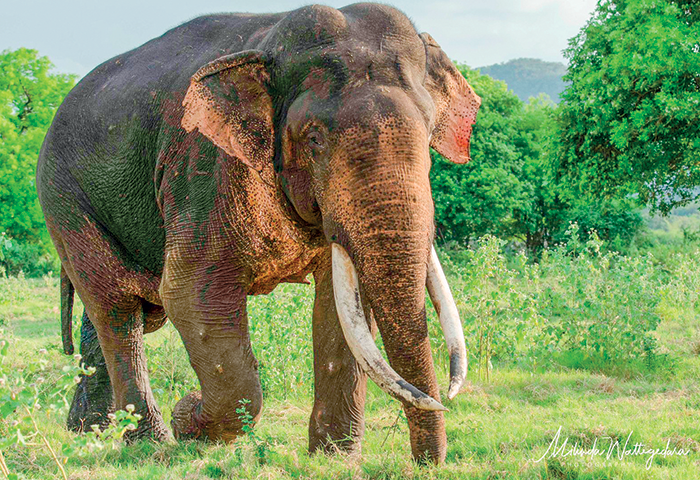
Mahasen, one of Sri Lanka’s most iconic wild tuskers, photographed during his majestic prime in 2014 and in 2025 as the ageing giant continues his struggle for survival in the island’s shrinking wilderness
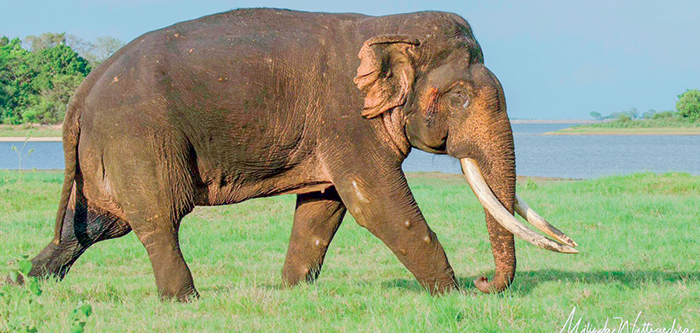
Later, the giant elephant was named Mahasen in honour of the ancient King Mahasen, the visionary ruler who built the magnificent Minneriya Tank. The name reflected not only strength and majesty, but also a deep connection to the same historic landscape shaped by kings, forests, and elephants thousands of years ago.
Today, Mahasen is believed to be around 60 years old, making him one of the oldest surviving wild tuskers in Sri Lanka. Towering above most elephants, he possesses perhaps the largest pair of tusks ever documented among Sri Lanka’s wild elephants, stretching beyond six feet in length.
For decades, Mahasen became one of the greatest attractions of the famous elephant gathering at Minneriya National Park and Kaudulla National Park — one of the largest congregations of Asian elephants anywhere in the world.
Photographers from across the globe waited patiently for hours hoping to capture the old king emerging from the dusty grasslands, at dusk, his enormous tusks glowing beneath the golden evening light. For many wildlife lovers, witnessing Mahasen in the wild became an unforgettable experience.
“Mahasen carries an extraordinary presence,” Chandika Lakmal explained. “Even among large elephants, he stands apart. There is a certain calmness, confidence, and dignity in the way he moves. You immediately understand why ancient people considered tuskers sacred.”
Yet beyond his beauty and fame, Mahasen also represents the fragile future of Sri Lanka’s elephants.
Modern conservation science identifies elephants as “keystone species” and “umbrella species,” meaning their survival protects entire ecosystems. Elephants create pathways through forests, disperse seeds, maintain grasslands, and help sustain biodiversity across vast landscapes.
“Elephants are ecosystem engineers,” Chandika Lakmal said. “The forest itself depends on them. Without elephants, the structure of these ecosystems begins to change. Protecting tuskers, like Mahasen, means protecting entire habitats and countless other species.”
Sadly, Sri Lanka’s wild elephants now face mounting threats.
Habitat fragmentation, shrinking forests, electric fences, roads, railway accidents, illegal shootings, and human-elephant conflict continue to endanger their survival.
Nearly 60 percent of Sri Lanka’s wild elephants live outside protected national parks, surviving within fragmented forests and ancient tank ecosystems increasingly surrounded by human settlements.
Traditional elephant migration corridors that existed for centuries have now been blocked by agriculture and development projects. As elephants lose access to food and water, they are increasingly forced into villages and farmlands, creating dangerous encounters between humans and wildlife.
Even Mahasen has not escaped these pressures.
In recent years, the ageing tusker’s movements have become increasingly restricted. Wildlife observers believe the enormous weight of his tusks, combined with old age, has forced him into smaller forest patches between Kakirawa and Maradankadawala where food and water are available within shorter distances.
Several months ago, Mahasen was discovered with a serious wound on his back believed to have been caused either by a gunshot injury or a clash with another elephant. Wildlife officials intervened quickly and treated the giant tusker, offering hope that he would recover once again.
However, concern continues to grow among conservationists and wildlife enthusiasts as sightings of Mahasen have become increasingly rare in recent months.
For many Sri Lankans, the thought of losing Mahasen is deeply emotional.
“Mahasen is not just another elephant,” Chandika Lakmal said quietly. “He is one of the last living symbols of Sri Lanka’s ancient wilderness. Future generations deserve the chance to see such animals alive in our forests, not only in photographs or history books.”
Despite his immense ecological and cultural importance, many villagers living near elephant habitats still struggle with fear and economic hardship caused by crop raids and property damage.
Conservationists stress that long-term coexistence can only be achieved through proper land-use planning, protection of elephant corridors, community awareness, and sustainable conservation policies.
Across the forests of Yala National Park, Wilpattu National Park, Gal Oya National Park, and Wasgamuwa National Park, Sri Lanka’s remaining tuskers continue their silent struggle against an uncertain future.
But among them all, Mahasen remains special.
He is more than an old tusker wandering through fading forests.
He is the last king of a vanishing wilderness.
And as long as Mahasen still walks beneath the ancient trees of Sri Lanka’s dry zone, the spirit of the island’s wild heritage continues to survive majestic, untamed, and unforgettable.
By Ifham Nizam


Prime Minister Harini Amarasuriya met with the Secretary-General of the Commonwealth of Nations, Shirley Ayorkor Botchwey, at Marlborough House, in London, on Thursday (21).According to the Prime Minister’s Office, the meeting took place during the official visit of PM Amarasuriya to London, for the 43rd Commonwealth of Learning (COL) Board of Governors Meeting 2026.
PM Amarasuriya met with the Secretary-General to discuss areas of mutual cooperation and shared priorities within the Commonwealth framework.
During the meeting, the Prime Minister expressed appreciation for the Commonwealth’s engagement with Sri Lanka and commended the Secretary-General’s leadership in enhancing the relevance and effectiveness of the Commonwealth.
Discussions focused on climate change, climate finance, democratic governance, women’s political participation, and ongoing Commonwealth support for member states.
PM Amarasuriya highlighted Sri Lanka’s commitment to resilience-building, sustainable development, and inclusive governance, while appreciating the continued engagement and support extended by the Commonwealth Secretariat.
The Secretary-General reaffirmed the Commonwealth’s readiness to continue supporting Sri Lanka through technical assistance, capacity-building initiatives, and collaboration in areas including climate finance and electoral governance.
Both sides also exchanged views on upcoming Commonwealth engagements and underscored the importance of strengthening cooperation among member states to address shared global challenges.
High Commissioner Nimal Senadeera and senior officers of the High Commission of Sri Lanka accompanied the Prime Minister to the meeting.
The depreciation of the rupee continues, and the government is accused of making only half-hearted attempts to arrest it. The UNP has said the country is facing a very serious issue due to the uncontrolled tumble of the rupee, and during the 20 months since the current administration assumed office, the exchange rate has moved from around Rs. 292 at the time former President Ranil Wickremesinghe handed over office to around Rs. 354 against the US dollar. It has attributed the current situation to the JVP-NPP government’s failure to continue economic policies introduced by the previous administration and pointed to what it describes as a lack of a clear economic plan and failure to strengthen foreign reserves. According to the UNP, these factors have contributed to the rising value of the US dollar. The SLPP-UNP government was lucky that it did not face a global oil price hike and increasing shipping costs.
However, the Joint Apparel Association Forum (JAAF) has argued that the depreciation of the Sri Lankan rupee should be examined in the context of global pressures, such as increasing world oil prices and shipping costs. The rupee depreciation should not be interpreted as a sign that Sri Lanka’s economy is underperforming, JAAF has said. It has been pointed out that the Sri Lankan rupee has depreciated by 4.8% against the US dollar, the Indian rupee by 6.4%, the Nepalese rupee by 6.2% and the Indonesian rupiah by 5.2%.
The JAAF statement reflects the global economic reality, but Sri Lanka’s situation is more serious than that in many other countries. Sri Lanka is still recovering from an economic crisis. The government will have to go beyond imposing a 50% customs duty surcharge on vehicle imports to curtail the forex outflow, strengthen the rupee and shore up foreign currency reserves.
President Anura Kumara Dissanayake has urged the public to cut down on fuel consumption and help boost the country’s foreign currency reserves and arrest the rapid depreciation of the rupee. But they have already cut down on fuel consumption due to soaring oil prices.
President Dissanayake has claimed that a litre of diesel costs as much a Rs. 720, and a government subsidy on diesel amounts to Rs. 100 a litre. If a litre of diesel costs Rs. 720, as the President claims, are the private fuel retailers incurring huge losses by selling diesel at the current price (Rs. 392 a litre)? Is the Ceylon Petroleum Corporation overpaying for fuel? The increasing national fuel bill and the country’s forex woes cannot be blamed on the fallout from the West Asia crisis alone. True, the Iran conflict and the closure of the Hormuz chokepoint have driven the world oil prices up. However, the huge rise in Sri Lanka’s fuel bill from USD 98 million in February to a projected USD 522 million in May, as the President says, is also due to a massive increase in the use of diesel, etc., to operate the oil-fired power plants to compensate for the generation loss caused by substandard coal at the Norochcholai power complex.
With the government struggling to maintain an uninterrupted power supply by burning costly diesel, scheduled power cuts may not be far away. The Opposition has told Parliament that unofficial power cuts are already underway.
The national fuel bill no doubt must be curtailed, but there are other avenues that the government should explore to arrest the rupee’s tumble. Exporters have gained from the depreciation of the rupee, which they themselves have to take responsibility for to some extent. It has been alleged that Sri Lanka is deprived of most export proceeds due to various rackets. Exporters unlawfully park foreign exchange abroad. This practice is linked to exchange control violations, tax evasion, capital flight and, in some cases, even trade-based money laundering. Common methods used by unscrupulous exporters to avoid the repatriation of most export proceeds include the following as we have reported over the years, quoting experts: under-invoicing exports, over-invoicing imports, keeping proceeds abroad through offshore entities, use of “open account” arrangements, multiple invoicing and phantom shipments. Some fraudsters use hawala or informal settlement systems. The media has exposed these malpractices over the years, but in vain.
These export-related rackets have prompted many countries to require exporters to repatriate export proceeds within a relatively short period, submit shipping and banking documentation, and convert part or all export earnings into local currency. Sri Lanka has adopted some of these methods but no government has had the courage to go the whole hog to ensure compliance, for exporters have huge slush funds to bankroll election campaigns. The JVP-NPP government must get tough with the errant exporters who resort to malpractices and deprive the country of much-needed forex. Ensuring the repatriation of export proceeds in a proper manner is half the battle in breaking the back of the forex problem.
The need for a holistic approach to rupee depreciation cannot be overstated, but stringent measures are necessary to curb the outflow of foreign currency.

To be sure, the political dimension cannot be downplayed. For very good reason China could be seen as holding the power balance somewhat evenly between East and West. The international politics commentator couldn’t be seen as overstating the case if he takes the position that China could exercise substantial influence over the East currently; that is Russia and Iran, in the main. The latter powers hold the key in the Eastern hemisphere to shaping international politics in the direction of further war or of influencing it towards a measure of peace.
For example, time and again China has prevented the West from ‘having its own way’, so to speak, in the UN Security Council, for instance, in respect of the ongoing conflicts involving Russia and Iran, by way of abstaining from voting or by vetoing declarations that it sees as deleterious. That is, China has been what could be seen as a ‘moderating influence’ in international politics thus far. It has helped to keep the power balance somewhat intact between East and West.
At present a meet is ongoing between Chinese President Xi Jinping and Russian President Vladimir Putin in Beijing. This happened almost immediately after the Trump visit. Apparently, Beijing is in an effort to project itself as treating the US and Russia even-handedly while underscoring that it is no ‘special friend’ of the US or the West.
This effort at adopting a non-partisan stance on contentious questions in international politics is also seen in Beijing’s policy position on the Hormuz tangle and issues growing out of it. The Chinese authorities are quoted as saying in this regard, for instance, that China is for ‘a comprehensive and lasting ceasefire in the Middle East’.
Such a position has the effect of enhancing the perception that China is even-handed in its handling of divisive foreign policy posers. It is not openly anti-West nor is it weighing in with Iran and other Eastern actors that are opposed to the West in the West Asian theatre. A ‘comprehensive and lasting ceasefire’ implies that a solution needs to be arrived at that would be seen as fair by all quarters concerned.
On the highly sensitive Taiwan issue, President Xi was comparatively forthright during the Trump visit, but here too it was plain to see that Beijing was not intent on introducing a jarring, discordant note into the ongoing, largely cordial discussions with Washington. On the Taiwan question President Xi was quoted saying: ‘If mishandled, the two nations could collide even come into conflict.’ In other words, the US was cautioned that China’s interests need to be always borne in mind in its handling of the Taiwan issue.
The cautioning had the desired result because Trump in turn had reportedly conveyed to Taiwan that the latter’s concerns on the matter of independence had to be handled discreetly. He had told Taiwan plainly not to declare ‘independence.’
Accordingly, neither the US nor China had said or done anything that would have made either party lose face during their interaction. Apparently, both sides were sensitive to each others’ larger or national interests. And the economic interests of both powers were foremost among the latter considerations.
There is no glossing over or ignoring economic interests in the furtherance of ties between states. They are primal shaping forces of foreign policies and the fact that ‘economics drives politics’ is most apparent in US-China ties. That is, economic survival is fundamental.
Among the more memorable quotes from President Xi during the interaction, which also included US business leaders, was the following: ‘China’s doors will be open wider’ and US firms would have ‘broader prospects in the Chinese market.’
Xi went on to say that the sides had agreed to a ‘new positioning for ties’ based on ‘constructive strategic stability’. The implication here is that both sides would do well not to undermine existing, mutually beneficial economic relations in view of the wider national interests of both powers that are served by a continuation of these economic ties. That is, the way forward, in the words of the Chinese authorities, is ‘win-win cooperation.’
It is the above pronouncements by the Chinese authorities that probably led President Trump to gush that the talks were ‘very successful’ and of ‘historic and landmark’ importance. Such sentiments should only be expected of a billionaire US President, bent on economic empire-building.
One of the most important deals that were put through reportedly during the interaction was a Chinese agreement to buy some 200 Boeing jets and a ‘potential commitment to buy an additional 750 planes.’ However, details were not forthcoming on other business deals that may have been hatched.
Accordingly, from the viewpoint of the protagonists the talks went off well and the chances are that the sides would stand to gain substantially from unruffled future economic ties. However, there was no mention of whether the health of the world economy or the ongoing conflicts in West Asia were taken up for discussion.
Such neglect is regretful. Although the veritable economic power houses of the world, the US and China, are likely to thrive in the short and medium terms and their ruling strata could be expected to benefit enormously from these ongoing economic interactions the same could not be said of most of the rest of the world and its populations.
Needless to say, the ongoing oil and gas crisis, for instance, resulting from the conflict situation in West Asia, is taking a heavy toll on the majority of the world’s economies and the relevant publics. While no urgent intervention to ease the lot of the latter could be expected from the Trump administration there is much that China could do on this score.
China could use its good offices with the US to address the negative fallout on the poorer sections of the world from the present global economic crunch and urge the West to help in introducing systemic changes that could facilitate these positive outcomes. After all, China remains a socialist power.
Prime Minister Dr. Harini Amarasuriya attended the 2026 OSGA Annual Lecture held at the University of Oxford on May 19, where she delivered a lecture titled “The Politics of Development: Sri Lanka and Beyond.”
The lecture was held at the St Antony’s College, University of Oxford, and organized by the Oxford School of Global and Area Studies (OSGA), the department’s flagship annual event that brings together leading academics, policymakers, and practitioners to discuss contemporary global challenges.
Addressing an audience comprising students, academics, and researchers from across the University, the Prime Minister reflected on the intersections of development, governance, and politics in Sri Lanka while discussing the broader realities faced by countries attempting to achieve meaningful social and economic reform.
During her lecture, Dr. Harini Amarasuriya emphasized that development cannot be understood only through policies, statistics, and economic models, but must also be viewed through the everyday experiences of people. She highlighted that governance often requires balancing ideals with practical realities, particularly in countries recovering from economic crises, institutional challenges, and long-standing inequalities.
The Prime Minister also spoke extensively on women’s political participation and representation in Sri Lanka, noting the growing involvement of women in grassroots political movements and leadership spaces. She reflected on the efforts taken to create greater political opportunities for women and the continuing challenges faced in transforming deeply rooted social and political structures.
Speaking on economic recovery and social policy, Dr. Amarasuriya highlighted the importance of recognizing both paid and unpaid care work, stressing that the contribution of women to families, communities, and the economy has often remained invisible in traditional economic systems. She noted that sustainable development must ensure economic progress while also protecting dignity, fairness, and social well-being.
The Prime Minister further reflected on the relationship between governments, international development agencies, and local institutions, emphasizing the importance of ensuring that development priorities remain grounded in local realities and accountable to the people they are intended to serve.
Drawing from her experiences as a social anthropologist, activist, academic, and political leader, Dr. Amarasuriya also discussed the challenges of translating activism and public movements into long-term policy reforms and institutional change. She noted that meaningful transformation requires patience, negotiation, and sustained public engagement.
The lecture was followed by an interactive question-and-answer session with the audience, during which discussions focused on governance, institutional independence, political reform, economic recovery, and the challenges of balancing democratic accountability with policy implementation.
Professor Diego Sanchez-Ancochea, Head of the Oxford School of Global and Area Studies, commended the Prime Minister’s lecture, describing it as an important and timely reflection on the relationship between politics and development, informed by both scholarly insight and practical political experience.
Prime Minister’s Media Division
The regulatory environment in Sri Lanka plays a decisive role in shaping the growth of the private sector, influencing investment decisions, and improving overall business competitiveness.
Although the fundamental elements of the country’s economy remain strong, it has been observed that the existing regulatory constraints disproportionately affect small and medium-sized enterprises and also adversely impact the attractiveness of Sri Lanka as an investment destination.
Taking those matters into consideration, the Ministry of Industry and Entrepreneurship Development, with the assistance of the Asian Development Bank, has carried out a comprehensive assessment of the regulatory framework in
Sri Lanka, and following extensive discussions held with the relevant stakeholders, the National Regulatory Reform Action Plan and its operational mechanism have been formulated.
The aforementioned Action Plan has presented a number of practical and actionable recommendations, and such recommendations have been prioritized and sequenced across short-term, medium-term, and long-term timeframes. Further, it has been proposed to establish a National Regulatory Reform Council as the central institutional mechanism for the implementation, direction, and supervision of the aforementioned Action Plan.
Accordingly, the Cabinet of Ministers has approved the resolution furnished by the Minister of Industry and Entrepreneurship Development to establish the aforementioned Council under the chairmanship of the President and to designate his Ministry as its Secretariat of that council.
Seventeen years have elapsed since the defeat of LTTE terrorism, which plagued the country for about a quarter century. If not for the successful military campaign that eliminated the LTTE leadership, thousands of lives would have been lost in terror attacks and on the battlefield since 2009, and it would not have been possible to rekindle democracy in the North and the East. Today, children can go to school without fear of being abducted and turned into cannon fodder by the LTTE; political dissent is no longer violently suppressed; people can exercise their franchise freely in the former war zone, and there are no political assassinations. Ironically, those who did not oppose the LTTE’s terror campaign or supported it are now championing democracy and human rights. Among them are prominent Tamil politicians, civil society activists and religious leaders.
Terrorism is not a means to an end. It is both the means and the end. Hence, the need to eliminate it in all its forms and manifestations. There were numerous attempts to persuade the LTTE to agree to a political solution, but Prabhakaran remained intransigent, and his terror had to be wiped out. There is space for the remaining LTTE members and their sympathisers to take to democratic politics. They ought to learn from the former southern terrorists.
What paved the way for the JVP’s re-entry into the democratic process and rise to power was the decimation of its leadership and military wing, which was responsible for many gruesome crimes in the late 1980s. The JVP killed thousands of dissenters and state workers who did not follow its illegal orders, and destroyed state assets worth billions of dollars. Today, a JVP-led government is trying to develop the country.
Attempts are being made in some quarters to revive memories of old battles to reclaim lost ground on the political front. Prominent among those who are doing so are SLPP politicians who were in power when the LTTE was defeated. They are trying to rouse nationalism in a bid to make a comeback. They would not have been in the current predicament if they had not misused the defeat of terrorism for political gain.
What the Rajapaksas and their allies did to the country, after defeating the LTTE, was like saving a damsel in distress and abusing her. They laboured under the misconception that the defeat of terrorism for which they provided political leadership was a special licence for them to do as they pleased. They sought to politicise and monopolise the war victory to accelerate their dynasty-building project and perpetuate their hold on power. The post-war Mahinda Rajapaksa administration became a government of the Rajapaksas by the Rajapaksas for the Rajapaksas, with a member of the ruling family in almost every key position in the state sector. They bulldozed their way through, launching as they did witch-hunts against their rivals. They also resorted to state terror to further their political interests. Blinded by the arrogance of power, they ruined things for themselves and suffered a humiliating electoral defeat in 2015. They succeeded in returning to power four years later, as the public thought they had changed and voted for them, only to be disillusioned again when they mismanaged the economy, indulged in corruption and bankrupted the country.
The Rajapaksas squandered an opportunity that presented itself, after the conclusion of the war, to bring about national reconciliation and defeat the LTTE ideology politically. The entry of war-winning Army Commander General Sarath Fonseka into the presidential fray in 2010 at the behest of the JVP and others, provided the pro-LTTE groups, here and overseas, with a rallying point; they crawled out of the woodwork and backed Fonseka in a bid to see the back of Mahinda Rajapaksa, albeit in vain. They succeeded in 2015, and emerged stronger, after enabling Maithripala Sirisena to secure the presidency. In a dramatic turn of events in 2024, they threw their weight behind the NPP led by the JVP.
An oft-heard lament is that reconciliation continues to elude this country. This sorry state of affairs has come about because reconciliation has become a victim of hypocrisy. Those who claim to champion reconciliation are using it to further their own interests, and those who should have made a serious effort to help achieve it after defeating terrorism did not care to do so and chose to advance their own political agenda.

Here is the point that carries more weight than the headline PMI figures released by the Central Bank of Sri Lanka. While much of April’s contraction in manufacturing (42.6) and services (46.7) was dismissed as seasonal — the Sinhala and Tamil New Year holidays, fewer working days, fading festive demand — the rupture in new business flows tells a different, more troubling tale.
April 2026 marked the first month since April 2023 that services sector new business contracted. Not a slowdown. Not a plateau. An outright decline. Nor was it narrow in scope. The deterioration cut across transportation of goods, insurance, wholesale and retail trade, and accommodation, food and beverage service activities.
The Island Financial Review asked an independent analyst for his take. Here is what he said.
“These are not fringe sub-sectors; they are the arteries of Sri Lanka’s domestic economy. Why does this matter beyond the seasonal logic? Because new business is a leading indicator. What falls today in new orders will show up tomorrow in production, employment and stock purchases. April’s drop in new business — the first in three full years — suggests that May’s anticipated recovery may be shallower than hoped, and that a return above the neutral 50 PMI threshold before June is unlikely unless geopolitical tensions ease sharply.”
“Compounding the concern, the decline in new business was not an isolated Sri Lankan phenomenon. It arrived alongside two external shocks: rising energy prices, which hammered transport and personal services, and the ongoing Middle East conflict, which lengthened supplier delivery times and added logistical friction.”
“To be sure, expectations over the next three months remain positive. Firms hope for a stabilisation following the end of the war. But the first decline in new business in three years is a quiet alarm. Seasonal patterns explain April’s production dip. They do not explain why customers stopped placing new orders. For Sri Lanka’s policymakers and business leaders, that is the story to watch in May,” he said.
By Sanath Nanayakkare


At least eight people have been killed, and dozens injured, after a freight train crashed into a public bus in Thailand’s capital.
Flames engulfed the bus and nearby vehicles near an airport rail link station in the centre of Bangkok Saturday afternoon.
The city’s emergency services Erawan Medical Center confirmed the number of deaths, while Bangkok police chief Urumporn Koondejsumrit told AFP news agency at least 35 people were injured.
Speaking to reporters at the scene, Deputy Transport Minister Siripong Angkasakulkiat said that all the bodies were found on the bus. It was not yet clear how many people were on board in total.
Prime Minister Anutin Charnvirakul ordered an investigation into the crash, according to a statement from his office.
Al Jazeera’s Tony Cheng, reporting from Bangkok, said the crash unfolded around 3:40pm local time (08:40 GMT), when the bus appeared to get stuck on an intersection with the rail line after the safety barriers descended.
As the freight train rammed into the stationary bus and continued travelling, it dragged several nearby vehicles along with it before the bus burst into flames.
Siripong would not confirm whether the bus had stopped on the railway track or discuss reports that the barriers may not have lowered properly, saying the matter still needs to be investigated.
Firefighters and rescue crews were dispatched to pull people from the wreckage and battle the flames as motorcyclists and passersby attempted to redirect traffic.
The fire has since been brought under control.
[Aljazeera]
A 60-year-old Indian national was arrested at the arrival terminal of the Bandaranaike International Airport (BIA) yesterday while attempting to smuggle cocaine with a street value of nearly Rs. 108 million through the Green Channel.
The suspect was apprehended by officers of the Customs Narcotics Control Unit, following the detection of two kilos and 150 grams of cocaine concealed inside two certificate file covers in his luggage.
Customs officials said the suspect, a geologist by profession, had travelled from Kampala to Doha before arriving in Sri Lanka, on a Qatar Airways flight, at around 10.40 am.
The suspect and the seized narcotics were handed over to the Police Narcotics Bureau (PNB) officers attached to the BIA for further investigations.
by Norman Palihawadane