Monday, December 16, 2024

Justice Minister asks CID to probe bid to discredit him

Inclusion of ‘Dr’ before his name:

By Norman Palihawadane

Justice Minister Harshana Nanayakkara yesterday lodged a complaint with the CID, calling for an investigation into what he called the inclusion of erroneous information about his educational qualifications in the official Parliament database. He told reporters that he suspected there was a conspiracy to discredit him.

Last week, Parliament acknowledged a mistake in its online directory of Members of Parliament, where the title “Dr.” was placed before the name of Minister Nanayakkara. The Director of Legislative Services, Jayalath Perera, confirmed that it was a result of an error in entering the relevant information on the Parliament website.

Minister Nanayakkara said that, in addition to calling for a criminal investigation, he would also take legal action through a civil case against those who had been carrying out a malicious propaganda attack against him.


from The Island https://ift.tt/dcONMj4

Ten media veterans to be honoured at SLPA’s 69th Anniversary Convention

Ten distinguished media veterans are listed to be honoured at the 69th Anniversary Convention of the Sri Lanka Press Association (SLPA) and the D.F. Kariyakarawana Memorial Journalism Awards. The ceremony is scheduled to take place today at the Sri Lanka Foundation Auditorium.

The honorees, who have dedicated their careers to the advancement of journalism, are Daya Lankapura, V. Thanabalasingham, J. Sheela Wickramarathna, P. B. Ilangasinghe, Upali Arambewala, N. M. Ameen, Stanley Samarasinghe, S. S. Selvanayagam, Thusitha Malalasekara, and Alexander Balasuriya.

The annual event, which celebrates excellence in the field of media and journalism, will pay tribute to these veterans for their unwavering commitment and lasting impact on the industry. Their collective work has greatly shaped the media landscape in Sri Lanka, with many of them having contributed for decades to print, broadcast, and digital media.


from The Island https://ift.tt/r3kKIGh

Govt.’s anti-corruption agenda gets boost

by Jehan Perera

President Anura Kumara Dissanayake’s statement that the government will not permit the erosion of its mandate for accountable government in the context of the resignation of the Speaker of Parliament is on track with the promises made during the course of the elections that brought the NPP to power. The President reaffirmed his commitment to maintaining public trust, stating his government will take decisive action against any wrongdoing, regardless of rank, and emphasised the government’s mission to uphold the people’s mandate and ensure accountability at all levels. This is an indication that the government will be pursuing its anti-corruption agenda which will help it to retain its support base amongst the people. It will also offer the opportunity to legally and legitimately neutralize or incapacitate political rivals who will stoop to any level to come back to power, if they can be proven to have engaged in corruption.

Tackling the problem of corruption will be advantageous to the government in other ways, too. It will improve the climate for business in the country and, thereby, make Sri Lanka more attractive to foreign investors who have been unreceptive to the allurements, including tax breaks, that successive governments have been offering. The recent US government decision to sanction two Sri Lankans for involvement in corrupt government deals out of only 14 individuals sanctioned worldwide is significant. The sanctions target specific individuals rather than the government, signalling that the US is not against Sri Lanka’s leadership but is, instead, committed to upholding universal principles of justice and transparency. By acting against these individuals implicated in corruption, the US is indirectly reinforcing the government’s mandate to clean up its institutions.

Sri Lanka’s most recent position on the Ease of Doing Business Index (as of its final publication in 2020 before the World Bank discontinued the report) was ranked 99th out of 190 economies. Among the issues highlighted is the pervasive corruption in both public administration and regulatory bodies which leads to delays and demands for unofficial payments, discouraging both domestic and foreign investors. Despite attempts to streamline processes through digitization and one-stop services, corruption often shifts to more sophisticated forms rather than being eliminated. The international community appears to be willing to support the government to overcome the systemic corruption that has permeated society, to take on corrupt former government leaders and to improve the investment climate necessary for rapid economic development.

FLEXIBLE POLICY

Before the presidential election, critics argued that the NPP’s opposition to the IMF agreement risked plunging the country into another economic collapse. Concerns centered on a potential devaluation of the rupee, fuel shortages, and a recurrence of the dire conditions seen during the 2020-2022 crisis. There was a massive political campaign against the ruling NPP on economic grounds. There was a propaganda barrage that claimed that the old-school Marxists in the NPP would take the country to another economic collapse by rejecting the IMF agreement. They also claimed that the Sri Lankan rupee would plummet to a new low again and that there would be long lines outside petrol stations, and shortages of essential commodities that the country had seen three years ago. There was justification that the NPP had no viable alternative to the IMF agreement and yet was contemplating its rejection.

Indeed, at the outset of the presidential election campaign, the NPP (along with other Opposition parties) had been extremely critical of the IMF agreement, negotiated under the supervision of the former President, on the grounds that it was adverse to the interests of the working people and the national interest. Just before the elections, however, the NPP changed its stance to one of accepting the basic structure of the IMF agreement as negotiated under the former President, which it is now sticking to, though not in full measure. It has not, for instance, agreed to the wholesale privatization of state enterprises or to the undermining of the state education and health systems, as might have happened if the previous government continued in power for longer. There is now a discussion on private-public partnerships and as time passes, and the new government gains in confidence about the stability of the economy, there are likely to be more innovations.

The government’s settlement with private international bondholders reflects its commitment to continue on the economic course set by the agreement with the IMF and with the larger international community, including creditor countries, such as China, India and Japan. The government has now gained support from private creditors to restructure its international bonds. Investors, representing close to 98 percent of the country’s USD 12.6 billion in dollar bonds, are expected to agree to swap their securities for new notes. The widespread support would mean that the debt restructuring should be completed before year-end. The debt rework with private creditors was a necessary step under the agreement with the IMF. This appears to be the best option in an economic world in which Sri Lanka is but a small player.

MONEY SHORTAGE

The government’s biggest problem, at the present time, is the lack of money to meet the various expenditures it has to incur. The recent floods and the shortage of rice and coconuts are not of the government’s doings and there is little it can do due to the financial constraints it is under. However, by securing private bondholder cooperation, the government has demonstrated its ability to address complex negotiations. The successful negotiation with private creditors is a positive signal to global investors, bolstering Sri Lanka’s credibility and being better positioned to gain future investments. This can counter the Opposition criticism that the government has reneged on its promises made in its election manifesto and during the election campaign.

The mandate that the government sought was contained in a manifesto publication of 231 pages. There were a large number of promises in it on a wide array of subjects, ranging from arts and culture to economic development and good governance. At the core of the promise was to change the prevalent system in the country to be uncorrupt and to respect the rule of law. These were also the demands of the Aragalaya protest movement of 2022 that drove the then President and government from office through the power of mass movement and street protest. Those protests were motivated by the complete collapse of the economy which the NPP pledged to restore in its manifesto. But this is providing to be difficult in the short term.

Fortunately for the government, the absolute disillusionment of the general population with the other mainstream political parties has meant that the people are willing to be patient and give the government more time to get the economy back on track. Most people accept that the sins of the past cannot be laid at the doors of the present government and that more time is needed for them to be corrected. The government is continuing to maintain its credibility by adherence to its anti-corruption and accountability mandate. The claim to have university qualifications that cannot be shown to be true, has fallen into the realm of accountability that the government has now shown it will demand of its members. The resignation of the Speaker of Parliament, the third ranking member of the government, due to his inability to back his claim of academic achievement, is a sign of this commitment.


from The Island https://ift.tt/dD27PzT

Ways to help the poor and the disabled

I wish to share with your wide readership how the poor and disabled people are helped in the UK. Before that, on a glowing note, Sri Lanka’s was portrayed in the best possible light through Alexander Armstrong’s recent three-part series on Sri Lanka. On top of this achievement, Sri Lanka has also been recognised as the 5th best country to visit in your lifetime, according to CEOWORLD Magazine’s prestigious rankings for 2024.

The accolade highlights Sri Lanka’s diverse offerings and unique experiences that captivate travellers from around the globe. Sri Lanka continues to bask in the spotlight as one of the world’s top travel destinations, the recognition serves as a testament to the country’s enduring allure and unwavering hospitality.

CEOWORLD Magazine recently unveiled its list of the best countries to visit, providing invaluable insights to help travellers choose their next vacation destination.

The rankings, based on feedback from over 295,000 readers, reflect the highest level of participation in the magazine’s history.

Sri Lanka’s impressive ranking is attributed to its enchanting hill country, which offers a myriad of experiences for travellers of all interests with a total score of 60.53.

The hill country of Sri Lanka offers a wide range of experiences for travellers of all kinds, whether it’s Ayurveda treatment, unforgettable train rides, or visiting a tea plantation.

The country is rich in culture and traditions, with the Poya ritual being the most significant one celebrated at Buddhist temples.

Don’t miss out on the opportunity to enjoy a wholesome Sri Lankan breakfast, dine under the stars, and stay overnight in one of the country’s National Parks.

Additionally, Sri Lanka is a great destination for shopping enthusiasts, who can find gems, batik, tea, handloom fabrics, leather goods, antiques, jewellery, and ceramics,” the CEOWORLD Magazine noted about Sri Lanka.

Sri Lanka continues to emerge as one of the world’s best tourist destinations with accolades from various travel guides, travel magazines and travel web sites, including Lonely Planet, Travel Lemming website and Bloomberg website, etc.

Sri Lanka was selected by travel influencers as a top destination in Asia, and It was also given the Emerging Destination award.

It has gained the Travel Lemming readers award among the world’s top destinations by Travelling website some time ago. Also, a website in the UK ranked Sri Lanka as one of the 10 best places to visit.

It was so captivating that my Welsh wife and I got carried away to consider selling up to settle down back in my motherland! After half a century’s life in UK (I lost my Sri Lankan citizenship many decades ago), in reality the novelty would wear off soon.

Sadly, the stark truth is the ever-widening gap between the rich and poor while dragging the middle class down with it, mirroring the situation in India although the latter is on a massive scale! How the super rich, like Ambani had his son’s wedding celebrations lasting some four months attended by celebrity guests and heads of state from around the world! Let me return to the nitty gritty of the topic I wish to focus on, permanently settled in West Wales to enjoy our retirement looking after our menagerie of two ageing horses, remaining two rescued sheep and, of course, our beloved two little dogs, very much part of the family. Although we enjoy a comfortable lifestyle with our NHS and State Pensions, everyone gets GP prescribed medication free unlike in the more affluent England! Mine includes even Paracetamol, Ibuprofen and a host of others though they can be bought over the counter! Since suffering a nasty fall, slipping in the bathroom earlier in the year, I received a Blue Badge supported by GP recommendations which allows me to park in designated Disabled slots for free. Free bus passes to go anywhere in Wales! More disabled get mobility scooters. Blind people receive guide dogs.

Now that the previous Presidents who plundered the country and fled before stashing away the ill-gotten wealth are being taken to task, hats off to the new President for prioritising the basic needs of the poor while taking away the superfluous privileges traditionally granted to Ministers and MPs! In that context, it may well be AKD as he is often affectionately referred to in journals, could help improve the lot of the destitute and disabled (DDs) through a more pragmatic wealth distribution programme! As a practising Buddhist myself, I dare say some of the so-called Buddhist monks enjoying a luxurious lifestyle in Sri Lanka are only interested in asking for more and more donations! In conclusion, my empathy goes beyond the suffering mankind. What about the millions of stray dogs! I wish to pay a glowing tribute to a British vet who left behind her party lifestyle to start a street dog charity in Sri Lanka has revealed how going on a trip with her ex-boyfriend moments after they’d broken up changed her life forever.

Janey Lowes, 32, from Barnard Castle, County Durham, started her animal charity in Sri Lanka, WECare Worldwide, in 2014, after a holiday there inspired her to move to the Indian Ocean island permanently .

Sunil Dharmabandhu
Wales UK


from The Island https://ift.tt/AaieBcM

Sunday, December 15, 2024

President hails successful bond exchange which took two years of intense negotiations

Acknowledges those who were involved in it at leadership level

Says all our ‘collective efforts’ are now paying off

By Sanath Nanayakkare

On 19 the September 2024, Sri Lanka reached agreement in principle with each of the Ad Hoc Group of Bondholders, the Local Consortium of Sri Lanka and China Development Bank on bond restructuring terms.

On 25 November, Sri Lanka launched an official Invitation to holders of its ISBs to exchange their bonds against new debt instruments, pursuant to the above agreement with two representative groups of holders – one comprising international investors and the other domestic financial institutions – together holding approximately 50% of the total outstanding amount of ISBs.

On 13th December 2024, the Finance Ministry announced that the expiration of its Consent Solicitation and Exchange Offer related to its International Sovereign Bonds (ISBs), with preliminary results indicated a very high participation from market participants.

At the expiration of the offer period, the Finance Ministry said Sri Lanka was very pleased to report an extremely high level of participation across all series, which is expected to result in the exchange of close to 98% of the total outstanding amount of ISBs for new securities.

It quoted President and Finance Minister Anura Kumara Dissanayake, as saying: “We are very pleased to see this vote of confidence from our international and local bondholders. The past few years have been very challenging for the Sri Lankan population, but all of our collective efforts are now paying off. The implementation of this debt exchange, which is the result of two years of intense negotiations, will deliver substantial debt relief for Sri Lanka, freeing up resources in the short and medium term to finance our development and social agenda, while restoring the long term sustainability of our public finances.”

“We are committed to using this debt relief and fiscal space to ensure robust macroeconomic fundamentals and economic growth that will enable Sri Lanka to meet future debt service obligations and overall economic objectives. This successful bond exchange will also allow us to normalise our relations with bondholders and other key external partners,” Dissanayake added.

The President expressed appreciation to all stakeholders who supported through this complex process, including our official sector and commercial creditors, the co-chairs and secretariat of the Official Creditor Committee, the International Monetary Fund, and others with whom Sri Lanka worked in good faith to enable this positive outcome.

He also thanked those who were involved in this journey by providing leadership and numerous contributions at critical stages, enabling Sri Lanka to achieve this important milestone in her journey towards economic recovery.

“Today we open a new chapter of our history and turn the page following multiple years of crisis,” the President added.

Final results are expected to be available on 16th December (today). The settlement of the bond exchange is intended to take place on 20th December.


from The Island https://ift.tt/MjHt3wS

Husband found guilty of murdering his newlywed wife on their dream Fiji honeymoon


The defendant is set to face sentencing next month after a judge found him guilty of the murder of his newlywed wife during a drunken argument on their honeymon

from Daily Express :: US Feed https://ift.tt/W5D2HhT

Saturday, December 14, 2024

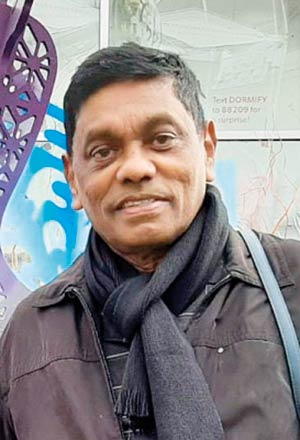
Dr. C. Sivandran (1948-2024): Engineer, Industrial Entrepreneur

by Rajan Philips

Writing obituaries becomes a poignant burden when those near and dear to us keep taking their turn while we wait for ours in life’s departure lounge. I have had my share of writing obituaries in the last two years, but this one gets preciously close because Sivandran, who passed away suddenly in Semarang, Indonesia, was my roommate throughout our Peradeniya years and later after graduation. We were best friends.

We were emailing on November 28 and his last email said that his health was a hassle; so, he was winding down in Indonesia and was heading home to Perth. Next day I received the sad news of his demise. “Death, be not proud,” John Donne’s Holy Sonnet came to mind, but more in anger than as assurance of what comes “one short sleep past.”

Sivandran graduated in Civil Engineering, in 1972, and went on to obtain his MSc and PhD in Geotechnical Engineering at the Asian Institute of Technology in Bangkok. He married Indrakanthi in 1976, at a gala wedding hosted by her parents, R. Yogarajah and Indranee Yogarajah, in their house that had once been the old Eighty Club on Queens Road. Sive was already bitten by the entrepreneurial bug and was onto a number of initiatives in Colombo. Their two sons, Gajan and Subajan, were born in Colombo.

The family moved to Perth, Australia, after 1983. He had earlier spent time in Australia when he had a two year (1980-82) affiliation with Monash University in Melbourne. In Perth, Sive turned to waste management and recycling industry with a global focus to find a satisfying outlet for his intelligence, enterprise, organizational abilities and entrepreneurial ambitions. We met in Canada when he came on a visit to solid waste recycling facilities in Vancouver and Guelph run by municipalities.

What he started in Perth eventually led him to land in Semarang, as Jakarta is too congested, and launch a new company, the PT Indo Energy Solutions, for extracting feedstock from Palm Oil Mill Effluent (POME) and supplying it as raw material for low carbon fuel production in Indonesia and elsewhere. The company is quite far flung in Indonesia – the head office in Semarang, marketing offices in Jakarta, processing and storage facilities in Lampung and six other locations, and multiple sites for waste collection from Palm Oil Mills. Sivandran had built up multiple clients within Indonesia, along with BP Singapore and clients in EU countries.

Sivandran had been scouting the Southeast Asian region for a number of years before locating his enterprise in Semarang, the capital of Central Java. Kanthi joined him from Perth, and Semarang became a convenient hub for them to travel from – to Perth and to Chicago and Singapore to visit Gajan and Subajan, their families, including their two grand children, Ella and Caiden.

Gajan and his wife Rebecca studied Environmental Engineering in Australia and went on to complete their PhDs at MIT. After stints at the Ohio State University and Boston Consulting, Gajan has recently started a faculty position as Professor at the Quantitative Science Centre, University of Washington, Seattle. Rebecca works as an international Consultant in Water and Climate Research, Public Engagement and Communications. Ella is their daughter, Sive’s and Kanthi’s first grandchild.

Subajan did Mechanical Engineering and followed it up with an MBA from HEC Paris, the well known French business school. He was a Director with Deloitte’s Asia in Singapore, and has now joined Bureau Veritas in Paris, working in Strategy, M&A and Sustainability. His wife Renee is a Psychologist with specialization in Early Childhood Development. They have a son, Caiden, Sive’s and Kanthi’s grandson.

Gajan and Subajan and their partners have done their parents proud. Sive was obviously pleased and proud that his two sons were well set on their own trajectories of accomplishments and achievements. It would have been gratifying for Kanthi, the children and the grandchildren to have had Sive around for many more years. That was not to be. But they have long memories of him that will stay with them without growing old or weary. I would hope that the few reminiscences that I sprinkle below will be a little addition to their trove.

Reminiscences

Sivandran was the youngest son of V. Coomaraswamy and Rukmani, after four sisters and two brothers. His father was an Irrigation Engineer, the family lived in Colombo and Sive started schooling at Royal College. He moved to St. John’s College when the family relocated to Jaffna after 1958. Old Coomaraswamy was a good volleyball player, known as “beauty Coomaraswamy” in the Department for his aerial smashes. Card games, especially bridge, carrom and table tennis were popular pastimes of old school Irrigation Engineers, and Sive’s whole family was groomed in them.

Sive was a shrewd bridge player and was also a good badminton player, thanks to his bother Vijeyndra. Vijey was a final year Medical student at Peradeniya when we entered Engineering, and already a national badminton player for Ceylon. Sivandran was student champion at Peradeniya and was captain and member of the University badminton team. Dr. Vijeyndra passed away in England a few years ago, and Sive’s surviving siblings are his oldest brother Mahendra, himself a Civil Engineer of the Colombo faculty vintage, now living in Perth; and sister Pathma Sokkanathan, a Lawyer, living in London.

Old relationships may not mean much for the younger generation, but it is worth recalling that Sivandran’s mother was the youngest sister of GG Ponnambalam, Q.C., a dazzling lawyer and a political colossus during the middle decades (1930-1970) of the twentieth century. Her other brother, Rev. GM Balasundaram OMI, was a prominent Catholic Priest in the Jaffna Diocese. The two brothers were exceptional orators of their generation.

Sivandran’s oldest sister Parameswari, a doctor, married Alfred Duraiappah, who would not only become the Mayor of Jaffna but would go on to create a national upset by defeating GG Ponnambalam in the 1960 March and July elections in Jaffna. Ponnambalam’s first defeat in 25 years. So, as a 12-year old, Sivandran would have had an early exposure to the tumults, as well as the twists and turns of the local Jaffna politics. But he was never consumed by politics at any level.

Yet, Sivandran had a real talent for organizational politics which he would quietly use to set his own goals, but always to positive ends, and skillfully pursue them without ruffling feathers, making arguments or hurting feelings. They were all evident throughout his university days at Peradeniya and later in Bangkok, and they would have come to full fruition in his entrepreneurial ventures. He was also a conscientious and disciplined student, who would never miss a lecture, was punctual with his coursework, and would divide his time efficiently between subjects regardless of whether he liked them or not.

We were first year roommates at Jayatilaka Hall. There were three of us sharing the room, including Karunaharan, Sive’s classmate at St. John’s College, and now living in Sidney. Our room was on the ground floor in the south wing of the Hall, and our balcony opened quite a vista extending through the expansive sports fields, the Arts Faculty, the Main Library and the Geography Theatre. The vista is still there even as it is etched in my mind.

From our early interactions, it became apparent that Sive knew more about galaxies and planets, and I knew more about federal and unitary constitutions. Outside studies, Sive was busy with badminton and Sports Council politics. I was drawn to debating and perorating in Tamil at the Tamil Sangam, and in English at the Engineering Students Union. Sive had no interest in voluble participation, but would provide critical observations on my omissions and lapses. We had many contrasts, but for all the years we were roommates, we had no differences over anything. Once at the Nallur Temple, he got me to remove my shirt to accompany him to the Sanctum Sanctorum. The first and the only time I have stood shirtless in a public square.

After Jayatilaka Hall, we moved to Meewathura, right by the Mahaweli River, renting a room in staff quarters and cooking our own food. Eating out became a convenient excuse. What was also convenient was that my uncle, Rev. Thani Nayagam had retired from the University of Malaya and was living in Lewella. He would invite us for weekly meals that were served and partaken with priestly aplomb. Sive took it in his stride but would later have a good laugh at the whole formality of the experience.

For our final two years, we moved to the Nell wing of the Akbar-Nell Hall that had nothing scenic about it, but was very convenient as it was next door to the Engineering Faculty. A good majority of the students who were with us at Akbar-Nell are now living abroad. Many of them left after 1983, and quite a few of them have died. I have not seen Sive in person for some time and occasionally lost contact with him. But when we resumed contact some time last year, it was as if we had never stopped corresponding. In his last email he said, “Hope to meet with you someday.” I caught its premonition only when it was too late. I have to live with that till it is my turn.


from The Island https://ift.tt/LwXpAi8