The Health Ministry yesterday warned of an organised racket that fleeces health workers seeking transfers. A senior Ministry official said that some individuals had sought money from the nursing staff promising them transfers to hospitals of their choice. The official urged them not to be deceived as transfers couldn’t be influenced by outsiders and the Ministry wouldn’t take responsibility for payments made to outsiders.
The US has launched a new round of strikes on Iran after President Donald Trump signalled he’d “hit them hard again tonight” following an overnight exchange of attacks on Tuesday.
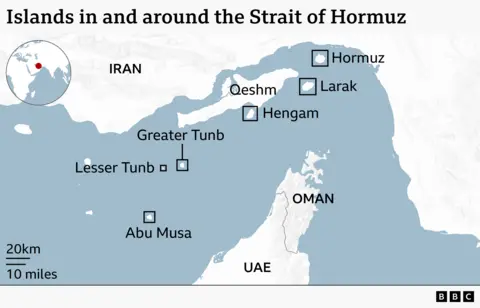
Explosions have been reported by Iranian state media in parts of the country’s south, including Sirik and Bandar Abbas – port cities on the Strait of Hormuz.
After the latest strikes, Trump said in a post on Truth Social: “This is in retribution for yesterday’s bombing of ships by Iran. If it happens again, it will get much worse!”
Iran has not yet commented, but senior officials earlier warned any attack from the US would be met with an “immediate response”.
US Central Command (Centcom) said the strikes were carried out to “further degrade Tehran’s ability to threaten freedom of navigation” in the vital waterway.
In a statement it added: “The United States is holding Iran accountable for recent unjustified aggression against commercial shipping and civilian crews freely navigating a vital international waterway.”
Several explosions have also reportedly been heard in other parts of the Iranian coast, including the cities of Konarak and Chabahar.
Iranian state TV reported eight explosions in Bandar Abbas, and said two missiles had hit the ports of both Sirik and Jask – also in southern Iran.
It added that two projectiles hit the island of Abu Musa, which has been the subject of a longstanding ownership dispute between Iran and the United Arab Emirates.
Air defence systems have been activated in Bandar Abbas, according to reports in Iranian state media.
The extent of damage from the US strikes is not yet known, but Iranian media has reported power cuts in Chabahar and a fire at an Islamic Revolutionary Guard Corps (IRGC) barracks in Bushehr.
Two of three power lines cut off in Chabahar had been restored quickly and a third would be operational soon, the Iranian Students’ News Agency said.
On Tuesday, the US military said it had launched “powerful” strikes in response to attacks on three tankers in the strait.
On Wednesday, Iran said it targeted US military sites in Bahrain and Kuwait in retaliation.
Tuesday into Wednesday saw the worst exchange of strikes between the US and Iran since the deal – known as a memorandum of understanding (MoU) – was signed on 17 June.
Trump said on Wednesday that the ceasefire agreement signed last month with Iran is “over”, and added the US “hit them very
hard last night” and will “probably hit them hard again tonight”.
In response, Iran’s Foreign Minister Abbas Araghchi said in a post on X: “We do not answer vulgarity with vulgarity, but with action: fearlessly and with great valour.”
The deal between the US and Iran included 14 points, among them a 60-day period for a ceasefire during which negotiations should continue, the safe passage of vessels through the Strait of Hormuz and the US lifting sanctions on Iran.
The 60-day-period for negotiations is not yet up, but Trump has said he saw further talks as “a waste of time”.
These are not the first strikes since the MoU was signed.
The US launched a series of strikes on Iran on 26 June after an Iranian projectile hit a cargo ship in the Strait of Hormuz.
Further US strikes took place on 27 June, following an attack on a tanker. But later that month both sides had agreed to “stand down”.
Prison riots in Negombo have claimed 27 lives including those of seven officers and left more than 100 others injured. It is believed that a clash between a group of drug peddlers among inmates and those who opposed their illegal operations led to the deadly mayhem. A committee has been appointed to probe the violence.
The drug Mafia has flexed its muscles again. The government has embarked on an ambitious campaign to rid the country of narcotics, and rightly so. The ongoing nationwide drug bust deserves the fullest public cooperation. However, if the latest outbreak of prison violence is anything to go by, a special programme needs to be launched to root out the scourge of narcotics in prisons, where some corrupt officers are in league with drug dealers.
The mastermind behind the Negombo Prison riots has been identified. He is an associate of a powerful drug dealer, according to media reports. The netherworld of narcotics and crime has emerged so powerful that it can plunge the country’s prison system into utter chaos at will. Worse, in 2023, an underworld gang planned a commando-style operation to free a drug dealer, called Nadun Chinthaka alias Harak Kata, detained at the CID headquarters. The STF managed to scuttle their plan. We reported that the gang had enrolled some serving military personnel and a sniper for the attack to spring its leader free. Another drug leader had High Court Judge Sarath Ambepitiya and his MSD bodyguard Inspector Upali Ranasinghe gunned down in late 2004. An underworld gang attacked a prison bus in Kalutara, killing five of its rivals and two prison guards, in 2017. Successive governments have only made half-hearted attempts to neutralise powerful crime syndicates run by drug dealers.
It is puzzling why the prison authorities did not transfer all troublemakers responsible for Sunday’s clash in Negombo to other prisons, after bringing the situation under control. On Monday morning, they gave the all-clear. It was the calm before the storm; violence erupted again soon afterwards. There was a total intelligence failure. If the rioters had been sent to other prisons on Sunday itself, Monday’s violence could have been averted.
Sadly, incidents of prison violence lead to political clashes between the government and the Opposition. There have been several deadly riots in prisons during the past several decades. In 1983, about 50 Tamil prisoners were massacred inside the Welikada Prison in two separate attacks. In the same prison, 27 inmates were killed in 2012 during a riot that followed a search operation conducted by the STF for weapons, drugs and mobile phones. In 2020, violent clashes in the Mahara Prison left 11 inmates dead. All those incidents triggered political battles, with Opposition politicians flaying their ruling party counterparts for failure to ensure the safety of prisoners. If they had put their heads together and taken action to eliminate the root causes of prison unrest and violence, instead of fighting political battles, perhaps the Negombo prison riots would not have occurred.
There have been some half-hearted attempts at prison reforms under successive governments. But the structural problems in Sri Lanka’s prison system remain unresolved. They include overcrowding, delays in court proceedings, gang rivalries, drug peddling, inadequate facilities, corruption and difficulties in maintaining security in large custodial institutions. The Negombo prison is reported to have been experiencing a shortage of officers. These issues have to be resolved urgently as part of a multi-pronged strategy to make prisons safe. Rhetoric won’t do.
Following the Mahara prison violence in 2020, President Anura Kaumara Dissanayake, who was an Opposition firebrand at that time, went ballistic in Parliament, condemning the then SLPP government for its failure to protect prisoners. A video of his fiery speech is doing the rounds in the digital realm. It has become grist for the Opposition’s mill.
Opposition politicians are now doing what the JVP did in the past; they are tearing into the JVP-NPP government over the Negombo prison violence. But prisons will not be any less vulnerable to violence even if the holders of power change; those who are berating the current administration may find themselves in the dock one day if they form a government.
The Cabinet of Ministers approved the resolution furnished by the Minister of Women and Child Affairs to appoint Ms. U. L. Mathisha Jinanjalie Jayathilake, the officer in Grade I of Sri Lanka Administrative Service to the post of the Commissioner at the Department of Probation and Child Protection Services with immediate effect.
Argentina staged a stunning comeback from 2-0 down to avoid a shocking exit at the hands of Egypt and prolong Lionel Messi’s World Cup career with a 3-2 win to reach the quarterfinals.
The holders looked down and out on Tuesday when goals from Yasser Ibrahim and Mostafa Ziko, either side of Messi having a penalty saved, put the Pharaohs in sight of a historic victory in Atlanta.
However, Cristian Romero’s header sparked the comeback as Argentina struck three times in the final 11 minutes plus stoppage time.
Messi smashed home the equaliser to score for a ninth consecutive World Cup game and retake the lead for the Golden Boot with eight this tournament.
Enzo Fernandez completed the turnaround with a superb header two minutes into stoppage time.
At the end, Messi shed tears of joy as he embraced his teammates.
Egypt were left furious after a number of controversial calls went against them, including a disallowed goal early in the second half, and a member of their coaching staff was red-carded in the aftermath of the winning goal.
But despite a second almighty scare against African opposition, Argentina will face either Colombia or Switzerland in the last eight on Saturday.
Lionel Scaloni attempted to refresh a side that looked dead on their feet in the closing stages of a 3-2 win over Cape Verde in the last 32 on Friday.
Nicolas Tagliafico, Leandro Paredes and Julian Alvarez came in from the team that started in Miami, but Argentina got off to another slow start.
Marwan Attia’s deep cross to the back post was powered home by Yasser.
Argentina had the chance to level five minutes later when Tagliafico was wiped out by Haissem Hassan inside the box.
However, there was another chapter to Messi’s misery from the penalty spot at World Cups.
The eight-time Ballon d’Or’s strike was tentative, and Mostafa Shobeir flew to his left to save, meaning Messi has now missed four of his eight non-shootout penalties at World Cups. He also became the first player to miss two in a single tournament, having also failed to hit the target against Austria in the group stages.
Messi reacts after missing a chance to score [Aljazeera]
The penalty save was just the start of Shobeir’s inspired afternoon.
Alexis Mac Allister’s powerful header from point-blank range was next to be parried by the Al Ahly stopper.
Shobeir then produced one of the saves of the tournament to prevent Alvarez’s shot finding the bottom corner.
Egypt thought they had doubled their lead on the hour mark after a brilliant counterattack.
Mohamed Salah played in Mostafa Ziko, who dinked the ball perfectly over the onrushing Emi Martinez.
However, Egyptian celebrations were cut short by a hugely controversial VAR intervention for a foul on Lisandro Martinez, just outside the Egypt box, at the start of the buildup to the goal.
The decision finally fired up the majority Argentinian crowd, but they were silenced once more moments later by another blistering Egyptian break.
Zico celebrates scoring Egypt’s second goal [Aljazzera]
Salah again led the charge before feeding Hassan, and his cross was swept in by Zico.
Argentina looked like a beaten side with Messi among those whose head was bowed during the second-half drinks break.
Yet Romero’s header – that Shobeir just failed to keep out – sparked a remarkable revival as the defending champions hauled themselves off the canvas.
Moments later a dazzling run by Messi teed up Lautaro Martinez, who headed just wide and Messi was to have his moment of redemption seven minutes from time.
Gonzalo Montiel fed the ball back for his captain to strike sweetly on the half volley.
Shobeir again got a touch but could not keep it out as the ball cannoned in off the bar for Messi’s 21st World Cup goal.
Then Fernandez’s bullet header from Lautaro Martinez’s cross completed the fightback, and Argentina’s relief was on full display after the final whistle.
Scaloni gave a very brief interview to reporters after the match.
Six-time champions Sri Lanka are leaving no stone unturned in their bid to regain the Asian Netball Championship title when they travel to Hong Kong next month.
Asia’s premier netball tournament will be held from August 7 to 16 at the Kai Tak Sports Park. As part of their preparations, the selected Sri Lankan squad is currently engaged in a four-leg Netball Exposure Series against New Zealand’s Lincoln University team.
The visitors won the opening leg in Galle, while Sri Lanka bounced back in Kandy with a thrilling 56-55 victory after edging a closely contested encounter. The remaining matches will be played in Kelaniya and Colombo before the series concludes on July 9.
The Netball Federation of Sri Lanka and the Ministry of Sports, the organisers of the Exposure Series, believe the high-intensity matches against strong international opposition will provide valuable preparation ahead of the continental championship.
The Asian Championship carries added significance as it also serves as Asia’s qualifying tournament for the 2027 Netball World Cup, with the top two teams securing places at the global showpiece.
Sri Lanka team in action during the series against Lincoln University team in Galle.
Sri Lanka remain the most successful nation in the history of the Asian Netball Championship, having won six titles since the inaugural tournament in 1985. The Lankans have also displayed remarkable consistency, finishing among the top three in every edition of the tournament. Their most recent campaign ended in heartbreak when they lost a thrilling 67-64 final to defending champions Singapore in 2024.
The 2026 squad will be led by experienced captain Thisala Algama, with the selectors combining seasoned campaigners and exciting young talent in their quest to reclaim the Asian crown.
With several experienced players retained from the 2024 runners-up squad and a number of promising youngsters added to the mix, Sri Lanka will be aiming to mount another strong title challenge. However, they are expected to face stiff competition from defending champions Singapore, Malaysia, hosts Hong Kong and the other leading Asian nations.
Backed by a proud tradition and an outstanding record on the continental stage, Sri Lanka will be hoping to capture a record-extending seventh Asian title and reaffirm their status as one of Asia’s netball powerhouses. (RF)
President Anura Kumara Dissanayake’s recent attempt in Parliament to defuse the ongoing controversy over his government’s plan to extend the retirement ages of the judges of the Supreme Court (SC) and the Court of Appeal (CA) has been in vain. He spoke at length, offering excuses for his failure to initiate action to fill judicial vacancies, but they did not sound convincing. They have only prompted the Bar Association of Sri Lanka (BASL) and other lawyers’ associations to reiterate their opposition to the prospect of a constitutional amendment being moved to raise the retirement ages of the SC and CA judges.
Addressing a public forum, on Saturday, BASL President Rajeev Amarasuriya reiterated his association’s opposition to the proposed move to change the SC and CA judges’ retirement ages arbitrarily. The BASL’s position has been endorsed by several legal associations, including the Colombo Law Society, the Colombo High Court Lawyers’ Association (CHCLA), LAWASIA, and the Commonwealth Lawyers’ Association (CLA).
CLA President Steven Thiru has gone to the extent of warning that Sri Lanka risks repeating Zimbabwe’s judicial crisis if it goes ahead with its controversial plan to extend the retirement ages of sitting superior court judges arbitrarily. Stating that the CLA did not object to the extension of the mandatory retirement age of judges, given changing demographic realities, Thiru pointed out that the danger lay in the politicised context and particularised application of the proposed move by the sitting executive and the legislature to alter the tenure of a few judges. He stated that Sri Lankan leaders had to heed “the sobering lesson of the Zimbabwean crisis; when a ruling government alters the rules of judicial longevity mid-stream, the damage to the legal fabric is severe. “If Sri Lanka proceeds with an ad hoc, non-transparent extension of Superior Court judges’ tenure without a broad consultative process, it risks plunging its legal system into a similar crisis of legitimacy,” he warned, noting that a structural policy matter must not be perceived as a personalised intervention; to do so would fundamentally invite public cynicism, compromise the appearance of judicial neutrality and shatter the very institutional stability that is to be protected.”
It is hoped that the JVP-NPP government will heed the concerns of lawyers’ associations, abandon its plan at issue and ensure that constitutional reforms follow proper consultation, without undermining judicial independence or public confidence in the judiciary. The JVP/NPP came to power promising a new Constitution and not politically motivated piecemeal constitutional amendments. It said in its election manifesto, inter alia, “A new constitution will be drafted and passed through a referendum with necessary changes, if any, after going through a public discourse” (A Thriving Nation: A Beautiful Life, 2024, p. 109).
As the CHCLA, in a letter to President Dissanayake, has rightly pointed out, “the Judicial Service of Sri Lanka is constituted by officers who ascend through a rigorous hierarchy … This progression is not merely a career ambition; it is a legitimate expectation, recognised and protected by the principles of natural justice and the law governing public service. Officers of the Judicial Service plan their professional and personal lives around the reasonable anticipation of such advancement.” The CHCLA’s views deserve serious consideration.
Meanwhile, Chief Justice Preethi Padman Surasena, addressing a group of newly recruited Magistrates, at Sri Lanka Judges’ Institute, recently, stressed the need for judicial officers to do their best to preserve public confidence in the judiciary. A country could be destroyed by a bad judiciary in the same way it could be devastated by natural disasters, the Chief Justice said, stressing the need to safeguard the integrity, independence and dignity of the judiciary. His message was loud and clear.
However, some factors that erode public confidence in the judiciary are beyond the control of judges. The alleged government move to extend the retirement ages of the judges of the SC and the CA is a case in point. It is widely seen as an instance of political interference with the judiciary. One can only hope that the Sr Lankan legal fraternity and international lawyers’ associations will be able to knock some sense into the JVP-NPP government, and prevent this country from facing the same fate as Zimbabwe, where a serious constitutional crisis erupted in 2021, when its Constitution was arbitrarily amended to change the judges’ retirement ages. That issue raised broader concerns about the separation of powers and judicial independence. The constitutional amendment undermined public confidence in courts and amounted to political interference with the judiciary. Another crisis is the last thing Sri Lanka needs at this juncture.