Sunday, November 30, 2025

Red alert as Cyclone Ditwah nears Tamil Nadu coast

The India Meteorological Department (IMD) yesterday issued a red warning for north Tamil Nadu, Puducherry and adjoining south Andhra Pradesh coasts in the wake of Cyclone Ditwah. The weather agency has predicted that Cyclone Ditwah is very likely to continue to move north-northwestwards and reach over southwest Bay of Bengal near North Tamil Nadu, Puducherry and adjoining south Andhra Pradesh coasts by early morning today (01).

According to the India Met Department, while moving north-northwestwards, the cyclonic storm will be centred over the southwest Bay of Bengal within a minimum distance of 60 kilometres from the Tamil Nadu coastline by midnight tonight.

Meanwhile, IMD has forecast heavy rainfall, isolated extremely heavy rainfalls over Tamil Nadu till today (01). Heavy to very heavy rainfall is likely to prevail over Coastal Andhra Pradesh, Yanam and Rayalaseema till Monday. The Met Department has advised fishermen not to venture into the coastal areas of Sri Lanka, Tamil Nadu, Puducherry and the south Andhra Pradesh coasts till Monday.


from The Island https://ift.tt/lXniodV

Saturday, November 29, 2025

Working in Multitudes: Rediscovering Martin Wickramasinghe

It was on the day before his birthday, in 2019, that I called Indunil.

“Here, are you free tomorrow? There’s a place I want to take you to.”

By Uditha devapriya

After finishing work the following day, I hired a tuktuk. Picking up Indunil, I proceeded to Kohuwela. There we stopped by the Keell’s building.I had not explained why we had come. As we got down from the tuktuk my friend gave me a bemused and puzzled stare. “Where are we going?”

I did not answer. We passed the Keell’s building. Soon he saw that my eyes were set on an old, decrepit building behind. It was the sort of building you never really noticed unless you strained your eyes. It did not just stand apart from the other buildings in the vicinity, it seemed to belong to an older period. It almost seemed on its way out.

We went up three flights of stairs. The closer we got to the top the more visible became its old and worn-out state. There seemed to be no soul in the building. Pigeons had made it their lair. One could see their droppings in every corner: stretches of white across old red polished floors. Hardly the sort of surprise for one’s 18th birthday.

This was the office and location of the old Tisara Bookshop. I did not tell Indunil until we reached the top floor. There, in a warehouse that had once served as one of the most sought after and popular book stores in the country, lay tons and tons, volumes and volumes, of reprints and old editions of books from a totally different era.

I beamed at him as he stared at the collection.

“Pick whatever you want,” I said, “and happy birthday.”

I had come here a week or so before in search of Vito Perniola’s 14-volume history of the Catholic Church in Sri Lanka. I had got what I wanted but had fallen into conversation with the lady who was more or less running the show here. Through her I had got to know that, at its peak years ago, Tisara had published reprints of old titles, all the way from Robert Knox to Leonard Woolf and beyond. I could see Woolf’s Diaries in Ceylon, Knox’s An Account of Ceylon, Antony Bertolacci’s A View of the Agricultural, Commercial, and Financial Interests of Ceylon, along with John Davy and Emerson Tennent. I had heard of these books as a child; seeing them in front of me, I could not resist buying and reading them.

But it was not after any of these writers that I was here. I noticed Indunil gaping at the whole collection. He seemed too lost for words. At the time I had money on my hands and I told him he could buy whatever he wanted, and however much he wanted. Then I pointed him out to the author and the books I specifically liked him to check out.

Unlike me, Indunil had been completely educated in Sinhala. He hence had a much greater awareness, knowledge, and appreciation of Sinhala literature. Yet as he pored over the titles and saw the name of their author, he became very surprised.

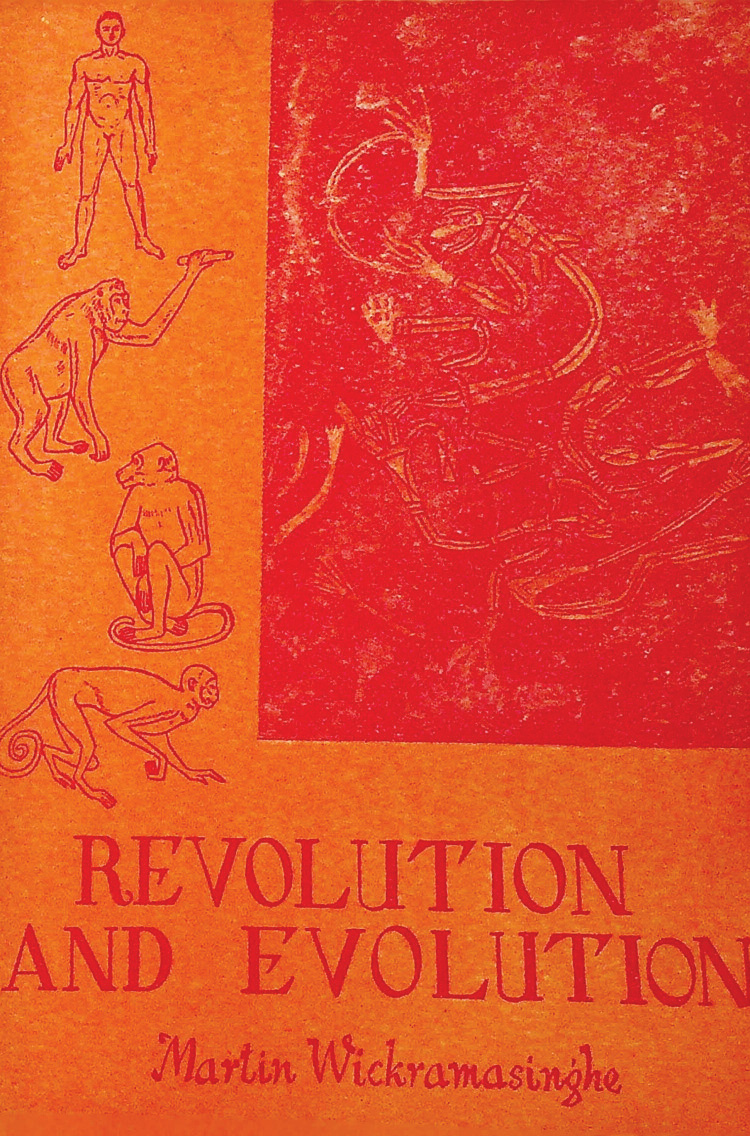
Revolution and Evolution. Courtesy Martin Wickramasinghe Trust

“I thought Martin Wickramasinghe only wrote novels,” he confessed to me after we had bought a ton or so of books – all at very low prices – and went downstairs.

I smiled. I had discovered Wickramasinghe just a few years earlier, but not through his fiction. “He was much more than a novelist,” I replied.

Indunil agreed. He must have had a bagful of books with him. He proceeded to read them a few days later. The last time I checked, which was around two weeks ago, he still had those books: some at his village home, some in his boarding place, a few scattered here and there at the many places he had stayed in after his A Levels in 2021.

Among the books I bought for Indunil that day was a large collection of Wickramasinghe’s English-language essays. These in turn had been collated from four essay collections that had been printed before, including Aspects of Sinhalese Culture, Buddhism and Culture, Sinhala Language and Culture, and his last anthology of English-language essays, Buddhism and Art. Having bought a copy a week or so before, I had become engrossed in these writings: not so much over what they had to say on their subjects as what they revealed about their author and his attitudes, his beliefs and his biases.

I discovered Martin Wickramasinghe, as I wrote before, somewhat late in life. Because of this I read his non-fiction before I read his novels. Much of his writings on art, culture, and history engrossed me, mostly owing to how he approached these subjects. Eventually, when I got around reading his Sinhala-language essays, I found the same attitudes, the very same world-view, in them. These writings easily made him a leading contrarian thinker, perhaps the pre-eminent public intellectual of his day in Sri Lanka.

But as Indunil noted for me more than once, among most Sri Lankans he remained, at best, a novelist, the author of Madol Doowa, Gamperaliya, and Viragaya. Landmarks though these works doubtless are, they offer only glimpses into a highly original if provocative mind. The novel is still one of the most enduring literary genres out there. Though it was at an incipient stage in Sri Lanka when Wickramasinghe began his writing career, he quickly raised the stature of the genre in the country, carrying forward the work of such predecessors as Piyadasa Sirisena and W. A. Silva. It is perhaps this that explains why we focus on his career as a novelist so much that we overlook his contributions as a critic.

My reading of Wickramasinghe did not begin in 2019. I had come across him before as a child, even if sporadically. But reading his essays in a fresh light, I realised there was more to him to discover. Like Chekhov, Tolstoy, Andre Gide, and the other novelists he read and was influenced by, Martin Wickramasinghe did not stand idly by a corner as history moved on. He commented on all the raging topics of the day and was not afraid of identifying himself on this or that side of the spectrum. I knew that the task of rediscovering him would have to be undertaken someday, and that Wickramasinghe’s work deserved no less.

What I did not know is that Indunil and I would be brought together in this task. I had met and been introduced to him in 2018. Back then he was barely 17 years. How I met him, in what circumstances, and how things evolved from there are for another day. What is important is that, from the first day, I discerned in him an almost insatiable interest in art, culture, history – and more than anything, literature and poetry.

Sinhala Lakuna (Courtesy Martin Wickramasinghe Trust)

Like most of his friends who had introduced me to him, Indunil was a product of a world outside Colombo. Born in Kurunegala, near Wariyapola, in 2001, the son of a principal and a local government officer, he was initially educated at the local government school. In 2011 he appeared at the Grade V Scholarship Exam. Being the son of a principal meant that he got the resources he needed from home for the test. As it turned out, Indunil not just passed it but secured enough marks to enter a better school.

The following year he entered Royal College. Boarded as a hosteller – like most of his friends whom I would meet before him – Indunil found himself adapting to a different culture. From early on at Royal, he displayed an interest in art, culture, and literature. At home he had come across and read newspapers and magazines which dwelt on these topics. At Royal he began making friends with people who fuelled his interests more. Through them, he made his way to various clubs. By the time Indunil sat for his O Level Exams, he had settled in the Sinhala Dramatic Society. One of the most distinguished clubs at Royal, the Sinhala Dramatic Society encouraged him to discover his talents in performance art. Meanwhile, from Hostel Prefect to Steward to Senior Prefect, he coveted and claimed all the top leadership positions at school, the highest honours a student could claim at Royal.

By the time I met him Indunil was about to become a Steward. We connected on and off thereafter, attending public discussions and engaging each other on the topics which interested us. Then I met him after he left school, when he became Prefect in 2021: the year after Covid-19 began to spread across Sri Lanka. Somewhere towards the end of that year, when the country was slowly getting used to the pandemic, we met at the Race Course, where he was doing the rounds in his school prefect duties. Taking a small break, we ate a light lunch before thinking of the future. Indunil was doing his A Levels again, and he suggested that someday, we get together and engage in a research project.

I did not then see how this was possible. I was unemployed at the time, writing on and off to newspapers. He, too, did not have many bright prospects before him. Yet in 2024, three years later, we began working on a project on Martin Wickramasinghe. How we wound up doing this project is, again, for another essay and time.

I decided on the parameters of the research before I got in touch with Indunil. For too long, Wickramasinghe had been limited to bookshelves and book fairs, his reputation resting on the Koggala Trilogy – Gamperaliya, Kaliyugaya, Yuganthaya – and Viragaya, and a few short stories. I felt, for better or worse, that we needed to focus on his non-fiction, including but not limited to his writings on science and evolution, and that these writings would offer us a glimpse into the way he thought as a novelist, critic, and journalist.

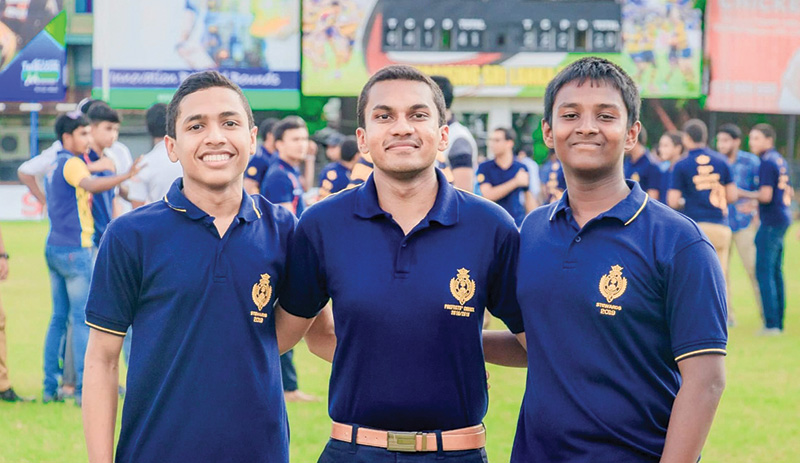
Serving as a Steward, 2019, left

I felt the timing could not have been more suitable. The year 2025 marked Wickramasinghe’s 135th birth anniversary, while 2026, the next year, would mark his 50th death anniversary. Initially we thought of two short books. Then we hit upon the idea of a large, comprehensive study, delving not so much into Wickramasinghe’s writing as the social, culture, and political context within which he evolved. Taking as the main – though not the sole – source, his two memoirs, Upan Da Sita and Ape Gama, we explored the manuscripts, the letters and correspondences, belonging to Wickramasinghe. We also explored his personal book collection at the National Library. In all this, we were and continue to be helped, and guided, by the Martin Wickramasinghe Trust at Nawala.

Where has this research led me, and led us? Last week I was in New Delhi, where I delivered on 20 November a lecture on Wickramasinghe, framing him as a South Asian modernist different to his contemporaries in Sri Lanka. The week before I delivered a webinar on the man and his writings for SOAS. The following week, on 27 November, we headed another lecture at Lakmahal. These will be followed by a lecture at the Social Scientists’ Association on 10 December, and several other presentations elsewhere.

Indunil is now in university. He has progressed well, somewhat different to the impudent, mischievous boy I came across seven years ago. Yet he remains as sharp-minded (and sharp-tongued) as he always was, keen and devoted to whatever subjects take his fancy. To a large extent, he and his friends were responsible, in those early years, for anchoring me in the culture and society of my country – in the ways of seeing and thinking there. I think I have dwelt on this in countless articles elsewhere, so I will not repeat it here.

Meanwhile, as I keep reading Wickramasinghe, I remain mindful of the different worlds his writings have opened us to. I believe Whitman’s line sums him up well: like the American poet, he worked in multitudes. As Indunil and I continue in our research, we are conscious of how big a thinker he was, and how much more about him we have yet to discover.

(Uditha Devapriya is a writer, researcher, and analyst whose work spans a range of topics, including art, culture, history, geopolitics, and anthropology. At present he is working on a study of Martin Wickramasinghe. He can be reached at udakdev1@gmail.com.)


from The Island https://ift.tt/uzmpY7C

Friday, November 28, 2025

Share market fervour soars over rampaging flood waters

The business sentiment and confidence among investors were visible yesterday at the CSE despite there being an emergency situation in the country stemming from the weather havoc.

Share trading lasted only three hours, yesterday being a public holiday owing to the adverse weather. Moreover business networking and connectivity issues occurred.

Amid those developments both indices moved upwards. The All Share Price Index up by 50.73 points while the S and P SL20 rose by 10.12 points. Turnover stood at Rs 1.94 billion with three crossings.

Those crossings were reported in JKH where 3.4 million shares crossed to the tune of Rs 75 million; its shares traded at Rs 22, DIMO 35000 shares crossed for Rs 73.5 million; its shares traded at Rs 2100 and Sampath Bank 175,000 shares crossed for Rs 25.4 million; its shares traded at Rs 145.

In the retail market companies that mainly contributed to the turnover were; JKH Rs 209 million (9.5 million shares traded), Dialog Axiata Rs 163 million (5.7 million shares traded), Colombo Dockyard Rs 125 million (279,000 shares traded), Access Engineering Rs 81 million (1.15 million shares traded), SLT Rs 54 million (133,000 shares traded), CW Macky Rs 45.1 million (287,000 shares traded) and Commercial Bank Rs 41 million (198,000 shares traded). During the day 63.2 million share volumes changed hands in 16279 transactions.

It is said that manufacturing sector counters, especially JKH, led the market while the banking sector, especially Commercial Bank, played an important role at the floor. The Telecommunications and motor vehicle sectors also actively participated in the market.

Yesterday the rupee was quoted at Rs 307.90/308.20 to the US dollar in the spot market, weaker from Rs 308.05/15 the previous day, dealers said, while bond yields remained steady.

Details are as follows:

A bond maturing on 15.03.2028 was quoted at 9.05/13 percent.

A bond maturing on 15.12.2028 was quoted at 9.15/25 percent.

A bond maturing on 15.06.2029 was quoted at 9.45/53 percent.

A bond maturing on 15.09.2029 was quoted at 9.50/57 percent, up from 9.50/55 percent.

A bond maturing on 15.10.2029 was quoted at 9.50/60 percent.

A bond maturing on 01.07.2030 was quoted at 9.55/60 percent, down from 9.59/64 percent.

A bond maturing on 15.03.2031 was quoted at 9.90/95 percent.

Meanwhile, a bond maturing on 15.12.2032 was quoted flat at 10.23/30 percent.

By Hiran H Senewiratne


from The Island https://ift.tt/aYBtVPp

Thursday, November 27, 2025

Peace Corps returns North: 23 new volunteers sworn in

US Ambassador Julie Chung joined Peace Corps Sri Lanka Country Director Jeffrey Goveia in Vavuniya today to administer the Pledge of Service to twenty-three new Peace Corps Volunteers.  Nimali Baduraliya, Director of English and Foreign Languages at the Ministry of Education, Higher Education, and Vocational Education, also attended the ceremony. The event marked a major milestone for the US Peace Corps as the incoming Volunteers begin their two-year assignments supporting English language education across Sri Lanka, expanding Peace Corps’ presence beyond existing placements in the Uva and Central Provinces into communities in the Northern and North Central Provinces for the first time in decades.

In her virtual remarks, Ambassador Chung highlighted the spirit of service and the people-to-people ties at the heart of the US–Sri Lanka partnership. “Today we celebrate service, partnership, and the enduring friendship between the people of Sri Lanka and the United States. Since 1962, nearly six hundred Peace Corps Volunteers have served here, creating a living bridge between our nations. As English Volunteers, you will help open doors to education and opportunity. And by learning Sinhala or Tamil and participating in community life, you honor the people you will serve…You represent the United States not as officials, but as lower-case ‘a’ ambassadors of the American people. The kindness you show, the curiosity you bring, and the respect you offer will speak more loudly than any policy ever could. You embody the best of our country’s spirit — a belief that the world is stronger when we serve beside our friends.”

Prime Minister Dr. Harini Amarasuriya, who also serves as Minister of Education, Higher Education, and Vocational Education, welcomed the Volunteers, through a prepared statement that was delivered on her behalf by Nimali Baduraliya, and recognized their contribution to strengthening English language learning across Sri Lanka. “I extend my congratulations and gratitude to the new batch of 23 United States Peace Corps Volunteers who are being sworn in today and beginning their two year service in Sri Lanka to strengthen English language education in Sri Lanka, Your decision to dedicate your time and skills and compassion to our communities is deeply appreciated by the Government and the people of Sri Lanka.”

Peace Corps Sri Lanka Country Director Jeffrey Goveia emphasized the strength and continuity of the partnership with the Ministry. “Peace Corps’ partnership with the Ministry is the foundation that makes our work possible, and we are grateful for the Ministry’s long-standing collaboration. We are here at the Ministry’s invitation and aligned with its commitment to strengthen English language learning across Sri Lanka. The Pledge of Service reflects that shared purpose. Our Volunteers serve not as experts, but as partners—working shoulder-to-shoulder with teachers, students, and communities to support the Ministry’s goals and contribute to the country’s ongoing investment in education.”

As part of their 12-week pre-service training, the Volunteers studied Sinhala or Tamil to help them navigate daily life and settle into the communities where they will serve. Their training also included cross-cultural workshops, classroom preparation, and hands-on teaching practice at local schools near Vavuniya. Peace Corps Volunteers are also strengthening English education across Sri Lanka by leading school-break English camps and partnering with Regional English Support Centers to train teachers and develop new tools that will benefit classrooms for years to come.

Following the ceremony, the newly sworn-in Volunteers will travel to schools across the Northern and North Central Provinces, expanding Peace Corps’ geographic footprint and deepening its engagement with Sri Lankan communities. Over the next two years, they will co-teach English alongside Sri Lankan educators, participate in community life, and support locally led education initiatives.

Nearly 600 Americans have served as Peace Corps Volunteers in Sri Lanka. The new cohort will join those already serving in the Uva and Central Provinces, bringing the total number of Volunteers supporting English language education and people-to-people connections to 53 nationwide. Peace Corps departed Sri Lanka in 1998 and was invited to return in 2016, resuming operations in 2018 under a renewed partnership with the Ministry of Education.


from The Island https://ift.tt/HDxwoFI

Trump accused of slowing down as health speculation mounts: 'he's different'


News anchor Katy Tur has commented on reports of President Donald Trump's apparent cognitive and physical health decline following a New York Times analysis

from Daily Express :: US Feed https://ift.tt/eODyI5E

Wednesday, November 26, 2025

Graduates will be recruited to fill government vacancies through a structured process based on recommendations of the Carder Management Committee – PM

Prime Minister Dr. Harini Amarasuriya stated that, with Cabinet approval based on the review of the public service recruitment process and the recommendations of the Carder Management Committee, graduates will be recruited to government vacancies through a structured process in the near future.

The Prime Minister made these remarks in Parliament on 26th of November , in response to a question raised by the Leader of the Opposition, MP Sajith Premadasa.

The Prime Minister further stated,

“The current number of unemployed individuals in Sri Lanka stands at 360,951. The Government has initiated a series of short-, medium-, and long-term measures to address the issue of unemployment.

Accordingly, as a macro-economic target for the coming years, the Government expects to reduce unemployment rates to 4.4% in 2025, and further to 4.2% in both 2026 and 2027.

The Prime Minister further noted that the Government has developed a recruitment plan to provide job opportunities to 35,000–40,000 graduates, recruiting them to vacant positions in the public sector through systematic mechanisms, subjecting to Cabinet approval, and based on the recommendations of the Carder Management Committee.

The recruitment of 25,000 graduates to Grade 3-I (a) of the Sri Lanka Teachers’ Service will be initiated as soon as the final determination of the ongoing Court of Appeal case is officially issued. The Government will take necessary steps to provide employment to 37,000 graduates.

[Prime Minister’s Media Division]


from The Island https://ift.tt/p87RLfW

Foreign warships arrive in Sri Lanka to take part in International Fleet Review 2025

In a display of naval cooperation, three warships representing Bangladesh and India made port calls in Colombo on 25 and 26 November, for the International Fleet Review (IFR) 2025,
scheduled to be held on 30 November.

The visiting ships were welcomed by the Sri Lanka Navy in accordance with time-honoured naval traditions.

The Sri Lanka Navy is hosting this  event in celebration of its proud 75th anniversary.

Warships from Iran, Malaysia, the Maldives, Pakistan, and Russia are also scheduled to arrive in the island to participate in the fleet review.

Among the ships that arrived in Colombo were BNS Prottoy (90.1m) from the Bangladesh Navy, commanded by Captain MD Touhidul Haque Bhuiyan.

From the Indian Navy, the Aircraft Carrier INS Vikrant (262.5m), commanded by Captain Ashok Rao, and INS Udaygiri (149.2m), commanded by Captain Vikas Sood, also arrived in port.

The IFR 2025 will be complemented by a series of cultural and community activities, including a beach clean-up initiative, sporting fixtures, a musical band performance, a food gala, and a city parade featuring foreign naval personnel.


from The Island https://ift.tt/2CwugHb

Tuesday, November 25, 2025

How CSE is designed to fail retail investors

Six Charges, 700% More Expensive:

Imagine walking into two shops selling the same product. In the first shop, you pay a simple 0.6% fee. In the second shop, you’re hit with a bewildering array of charges from multiple entities, and by the time you’re done, you’ve paid 2.27%. And that’s for a complete transaction: buying and selling.

The Shocking Numbers

Sri Lanka loves to say it wants to “develop the capital market.” But the way we charge investors tells the real story – a story of policy confusion, fee-layering, and a system designed to favor big players while suffocating small retail investors.

The evidence isn’t hidden. It’s printed clearly in every contract note that brokers issue.

Think about what this means in real terms. If you’re a teacher, government servant, or small business owner investing Rs. 100,000 in shares, you’ll pay approximately Rs. 2,270 just to complete a buy-sell cycle in Sri Lanka. In New Zealand, that same transaction costs just Rs. 300.

Sri Lanka is nearly four times more expensive than New Zealand – for the exact same act of investing.

Death by a Thousand Cuts

The problem isn’t just the total amount – it’s the sheer complexity. While New Zealand streamlines everything into one clean charge, Sri Lankan investors face a labyrinth:

*  Brokerage (negotiable, but only if you’re wealthy)

SEC Fee (Security Exchange Commission)

*  CSE Fee (Colombo Stock Exchange)

CDS Fee (Central Depository Systems fees)

*  STL (Share Transaction Levy)

Clearing Fee

*  Foreign Brokerage for foreign transactions

*  Various “special fees” are added periodically

Sri Lanka’s stock trading contract note reads like a mini-budget speech (Figure 1). Meanwhile, most modern markets charge one number. For an ordinary person trying to understand their contract note, it’s nearly impossible to figure out what they’re actually paying and why. Figures 2 and 3 show the stock trading “Sell” contract notes for a New Zealand Stock Exchange transaction and an Australian Stock Exchange transaction, (“Buy” contracts are similar) respectively.

The Rich Get Richer – By Design

Here’s where it gets truly disturbing. While small investors are locked into these punishing charges, the CSE allows brokers to negotiate lower fees for large transactions – typically those exceeding Rs. 100 million.

Let that sink in: If you’re a retail investor putting in your life savings of Rs. 500,000, you pay the full 2.27%. But if you’re moving Rs. 100 million, you get a discount.

This isn’t just unfair – it’s a systematic transfer of wealth from small investors to large players. The very people who need protection are subsidising the fees for those who need it least.

In modern markets like India, New Zealand, Canada, and Japan, all investors pay the same percentage. No negotiation. No special deals behind closed doors.

The Market Manipulation Connection

This two-tier system has darker implications. Large players, already enjoying preferential fee structures, have repeatedly been caught manipulating the market. The Securities and Exchange Commission has filed numerous cases against major investors for price manipulation, insider trading, and other violations.

These large players can:

*  Move in and out of stocks quickly due to lower transaction costs

*  Manipulate prices knowing small investors can’t react fast enough (their costs are too high)

*  Accumulate positions while retail investors are trapped by the fear of paying 2.27% round-trip costs

Sri Lanka’s fee structure encourages large speculative swings, discourages genuine retail participation, creates an uneven playing field, and opens doors for manipulation and cornering of illiquid stocks.

The Ethical Bankruptcy of Regulatory Charges

Let’s call this what it is: regulatory authorities charging fees that actively harm the market they’re supposed to develop are ethically bankrupt. In most countries, regulators protect investors. In Sri Lanka, they bill investors. Every trade finance the regulator (SEC), the exchange operator (CSE), the clearing house (CDS), the broker, and the government (through VAT).

This is ethically questionable because:

Regulators must be neutral – not profit from transactions

Charging retail investors to fund regulation creates a conflict of interest

It reduces trust, especially after repeated market manipulation cases

When regulators impose charges that make it unprofitable for ordinary people to invest, they’re not protecting investors – they’re protecting their own revenue streams at the expense of market development. When exchanges allow discriminatory fee structures, they’re not creating a level playing field – they’re creating a rigged game.

Why Sri Lanka’s Market Cannot Grow

Sri Lanka keeps asking: “Why is liquidity so low? Why don’t more people invest? Why doesn’t the stock market support economic growth?” Based on my research, using AI tools, here’s a comprehensive comparison table of stock market participation across the countries we mentioned:

Sri Lanka stands out negatively. The CSE has 284 listed companies representing 20 business sectors. Despite having a population similar to Australia (22 million vs 26 million), Sri Lanka has an estimated 50-100 times fewer stock market participants.

According to the Central Depository Systems (CDS) Annual Report 2024 for the Colombo Stock Exchange (CSE), the total number of local account holders (traders/CDS holders) was approximately 706,864 in 2024, up from 693,415 in 2023. The number of foreign account holders was 11,082 in 2024 compared to 10,937 in 2023. This places the total number of traders around 718,000+ in 2023-2024.

Critical Implications

Sri Lanka’s stock market participation rate, estimated at a low 3-4%, starkly trails regional peers such as India, where participation hits 6-8%, roughly two to three times higher. This gap highlights a critical structural problem in the Colombo Stock Exchange (CSE) ecosystem, where high fees averaging 2.27% combined with low participation create a vicious cycle that severely impedes market development. The core issues are both systemic and strategic.

The Marketing Failure: A Stock Exchange That Doesn’t Want Customers

Unlike its counterparts globally, the CSE remains more akin to an exclusive club rather than an accessible retail investment platform.

Where India’s National Stock Exchange (NSE) partnered with fintech innovators to create user-friendly investment apps while the CSE’s outreach is limited to sporadic seminars mostly attended by brokers and affluent investors. The CSE doesn’t want millions of small investors; it wants thousands of large ones who won’t complain about the fees.

There are no robust nationwide campaigns demystifying investing, no telecom partnerships to penetrate rural markets, and the mobile apps are not intuitive and fail to simplify account opening processes as expected. The CSE’s web and social media presence remain outdated, and when India onboarded over 40 million retail investors in three years via aggressive digital marketing, Sri Lanka struggled to add even 40,000 investors. This is not accidental, but symptomatic of an institution that profits more from high fees on lower volumes than from a broad base of smaller investors. The system favors wealth extraction from a few large players while discouraging retail participation.

Bureaucratic Ossification: When Vision Dies in Committee Rooms

The CSE suffers from a stifling bureaucratic culture, trapped in colonial-era mindsets with fragmented decision-making authority dispersed over multiple regulatory bodies like the SEC, Central Bank, and ministries. Sri Lanka’s capital market leadership remains focused on maintaining the status quo, prioritizing regulatory compliance over innovation. Without a strategic vision to increase retail participation, possibly aiming for even a modest 10% target, the exchange risks remain a peripheral entity rather than a genuine engine of national wealth.

The disconnect between high market returns (close to 50% in 2024) and low investor participation underscores the urgent need for the CSE to radically change course from a fee-heavy, opaque, bureaucratic institution to a transparent, technology-enabled, investor-friendly market. Unless Sri Lanka’s capital market astrology embraces inclusive, technology-driven, and simplified structures combined with aggressive marketing and retail investor protection, it will continue to underperform relative to regional peers, hampering broader economic growth and wealth creation.

Marketing Malaise: How the CSE Misses the Retail Wave

There are no nationwide campaigns to demystify investing. No partnerships with firms like financial institutions and tertiary education establishments, such as universities, where eligible customers are abundant and to reach rural areas. When India added over 40 million new retail investors in just three years through aggressive digital outreach, Sri Lanka couldn’t add 40,000. This isn’t accidental – it’s the natural result of an institution that makes more money from high fees on low volumes than it would from low fees on high volumes.

Bureaucratic Ossification: When Vision Dies in Committee Rooms

The CSE’s administration suffers from a fatal combination: colonial-era bureaucratic mentality married to a complete absence of strategic vision. While global exchanges have transformed into technology-driven, investor-first platforms, the CSE remains trapped in a time warp protecting its turf and revenue streams. Decision-making moves at the speed of a government file, while markets move at the speed of light.

The result is an exchange governed by administrators rather than visionaries. When Singapore launched a comprehensive digital trading ecosystem, when India implemented T+1 settlement cycles, when New Zealand simplified its entire fee structure to one transparent charge, Sri Lanka’s was busy protecting the status quo. There’s no long-term strategic plan to achieve even 10% retail participation. No vision for how Sri Lanka’s capital market fits into the economy of 2030. The CSE operates like a government department completing its KPIs rather than a dynamic institution building national wealth. The entire ecosystem – from the SEC to CDS to brokers – protects a broken system because they all profit from it.

Whenever the question of low retail participation comes up, officials trot out the same tired excuses: lack of investor awareness,’ ‘risk appetite,’ budgetary constraints for promotions.’ What they never admit is the elephant in the room, Sri Lanka’s fee structure. Charging 2.27% in a fragmented, opaque system while allowing negotiated rates for the wealthy isn’t market design, it’s a wealth extraction scheme dressed in regulatory language (Figure 3).

Add to that a lethargic marketing approach for attracting a wider population. Instead of proactive campaigns, digital engagement, and investor education, the system relies on outdated methods that fail to inspire confidence. The result? A market that moves backward while global peers surge ahead.

Our regulatory authorities have created a system that achieves the exact opposite of what a stock market should do. Instead of encouraging saving and investment, we punish it. Instead of attracting retail participation, we drive small investors away. Instead of ensuring fairness, we let the rich negotiate better terms.

The Bottom Line

The Colombo Stock Exchange and its regulatory framework aren’t just failing small investors – they’re actively working against them. No stock market can flourish when fees punish participation and policy rewards big players while suffocating small ones.

If Sri Lanka wants a real capital market – not just a slogan – it must not only stop taxing retail investors to fund inefficiencies and start building a market that ordinary citizens can finally trust, but also, they should actively promote the retail participation with more promotional activities to reach them by making collaborations with relevant firms such as financial institutions and tertiary educational establishments, especially universities.

Until someone in authority has the courage to blow up this exploitative system and start fresh, ordinary Sri Lankans will continue to be better off keeping their money under the mattress.

(The writer, a senior Chartered Accountant and professional banker, is Professor at SLIIT, Malabe. The views and opinions expressed in this article are personal.)


from The Island https://ift.tt/XsPOfv4

Monday, November 24, 2025

Browns Agriculture strikes gold

Browns Agriculture was recently honoured with the prestigious Gold Award for “Glocal Brand of the Year” for its Browns SUMO WORLD Harvester at the SLIM Brand Excellence Awards 2025. Organised by the Sri Lanka Institute of Marketing (SLIM), the national body for marketing in Sri Lanka, the event is one of the country’s most respected platforms that celebrates outstanding brands, strategic excellence and impactful marketing leadership. Held at the Monarch Imperial, the ceremony recognised brands that continue to shape industries, communities and the national economy.

For over 100 years, Browns Agriculture has been at the forefront of mechanising Sri Lanka’s farming sector. This century-long legacy in agricultural innovation laid the foundation for the creation of the Browns Harvester, which today stands as the country’s number one harvester, commanding an impressive 73% share of the national market. Designed and customised specifically for Sri Lankan paddy fields, the Browns Harvester is engineered to endure local soil conditions, varying terrains and climatic challenges, making it the best fit for Sri Lankan cultivators seeking a reliable and high-performing solution.

Offering a fully mechanised range from 15 HP to 100 HP under two trusted brands, Browns SUMO WORLD and Browns Yanmar, the Harvester portfolio supports diverse crop systems across Sri Lanka. While paddy remains the core focus, these machines are also engineered to handle maize, sugarcane, and other crops, enabling scalability and diversification for farmers. Advanced monitoring systems track machine performance in real time, allowing remote maintenance adjustments and ensuring uninterrupted operation throughout the harvesting season.


from The Island https://ift.tt/FDtemWG

Trump postpones major healthcare appointment for an unexpected reason


Donald Trump reportedly cancelled a scheduled announcement after a journalist reported he was facing strong backlash

from Daily Express :: US Feed https://ift.tt/14KtOn6

Sunday, November 23, 2025

Review: Simon’s Thomia: For School and Country

THOMIA by Richard Simon. 2 Volumes, 81Chapters, 896 pages. Published by Lazari Press, Colombo (2025). Dedicated to the memory of his classmate, Richard de Zoysa.

James Chapman set sail for Ceylon from England in 1845, to become the first Anglican Bishop of Colombo. He was studying Sinhala on board the Malabar. Chapman was determined to embark on the greatest mission of his life, to create S.Thomas’ College, to resemble his alma mater Eton and his King’s College Cambridge.

Simon’s epic rendering spans two hundred years of British colonial Ceylon and post-independent Sri Lanka’s political history, told as “The entangled histories of Lanka and her greatest public school”.

This work creates a living atmosphere for events that influenced the greater British colonial process in Ceylon. In the author’s bid to intertwine the complex relationship of church and state of those times, he unravels fascinating socio-political insights of elite formation in Ceylon.

In 1851, opposite the Port of Colombo in Mutwal, forty-five boys drawn exclusively from the upper ranks of Ceylonese society sat for lessons in a Cadjan hut under a massive Banyan tree, and S.Thomas’ was founded.

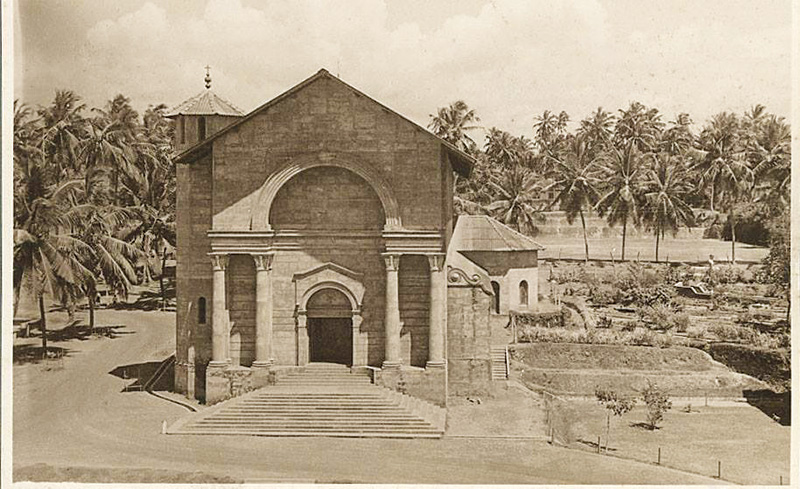
Chapel of the Transfiguration of Gothic architecture

They were taught Latin and Greek and English, fed on Etonian roast beef and plum pudding, and learnt to play cricket. Ceylonese who could afford it, were only too eager to educate their sons, after the manner of  the British upper classes.

The motto of the school was the same as Eton, Esto Perpetua, be thou forever.

 Despite the belief that the divinely ordained purpose of the empire was to bring Christian salvation to the ‘heathen’, just three years before the school was founded, in 1848 the Kandyan Sinhalese in the highlands had rebelled. They were asking the colonial government to uphold the Kandyan Convention to protect Buddhism.

Kandy was the last Sri Lankan kingdom to fall to the British in 1815, when the Kandyan Sinhala aristocracy betrayed the country’s last king, a minority Tamil to the British, and signed the Kandyan convention. The island became Ceylon, with English as its official language.

After the colonial government resumed custody of the sacred tooth relic of the Buddha, and supposedly supported the protection of Buddhism under the Kandyan Convention, English Christian clergy protested the “re-connection of the British government with Buddhist idolatry”. Bishop Chapman distanced himself from his clergy on the issue, as his Anglican priests rebelled against him.

This voluminous work departs from the standard well-researched history, or the  accepted norms of political analysis. It ventures into the creative realm of writing. Simon stamps his mark without any inhibitions, to tell his story. This makes this monumental work a pleasure to read.

Fifty years later in 1901, a Christian boy from a Buddhist family named Don David Hewavitarana walked out of S.Thomas’. He had not been allowed to be absent, on the holiest Buddhist Vesak Day. He was destined to lead the nineteenth century Buddhist revival in the island as Anagarika Dharmapala, and become the ideologue of ethno-religious Sinhala nationalism.

However, in schools like S.Thomas’ founded by Christian missionaries, it was a boy’s individual character and abilities, rather than his blood or his inherited advantages that mattered. It was in these schools, the concept of Ceylon as a diverse but integrated modern society first took hold.

Born and nurtured in the high summer of imperialism and English educated, these boys were to become the men who cast long shadows over the landscape of Sri Lankan history, as the sun declined in the West.

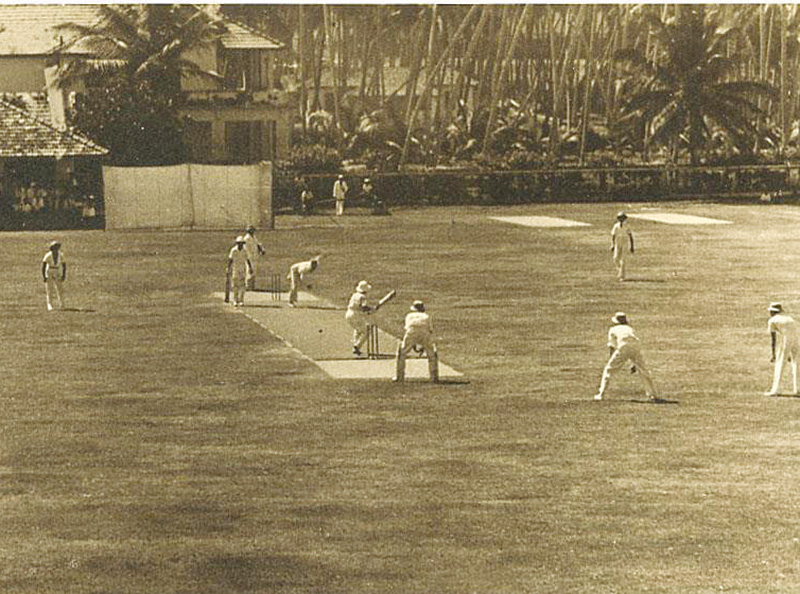
Cricketers on the War Memorial Grounds

The sensitive subjects of discussion in this writing have made demands on the writer to carefully balance the contents of the events he describes and documents. It is neither an anti-imperial work, or a pro-nationalist treatise. Simon achieves objectivity of reportage; by his selection of men and matters, in the massive canvass he has dared to unfold.

Thomia as a testimony of those times has to be viewed in context of Victorin rule at the helm of the empire. The attitude of the English was clear when British historian and politician, Thomas Macauly famously said, we will create in our colonies those who are like us in attitude and language, only different in the colour of their skin.

At the outbreak of World War 1, many old boys of the school were fighting in the frontlines in Europe and the Mediterranean. Many Old Thomian tea planters fell into action. One of them, Second-Lieutenant Basil Horsfall was the first Ceylonese to be posthumously awarded Britain’s highest military decoration, the Victoria Cross for bravery.

Before the war ended, the 1915 Sinhala-Muslim riots led to events that marked the beginning of the end of British rule in the island. It began with a Muslim mob obstructing a Buddhist religious procession on Vesak Day, going past a mosque in the Kandy district.

An Old Thomian, Captain of the Guard Henry Pedris, a Buddhist, was accused of incitement to riot and using firearms. He was sentenced to death. Warden Stone interceded for Pedris’s life. An appeal was made to the King but was of no avail. Pedris was shot dead by a military firing squad.

Among Old Thomian Sinhala Buddhist leaders imprisoned was Don Stephen (D.S) Senanayake. He was shown the chair, still dripping in blood, to which Pedris had been tied and executed, and warned of the fate that awaited traitors to the crown.

The execution of Pedris is often cited as the moment the cry for independence was born. The English Governor was recalled to England. Senanayake was destined to lead the country to independence.

The Anglicised elite of Ceylon, who identified themselves with their overlords, considered itself an honour to volunteer their lives on behalf of ‘King and country’. One of the last to go to the front during the Second World War was a future first Ceylonese Warden of the School, Canon De Saram. When he reached Port Said the war ended, and he saw no action.

However, in 1941 it was a Thomian who led a mutiny against the British in an outpost of the empire, in Cocos Islands between Ceylon and Australia. Influenced by Japanese English language propaganda broadcasts, Bombardier Gratien Fernando began to believe in Asia for the Asiatics and was in sympathy with Japanese war aims.

He led a failed mutiny which led to his execution, along with two other Ceylonese, Gauder and De Silva. They refused any offer of clemency. It was the only execution for mutiny during the Second World War by the British. Fernando’s last words were “loyalty to a country under the heel of the white man is disloyalty”.

At S.Thomas’, Senanayake had been a formidable wrestler. He played for three Royal-Thomian cricket matches, and had an enormous talent for natural authority and the ability to make himself loved. Stone wrote for the departing Senanayake that his conduct was irreproachable, and his influence most salutary.

In the outside world Senanayake the affluent planter was noticed as being indifferent to the divisions of race, caste and faith that meant so much to many other educated Ceylonese.

S.Thomas’ itself was facing its sunset at Mutwal. The coal dust from the expanding port had sounded its death knell. Warden Stone was entrusted with the task of taking the school to a fishing village seven miles away from Colombo. It was to Mount Lavinia.

Stone first looked at the abandoned stately, country residence of a former governor overlooking the Mount Lavinia Bay. The church had no money to buy the mansion, which was to become the famous Mount Lavinia Hotel.

After sixty-seven years, in 1918 the exodus to a half-built school was to see another generation of Thomian schoolboys sitting for lessons in Cadjan huts again. It was a new beginning, for boys who were accustomed to all the comforts of wealth and privilege.

But for Stone there was no grumbling or murmuring. He was an Englishman of working-class origins who had been to Cambridge, and had known a hard life. Stone held the reins of the school for a quarter century, from Mutwal (1901) to Mount Lavinia (1924).

He was determined to build the real Eton of Ceylon in Mount Lavinia, and nurture a generation with the best that Christian missionary education had to offer, to a country heading for independence.

It was to become a labour of love, for which every old boy was asked to contribute. The new school was begun to be built with money raised by selling the Mutwal school to the government for the Port. It was not enough for the grand edifice of Corinthian and Byzantine architecture, with a quadrangle and a cricket ground.

It would resemble one of the colleges of Oxford or Cambridge. It would overlook the blue waters of the Indian Ocean, in a garden of coconut palms swaying in the sea breeze, and become the iconic “School by the Sea”.  (To be continued)

Reviewed by
by Shavindra Fernando


from The Island https://ift.tt/5DyhP2I

Saturday, November 22, 2025

Commemorating the comrades in November

The Chinese people commemorated the 159th birth anniversary of great national hero Sun Yat-sen in Beijing on 12th November. He is remembered in China as a national hero, patriot and a forerunner of China’s democratic revolution. As a mark of respect to his immortal contributions to China’s National independence, social progress, public well being and strengthening the unity of the Chinese.

China’s supreme political body (National Committee of the Chinese People’s Political Consultative Conference) decided to have a grand commemoration to mark his 160th birth anniversary in November 2026. The 159th anniversary celebrations were attended not only by the Communist Party members but also by other parties and other prominent figures without party affiliations. Sun was a Chinese physician, revolutionary, statesman, a political thinker who founded the Republic of China and its first political party the ‘Kuomintang’. He played a key role during the 1911 Revolution to overthrow the imperial Qing Dynasty (1644-1911) and ended more than 2000 years of feudal rule in China. He is one of the few 20th century Chinese leaders revered in both Taiwan (as the father of the nation) and in the Peoples Republic of China (as the forerunner of the revolution).

His political philosophy, commonly known as the ‘three principles of the people’ intended to modernize China by promoting nationalism, democracy & livelihoods of the people within an ethnically united China. He has composed the national anthem of China focusing on above (Ref. Sun archives).

What can Sri Lankans learn?

One might argue that not many Sri Lankans who acted as if they believed in Communism had the vision of Sun Yet-sen. However, Sri Lankans will also be commemorating ‘November Heroes’ in the years to come and the younger generations may analyze and decide who are the real Sri Lankan heroes of the 21st century who contributed to national independence, social progress, public well being and strengthening the unity of Sri Lankans.

Those interested may study Sun Yet-sen’s immortal contributions to the Chinese society and work towards building a country not isolated in the world. Active economic, trade & cultural interactions between countries shall increase with opportunities such as the Belt & Road Initiative of China. If such opportunities are grabbed isolation will not be a challenge even if opportunists pressure Sri Lanka into unfavourable bilateral agreements.

By Prof. Samitha Hettige


from The Island https://ift.tt/XkASOLl

Friday, November 21, 2025

Sri Lanka College of Endocrinologists and Morison continue commitment to diabetes care

The Sri Lanka College of Endocrinologists (SLCE), in partnership with Morison, a pioneer in the Sri Lankan pharmaceutical manufacturing industry, has celebrated the successful graduation of the third batch of the Diabetes Care Training Program, reaffirming the shared commitment to strengthen Sri Lanka’s response to one of its most pressing non-communicable health challenges of patient-centred diabetes care.

With one in five Sri Lankans diagnosed with diabetes, the program continues to play an important role to equipping primary care doctors with the knowledge and skills to improve early detection, treatment, and long‑term management of the disease.

Launched in February 2024, the Certificate Training Program has now trained over 180 General Practitioners (GPs) from the three intakes. The third batch, which commenced in May 2025, has now successfully completed the four‑month course, receiving certification at a graduation ceremony held recently.

The certified GPs are equipped with the latest knowledge, practical tools and skills needed to improve early detection, treatment, and long-term management of diabetes. With the graduation of the third batch, SLCE and Morison are able to expand access to quality diabetes care and strengthen the healthcare system.

The four-month training course facilitated and delivered by the SLCE, is the first of its kind in Sri Lanka. Course content features an evidence-based curriculum, combining theoretical knowledge with practical applications, ensuring participants receive up-to-date knowledge adhering to the latest Clinical Practice Guidelines and international standards.

Further enhancing the value of the program, the graduates also benefit from SLCE’s awarding of Continuing Professional Development (CPD) points, further enhancing the value of the qualification.

Importantly, the initiative is helping to bridge the gap between specialist and primary care, ensuring more patients receive timely and effective treatment.Morison is a truly Sri Lankan pharmaceutical manufacturing company, with a rich legacy of over 60 years of industrial expertise.


from The Island https://ift.tt/qK8zXvF

Thursday, November 20, 2025

Bennett, Raza and Evans star in Zimbabwe’s win over Sri Lanka

Sri Lanka’s batting imploded in the face of a disciplined Zimbabwe attack, as they fell to a 67-run defeat in the second match of the men’s T20I tri-series in Rawalpindi. They were bowled out for 95, chasing a target of 163. For Zimbabwe, it was the perfect response to their opening game defeat to Pakistan.

The wickets were spread among each of the six bowlers used by Zimbabwe. Richard Ngarava was excellent picking up figures of 2 for 15, but he was outdone by the ever-reliable Brad Evans, who ended with match best figures of 3 for 9.

For Sri Lanka, only Dasun Shanaka, the stand-in skipper, produced an innings of any promise, during a backs-to-the-wall 34 off 25. The only other player to reach double digits was Bhanuka Rajapaksa, who struck a pained 11 off 18 playing his first T20I since January.

Zimbabwe, who had been put in at the toss, had a much better time with the bat, led by Brian Bennett (49) and Sikander Raza (47). It wasn’t a perfect innings as they limped to the finish, but it proved to be more than enough in the end. Wanindu Hasaranga picked up innings-best figures off 3 for 32, while debutant Eshan Malinga also impressed with 2 for 27.

Bennett, as he has been doing increasingly of late, gave Zimbabwe a fast start inside the powerplay as he and Tadiwanashe Marumani put on a 26-run opening stand in a little over three overs. Sri Lanka though struck back, through Maheesh Theekshana and Malinga, to share the opening period with Zimbabwe on 46 for 2 after six overs

However, Raza pushed himself up the order, likely in response to how their innings had fallen apart against Pakistan two nights ago, and together with Bennett set about putting up a 61-run partnership off just 44 deliveries.

While Bennett fell for 49 for a second game running, the pair had ensured a solid platform as Zimbabwe’s 100 came up inside the 14th over. Raza continued on unbothered, on his way to 32-ball 47, inclusive for three fours and two sixes. With Raza at the crease, 180 was on the cards, and it would take a fantastic running catch in the deep from Shanaka to end his innings.

With Bennett and Raza both back in the dugout, Zimbabwe’s innings closed out with a relative whimper; they struck 22 runs in the final three overs to sneak past the 160-mark. Malinga added to his impressive debut with a double-wicket penultimate over, while Dushmantha Chameera also gave away just 12 runs bowling two of the final three overs.

Chasing 163, after the powerplay Sri Lanka had found themselves on 25 for 2, their lowest powerplay total in 14 T20Is in 2025. Zimbabwe’s combination of tight lines and lengths, and solid plans, had short-wired the thinking of the Sri Lankan batters.

Pathum Nissanka had chipped one to midwicket in the opening over and Kusal Perera skied one to short fine leg in the next, but what followed was truly calamitous.

The returning Rajapaksa and Kusal Mendis ate up 26 deliveries in their 19-run stand, and such was the pressure being built by the likes of Ngarava, Tinotenda Maposa and Evans during this period, that the Lankan batters were starved of boundary deliveries and forced to take ever more risky singles.

It was one such ill-fated run that brought an end to the partnership, as Rajapaksa struck one straight to cover before setting off on a non-existent single. By the time he looked up to realise his partner still at the other end, Rajapaksa was already halfway down. Not even a wayward throw to the wicketkeeper could save Kusal Mendis, who had made a belated dash for safety.

An over later, Rajapaksa was at the non-striker’s end turning down a fairly straightforward single and nearly had Shanaka run out – a wicket spared only by a truly horrendous throw to the keeper.

It wasn’t long before Rajapaksa himself was dismissed, clean bowled looking to hit out. It meant Sri Lanka had lost their top four inside the opening 10 overs – it was five midway through the 11th when Raza snuck one past Kamindu Mendis. Only Shanaka showed some defiance, but when he edged one behind from Ryan Burl, Sri Lanka’s faint hopes went with him. The rest of the batting dragged the game to the death, before Evans cleaned up the innings off the final delivery.

Brief scores:
Zimbabwe 162 for 8 in 20 overs (Brian Bennett 49, Tadiwanashe Marumani 10, Brendan Taylor 11, Sikandar Raza 47, Ryan Burl 18, Tashinga Musekiwa 11; Maheesh Theekshana 1-30, Dushmantha Chameera 1-27, Eshan Malinga 2-27, Wanidu Hasaranga 3-32)  beat  Sri Lanka 95 in 20 overs  (Bhanuka Rajapaksa 11, Dasun Shanaka 34; Brad  Evans 3-09, Richard Ngarava 2-15, Tinotenda Maposa 1-17, Sikandar Raza 1-23, Graeme Cremer 1-17, Ryan Burl 1-08) by 67 runs

[Cricinfo]


from The Island https://ift.tt/gpRAQM3

Wednesday, November 19, 2025

New Anthoney’s premium meat retail outlet Meatlery expands to Delkanda

New Anthoney’s Group, a leading sustainable poultry producer in Sri Lanka, proudly announces the opening of its newest retail outlet under the Anthoney’s Meatlery brand in Delkanda. This expansion marks another significant step in its efforts to make high-quality, responsibly produced meat more accessible to consumers while elevating the overall retail experience in the sector.

Anthoney’s continues to be a preferred household chicken brand that pioneered antibiotic-free poultry through its HarithaHari range, also distinguishing itself with 100pct compostable packaging and various global food safety and halal certifications.

The Anthoney’s Meatlery concept was initially launched in Battaramulla as a modern retail destination for premium, fresh, and processed meat products. The new outlet in Delkanda now extends this vision to a wider audience, offering a curated selection of antibiotic-free chicken, beef, pork, mutton, sausages, eggs, and ready-to-cook items.

Commenting on the opening, Eranga Kurukulaarachchi, Director of New Anthoney’s Group, said, “We are thrilled to open our doors in Delkanda and bring Anthoney’s Meatlery closer to our valued customers. This new outlet represents more than a retail space. It’s a continuation of our promise to offer Sri Lankans meat that is fresh, traceable, and ethically produced. Consumers today seek transparency and quality, and with Anthoney’s Meatlery, we deliver on both fronts.”

The opening of Anthoney’s Meatlery in Delkanda reinforces its ongoing commitment to convenience, innovation, and consumer trust. Earlier this year, the company partnered with PickMe to introduce Sri Lanka’s first doorstep delivery service for their product range and was recently announced as the Official Poultry Partner for MasterChef Sri Lanka, supplying its premium HarithaHari chicken range to all participants of the renowned culinary competition.

This partnership highlights the brand’s alignment with global culinary excellence and its growing reputation for quality within the hospitality and food industries. Further, its e-commerce platform, Dorakadapaliya.com, won the Gold Award for Best eCommerce Website at the BestWeb.LK Awards 2025, a testament to the brand’s excellence in user experience and online retailing.


from The Island https://ift.tt/3EBWKRJ

Inside Meghan Markle and Prince Harry's Thanksgiving preparations


Megtext and Prince Harry are preparing for Thanksgiving at their Montecito, California home by harvesting sage from their garden

from Daily Express :: US Feed https://ift.tt/pNuXjKm

Tuesday, November 18, 2025

A captain brought down by a bouncer of his own making?

When Sri Lanka’s T20 skipper Charith Asalanka was quietly withdrawn from the tri-series in Pakistan, the early whispers blamed a bout of illness. But scratch beneath the surface and a different picture emerges — one where the captain’s defiance during the heated stand-off over continuing the Pakistan tour has come back to hit him like a nasty lifter on a cracked pitch.

Fast bowler Asitha Fernando, another key figure who padded up to return home, has suffered a similar fate. The pair go back a long way — teammates at Under-19 level when Roy Dias guided Sri Lanka to a rare series win in England in 2014. Both of them are back home now and not part of the tri-series in Bangladesh.

Asalanka, groomed meticulously for leadership, has long carried the air of a captain-in-waiting. At Richmond College he led with aplomb and his stint as Sri Lanka’s Under-19 skipper only polished those credentials further. When he debuted at 23, it felt inevitable that the armband would rest on his sleeve and once entrusted with the reins, he steered the side with a calm assurance that echoed Mahela Jayawardene’s trademark poise.

Under his watch Sri Lanka beat Australia and India in bilateral ODI series, climbing to number four in world rankings — a breath of fresh air after the Champions Trophy miss. With bat in hand, Asalanka earned a reputation for ice-cold finishing, often shepherding tricky chases and setting up imposing totals. His rise to number seven in the ICC ODI batting chart was no fluke.

But T20 cricket, the game’s madcap sprint, proved less forgiving. His returns with the bat dipped alarmingly, and Sri Lanka’s Asia Cup campaign unravelled with not a single second-round win. Meanwhile, some of his bowling changes raised eyebrows.

Entrusting the final over to a returning Dunith Wellalage with big-hitting Mohammad Nabi at the crease was a gamble and the youngster was launched for five sixes. Sri Lanka escaped that night, knocking Afghanistan out, but other blunders were not so easily covered up — like overlooking ex-captain Dasun Shanaka for a crucial over and instead handing the ball to Kamindu Mendis, whose ambidextrous spin could not prevent Bangladesh from chasing 169 on a tough deck.

Through it all, Asalanka maintained a spotless disciplinary record. He carried himself with dignity, never dragging the game into disrepute. But more recently, murmurs emerged of a small clique within the squad — predominantly his mates from Richmond. It was background noise until the bomb blast in Islamabad, 20 kilometres from the team hotel.

Despite assurances from Pakistani authorities and upgraded security plans, a small group — Asalanka included — stood firm that the tour should be abandoned. Sri Lanka Cricket, unwilling to blink, began lining up replacements. Though the players eventually agreed to stay after late-night persuasion, the damage had been done.

The message from top was unmistakable: no one is bigger than the game. Sri Lanka lost the ODI series with a match to spare, Asalanka sat out the finale and he was quietly flown home before the tri-series began.

The writing on the wall had appeared earlier when selectors named Dasun Shanaka as T20 vice-captain, a not-so-subtle hint that all was not well. Asalanka failed to read the field and now it seems Shanaka will retain the captaincy for the T20 World Cup on home soil. As for Asalanka, he suddenly finds himself not fighting for leadership, but fighting for his place in the XI.

In cricket, as in life, one misjudged shot can turn a match on its head. For Charith Asalanka, this might just be the toughest innings he has yet to rebuild.

Telecom Asia Sport


from The Island https://ift.tt/swEZcl9

Monday, November 17, 2025

Let’s understand what a masterpiece is and how it originated

Text of a lecture conducted by Bhagya Rajapakse.

Venue: Sri Lanka Archive of Contemporary Art, Architecture and Design, Jaffna on November 2025

Tamil Interpreter: Jasmine Nilani Joseph

Special Thanks: Prof.T.Sanathanan and Prof.Sarath Chandrajeewa.

(First part of this article appeared in The Island yesterday)

What constitutes a piece of art, a masterpiece?

There are three common elements that act as crucial in elevating a piece of art to the level of a masterpiece.

1. A Work of Art That Did Not Exist Before.

2. A Work of Art that is Not Bound by Time.

3. A work of art that Establishes a Benchmark for future generations of artists.

Something new and unconventional always catches our attraction.

Exceptional creativity, craftsmanship, and innovativeness

provide impetus for an artist to create something new and unconventional.

This is how originality comes in.

How would we define exceptional creativity, craftsmanship, and innovativeness?

Let’s understand this with a few examples.

On one occasion someone inquired of Michelangelo about how his sculpting process goes.

And the immediate answer of Michelangelo was, “I saw the angel in the marble and carved until I set him free.”

In the subject of marble sculpting, the meaning of creativity for Michelangelo was to remove the unwanted chunks and pieces from the marble block and save the figure he imagined on it. In his words, it’s liberating the figure from the marble that imprisons it.

Any masterpiece by Michelangelo was a clear and prime example that demonstrates how exceptional creativity, craftsmanship, and innovativeness converge in a single piece of art.

Another example is the 1942 sculpture by Pablo Picasso, ‘Bull’s Head.’

It’s nothing more than a merger of a bicycle seat and a bicycle handlebar. In this sculpture., Picasso converts two ordinary, unrelated objects into a unique and evocative structure within which unrelated objects form a correlated entity. A BULL’S HEAD.

That’s all about Picasso’s exceptional creativity, craftsmanship, and innovativeness.

Let’s move to another example.

What can one do with a few discarded machinery parts found in a scrap metal store, an iron rod, some wood blocks, and some copper strips?

A creative as well as innovative mind could do a lot more.

By bringing all these components into one single unit, sculptor Sarath Chandrajeewa gave life to something extraordinary. That is the 2023 abstract monument titled ‘Motion and Stillness.’

In this monument the artist embodies one of the most profound concepts in the world.

Motion and stillness is a concept found in physics and philosophy as well as spiritual approaches.

The existence of the whole world depends on the dynamic interplay between motion and stillness.

Motion signifies change and transformation, while stillness symbolises ‘rest’ or ‘pause,’ which ensures the continuity of motion.

One hundred years ago, in 1925, English poet Fredegond Shove

wrote a poem bearing the same title, ‘Motion and Stillness,’ as well as the meaning.

“The seashells lie as cold

as death.

Under the sea,

The clouds move in a

wasted wreath.

Eternally;

The cows sleep on the

tranquil slopes.

Above the bay;

The ships are like

evanescent hopes.

Vanish away.”

This is a moment where the same concept is embodied in two different forms of art by two different artists of two different eras and of two different countries. It’s just about being creative and innovative.

The most important thing to be noted here is that Sarath Chandrajeewa was unaware that there is a poem written a hundred years ago that holds the same title and meaning as his abstract monument does.

Art is universal; it manifests in numerous forms, conveying the same meaning and message over the centuries and beyond.

That is the reason why some works of art are considered timeless. The inherent nature of a masterpiece is that it is not bound by time and space. Instead, it transcends the boundaries of time and space. Mediums can be changed, and styles can be changed, but the core essence of any great work of art remains constant.

Works of art that transcend spatial and temporal boundaries have set precedent for aspiring artists throughout history.

All artists follow in the footsteps of the previous masters in any field of art. The masters of early days and their masterpieces act as models of excellence for other artists.

For instance, Paul Cézanne was a monumental figure for Pablo Picasso.

Picasso was greatly influenced by Cézanne’s work.

Picasso deliberately turned human faces into mask-like forms in his paintings. This was quite evident in his 1907 masterpiece, ‘Les Demoiselles d’Avignon.’ He probably got this idea from Cezanne’s 1894-1905 masterpiece ‘Bathers.’ The faces of the human figures seen in ‘Bathers’ were seemingly carved from wood.

“Cezanne is my one and only master. He was like the father of us all.” That was how Picasso admired and respected Cezanne.

Cezanne’s approach of breaking down forms and restructuring them in an abstract manner provided the foundational inspiration for Pablo Picasso and George Braque when co-founding ‘Cubism.’

Revolutionary moves taken by artists by radically changing the existing styles are always recorded by history. And their fearless approaches to art elevate their work to the state of masterpiece.

‘Cubism’ was one such revolutionary move that radically changed the landscape of art by challenging traditional perspectives and representations.

‘Cubism’ at the beginning of the 20th century shook the foundation of visual art. It was initially faced with incomprehension and rejection by the public as well as art critics.

The fragmented appearance given to the then conventional depictions by ‘Cubism’ was not well received by many.

French art critic Louis Vauxcelles first ridiculed this new style by Picasso and Braque.

In 1908, after seeing Braque’s exhibition, Vauxcelles dismissed the work by saying, “This style has reduced everything to little cubes.”

This was how this revolutionary style got its name, ‘Cubism.’

Similarly, ‘Impressionism,’ which emerged in France in the second half of the 19th century, left the viewers indifferent towards the new approach.

The first ‘Impressionist’ exhibition was held in Paris in 1874.

Claude Monet is considered a pioneer and father of the Impressionist movement.

In the 1874 exhibition, Monet’s masterpiece ‘Impression, Sunrise’ was among the exhibits.

After visiting the exhibition, French art critic and journalist Louis Leroy referred to Monet’s ‘Impression, Sunrise’ as a mere IMPRESSION rather than a finished work.

Thereafter the entire approach was named ‘The Impressionism.’

At the end of 1940, American artist Jackson Pollock established an unusual and unique abstract art technique.

In this technique he laid a canvas on the floor. Then dripped, poured, and splashed paint onto it using sticks and cans. Sometimes he rode the bicycle on the canvas, which was covered with paint.

Pollock’s revolutionary idea was to get rid of the traditional use of the ‘PAINT BRUSH’ and the role of the ‘LINE.’ He was adamant that the ‘LINE’ should not dominate the canvas any more. So, he said goodbye to the Brush and the Line, and both were given freedom from the task of painting.

But Pollock’s works were not immediately appreciated.

Art critic Harold Rosenberg gave the name ‘The Action Painting’ to this new technique initiated by Jackson Pollock.

The term ‘Drip Painting’ was coined by Time Magazine in 1956, and the magazine gave Pollock the nickname ‘Jack the Dripper.’

However, through ‘Drip Painting,’ Pollock set a precedent that influenced artists for generations.

Masterpieces are not immediately accepted by the public, and in the first run, those were highly criticised by the ‘experts’ in the field.

Because masterpieces challenge the accepted norms in any field of art.

The public as well as the critics are initially shocked by the shapes, techniques, styles, or subject matters set by the radical artistic approaches.

It is common for many works of art to be appreciated after the artist died.

Their work stands as timeless and priceless masterpieces posthumously.

In some cases works of art gain much popularity and continue to last because of the concept they carry as well as the location they are being placed in.

One hundred and eight years ago French artist Marcel Duchamp challenged the established perception of art by bringing a signed urinal into an exhibition space as a work of art titled ‘Fountain.’

Duchamp argued that the artist’s intention, idea, and the context made something art.

The context within which a work of art is placed is capable of changing the value of the work and the way others look at it.

Duchamp’s intention was to challenge the then-existing traditions of art to reconsider the nature of originality, authorship, and the way of defining art.

‘Fountain’ is considered the founding piece, and Duchamp is considered the founder of conceptual art.

The urinal titled ‘Fountain’ was not just a mass-produced commodity but a medium carrying a concept.

A commodity was converted to a work of art just by changing its context.

‘Fountain’ was discarded soon after it was submitted to the Society of Independent Artists’ Exhibition in New York in 1917.

The work known today as ‘Fountain’ is a replica authorised by Duchamp.

But the concept it carried keeps revolutionizing modern art to this day.

Another work of art that faced much controversy, praise, rejection, and ridicule predominantly on social media platforms in the recent past was ‘Comedian,’ a work by Italian artist Maurizio Cattelan in 2019.

It was all about a fresh yellow banana affixed to a white wall with ash grey duct tape.

The ordinary banana we daily see on the racks of fruit stores became extraordinary after changing its context.

As soon as the banana was placed within a high-profile exhibition space, hundreds of people gathered at the gallery to see this awe-inspiring banana.

It was no longer the banana we see in the market or just a nutritious fruit, but a concept.

According to the artist, ‘Comedian’ was interpreted as a work of art that signifies commodification of contemporary art.

The satirical commentary passed through a banana by Cattelan, in a way, pushes the viewer to re-evaluate their preconceived notion about what constitutes art and how its value is being determined in a consumer society.

‘Comedian’ was sold to three buyers on three separate occasions, and four editions of this art piece have been exhibited in 4 different locations: Florida, South Korea, New York, and France.

In 2019 the first two editions were sold at a price of $120,000, and in 2024 another edition exhibited in Sotheby’s Collection in NY was sold at $6.2 million.

When a banana rots or when someone has eaten the banana while it’s being exhibited, the artist simply replaces it again and again, and then it continues to be an original piece of art. But the concept it carries goes on to last for ages.

Speaking about bananas, this ordinary fruit has been a medium of carrying concepts in many countries, in many contexts, by many artists.

In 1967 American visual artist Andy Warhol launches a banana design screen printed on laminated plastic. This was featured on the pop album cover ‘The Velvet Underground and Nico.

Reviews say that this famous banana design by Warhol reflects his fascination with consumer culture and showcases how a primary object, such as a banana, symbolizes the rise of mass production and distribution.

In 2004 English artist Agnus Fairhurst creates a massive installation of peeled bananas. This nine-foot-long bronze peeled banana carried the concept that “Bananas are sensual, but they quickly decay.”

In the same year, 2004, Sri Lankan artist Sanath Kalubadana, through his installation ‘Dinner Table,’ expresses his disagreement over the horrors and destruction of the war in the medium of a table of food with bananas burnt to cinders.

In 2008, Austrian graphic designer Stefan Sagmeister creates a gigantic installation, ‘Banana Wall,’ with the phrase ‘Self-Confidence Produces Fine Results’ spelled out in green bananas placed among yellow ones.

Nearly ten thousand bananas are said to have been used in this installation. I quote a fascinating Facebook post by content creator ‘Ivan’ here to read out what he has said about this Banana Wall.

“It wasn’t just about shock value; it was about time, change, and transformation. Over the days and weeks, the banana slowly ripened, turning from bright yellow to spotted brown, and eventually to deep black. The scent of the room shifted too, from sweet tropical to something far less pleasant. Visitors returned again and again to see how the wall evolved, turning the space into a breathing piece of art.

If a work of art is to last for ages, it must be received by the public constructively.

Any extraordinary piece of art or a masterpiece has its unique way of initiating a silent dialogue with the viewer.

The masterpiece transmits the message of who they are, using an iconic visual language enriched with artistic elements.

The rhythm of the visual language of a masterpiece is complex. But not complicated.

No masterpiece is easy to understand and is full of complexities. But it never confuses the viewer.

Complexity is intriguing, and complication leads to confusion.

If a work of art confuses the viewer, he or she will no longer be in favor of it. That’s exactly where the silent dialogue between the masterpiece and the viewer comes to an end.

One of the most complex masterpieces in the world is Pablo Picasso’s ‘Guernica.’

Its powerful symbolism is not everyone’s cup of tea.

So, there were many arguments among the public as well as experts about what some symbols really mean.

Responding to this discourse, Picasso said, “It isn’t up to the painter to define the symbols; otherwise, it would be better if he wrote them out in so many words. The public who look at the picture must interpret the symbols as they understand them.”

Despite all the underlying complexities, people from all over the world spend millions to go to faraway countries to see the great pieces of art with their bare eyes.

Why?

Because every extraordinary piece of art has its own charisma and aura, which no replica of the same work can possess. It is the charisma and aura of Mona Lisa, David, Girl with a Pearl Earring, Guernica, and many more that draw millions of people to their countries to see them firsthand.

They are not just paint patches on canvases or stone figures. They are living beings. They have their own rhythm of breathing, they never die, and they remain immortal, as do the extraordinary masters who made them.-


from The Island https://ift.tt/x8oa6im

Sunday, November 16, 2025

SL seeks employment opportunities in Poland for Sri Lankan heavy vehicle drivers

Sri Lankan Ambassador to Poland, Priyangika Dharmasena recently met representatives of BATIM Sp. z o.o., one of Poland’s leading international transport and logistics companies, at the Embassy premises to discuss opportunities available for qualified heavy vehicle drivers from Sri Lanka, who could support the company’s expanding logistics operations in Europe, the Foreign Ministry said.

During the discussion, Ambassador Dharmasena underscored the professionalism and reliability of Sri Lankan drivers, who are recognised internationally for their discipline, as well as work ethic, and assured that the employment prospects presented by the company will be conveyed to the relevant authorities in Sri Lanka, for further collaboration.


from The Island https://ift.tt/unLXmG2

Mohammad Wasim and Fakhar Zaman help Pakistan complete whitewash

Pakistan eased to a six-wicket win over Sri Lanka to seal a 3-0 series whitewash. Three wickets from Mohammad Wasim and contributions from others bowled Sri Lanka out for 211, before a half-century by Fakhar Zaman took much of the jeopardy out of the chase. Sri Lanka fought hard through the middle, getting rid of Babar Azam and Salman Agha in quick succession, and though it succeeded in slowing Pakistan down, the visitors ultimately had too few runs to play with as Pakistan cantered to the win with 5.2 overs to spare.

When Sri Lanka began their innings, they appeared to have designs on a total above 300. Pathum Nissanka and Kamil Mishara were timing the ball particularly sweetly, racing along to a 50-run partnership inside the first eight overs. Shaheen Shah Afridi, in particular, was punished early by Mishara, who exploited the gaps as an opposition side racked up a 50-run opening partnership against Pakistan for the sixth ODI in succession.

But as has been so often the case for the visitors, wickets derailed their progress significantly. Mishara had chopped a few early on and survived, but Nissanka’s first inside edge clattered into the stumps, and from there Pakistan started to squeeze. Wasim found a bit of extra bounce to draw Mishara’s outside edge, and the free-flowing runs were suddenly no longer coming.

Kusal Mendis and Sadeera Samarawickrama rebuilt, but not nearly at the speed Sri Lanka needed on a wicket that looked like it would only continue to get better. Left-arm wristspinner Faisal Akram, replacing Abrar Ahmed in the side, enjoyed an excellent first spell, deploying his variations to great effect and keeping the batters honest. He had Samarawickrama trapped in front in single digits, but the batter got the decision reversed on review because the ball was turning too much.

But the pressure was invariably building up. It had taken 75 balls to score just 43 runs, and by the time Wasim returned to the attack, the urgency to score quickly had been amplified. He knocked them off course with a yorker that cleaned up the stand-in captain Kusal Mendis before a double blow from Akram blew the innings wide open. It included a splendid delivery that sliced through Samarawickrama’s defences two runs shy of a half-century, as well as a soft return catch that did for Kamindu Mendis.

Sri Lanka have set much store in 23-year-old batting talent Pavan Rathnayake, even if he was batting a tad too deep for their liking. The debutant showed impressive temperament as he shepherded the tail, and arguably played the shot of the day with a back-foot punch that flew over cover for a six. But he got limited support from the tail as Pakistan chipped away at the other end, and with nine wickets down, his desperation to get back on strike cost him his wicket. He had put up a spirited 32, but the 211 Sri Lanka ended up with never looked near enough.

Zaman drove that point further home as he started off in a hurry. It was almost as if he was making up for lost time after Haseebullah Khan’s brief tortured stay at the crease resulted in a 12-ball duck, the young wicketkeeper-batter getting more desperate with each ball before ultimately smearing one straight to mid-on. Babar Azam’s arrival lifted the crowd’s spirits while Zaman took care of the run-scoring, freeing his arms and finding the gaps either side of the wicket with regularity in the powerplay. Babar, meanwhile, looked like a man with rediscovered confidence, timing the ball beautifully as Pakistan cruised through the first 15 overs.

Zaman took on Jeffrey Vandersay, who was playing his first game this series, but the legspinner dragged his side back into the contest. After smacking him for his second boundary, Zaman went after Vandersay again, only for Kamindu Mendis to take a spectacular catch diving forward in the deep. Shortly after, he did for Babar with a googly that beat the batter all ends up, sneaking through the gate and making a mess of his stumps.

With their tails up, it was the first time since the opening powerplay in the game that Sri Lanka placed any kind of pressure on Pakistan. Vandersay beat Agha with a lovely legbreak that drifted in and then ripped away to trap him in front, and suddenly, the 97 runs Pakistan still needed seemed very far away.

But Rizwan and Hussain Talat hunkered down. For a while, run-scoring seemed a secondary thought; the next ten overs produced just 32 runs. But most importantly, Sri Lanka were being kept out of the wickets column, and with the asking rate far too modest to have any impact on the game, Pakistan, bit by bit, dragged themselves towards the finish line.

It left the last hour of the game in a holding pattern where the outcome was all but certain, but Talat and Rizwan were in no hurry to put Sri Lanka out of their misery. Rizwan coasted towards his half-century while Talat saw an opportunity to amass a few more runs in what has been a successful series for him. In the 43rd over, Maheesh Theekshana had Talat lbw but the batter got the decision overturned as the ball-tracking showed the ball bouncing over the stumps. It just about summed up Sri Lanka’s stuttering series in the Rawalpindi cold before the hosts finally limped over the finish line.

Brief scores:
Pakistan 215 for 4 in 44.4 overs  (Mohammed Rizwan 61*, Fakhar Zaman 55, Babar Azam 34; Jeffrey Vandersay 3-42) beat Sri Lanka 211 in 45.2 overs (Sadeera Samarawickrama 48, Kusal Mendis 34, Pavan Rathnayake 32; Haris Rauf 2-38, Mohammad  Wasim 3-47, Faisal Akram2-42) by six wickets
(Cricinfo)


from The Island https://ift.tt/3HfTyL5