
It was on the day before his birthday, in 2019, that I called Indunil.
“Here, are you free tomorrow? There’s a place I want to take you to.”
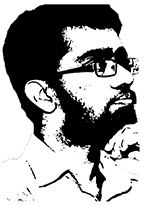
By Uditha devapriya
After finishing work the following day, I hired a tuktuk. Picking up Indunil, I proceeded to Kohuwela. There we stopped by the Keell’s building.I had not explained why we had come. As we got down from the tuktuk my friend gave me a bemused and puzzled stare. “Where are we going?”
I did not answer. We passed the Keell’s building. Soon he saw that my eyes were set on an old, decrepit building behind. It was the sort of building you never really noticed unless you strained your eyes. It did not just stand apart from the other buildings in the vicinity, it seemed to belong to an older period. It almost seemed on its way out.
We went up three flights of stairs. The closer we got to the top the more visible became its old and worn-out state. There seemed to be no soul in the building. Pigeons had made it their lair. One could see their droppings in every corner: stretches of white across old red polished floors. Hardly the sort of surprise for one’s 18th birthday.
This was the office and location of the old Tisara Bookshop. I did not tell Indunil until we reached the top floor. There, in a warehouse that had once served as one of the most sought after and popular book stores in the country, lay tons and tons, volumes and volumes, of reprints and old editions of books from a totally different era.
I beamed at him as he stared at the collection.
“Pick whatever you want,” I said, “and happy birthday.”
I had come here a week or so before in search of Vito Perniola’s 14-volume history of the Catholic Church in Sri Lanka. I had got what I wanted but had fallen into conversation with the lady who was more or less running the show here. Through her I had got to know that, at its peak years ago, Tisara had published reprints of old titles, all the way from Robert Knox to Leonard Woolf and beyond. I could see Woolf’s Diaries in Ceylon, Knox’s An Account of Ceylon, Antony Bertolacci’s A View of the Agricultural, Commercial, and Financial Interests of Ceylon, along with John Davy and Emerson Tennent. I had heard of these books as a child; seeing them in front of me, I could not resist buying and reading them.
But it was not after any of these writers that I was here. I noticed Indunil gaping at the whole collection. He seemed too lost for words. At the time I had money on my hands and I told him he could buy whatever he wanted, and however much he wanted. Then I pointed him out to the author and the books I specifically liked him to check out.
Unlike me, Indunil had been completely educated in Sinhala. He hence had a much greater awareness, knowledge, and appreciation of Sinhala literature. Yet as he pored over the titles and saw the name of their author, he became very surprised.
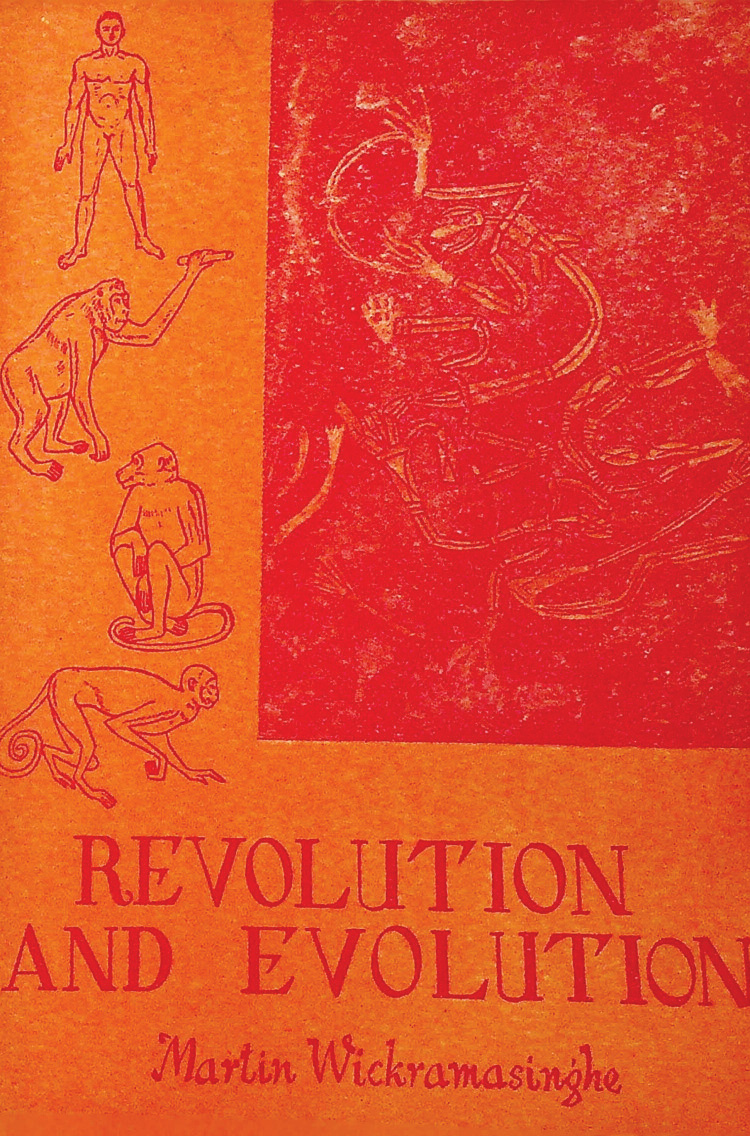
Revolution and Evolution. Courtesy Martin Wickramasinghe Trust
“I thought Martin Wickramasinghe only wrote novels,” he confessed to me after we had bought a ton or so of books – all at very low prices – and went downstairs.
I smiled. I had discovered Wickramasinghe just a few years earlier, but not through his fiction. “He was much more than a novelist,” I replied.
Indunil agreed. He must have had a bagful of books with him. He proceeded to read them a few days later. The last time I checked, which was around two weeks ago, he still had those books: some at his village home, some in his boarding place, a few scattered here and there at the many places he had stayed in after his A Levels in 2021.
Among the books I bought for Indunil that day was a large collection of Wickramasinghe’s English-language essays. These in turn had been collated from four essay collections that had been printed before, including Aspects of Sinhalese Culture, Buddhism and Culture, Sinhala Language and Culture, and his last anthology of English-language essays, Buddhism and Art. Having bought a copy a week or so before, I had become engrossed in these writings: not so much over what they had to say on their subjects as what they revealed about their author and his attitudes, his beliefs and his biases.
I discovered Martin Wickramasinghe, as I wrote before, somewhat late in life. Because of this I read his non-fiction before I read his novels. Much of his writings on art, culture, and history engrossed me, mostly owing to how he approached these subjects. Eventually, when I got around reading his Sinhala-language essays, I found the same attitudes, the very same world-view, in them. These writings easily made him a leading contrarian thinker, perhaps the pre-eminent public intellectual of his day in Sri Lanka.
But as Indunil noted for me more than once, among most Sri Lankans he remained, at best, a novelist, the author of Madol Doowa, Gamperaliya, and Viragaya. Landmarks though these works doubtless are, they offer only glimpses into a highly original if provocative mind. The novel is still one of the most enduring literary genres out there. Though it was at an incipient stage in Sri Lanka when Wickramasinghe began his writing career, he quickly raised the stature of the genre in the country, carrying forward the work of such predecessors as Piyadasa Sirisena and W. A. Silva. It is perhaps this that explains why we focus on his career as a novelist so much that we overlook his contributions as a critic.

My reading of Wickramasinghe did not begin in 2019. I had come across him before as a child, even if sporadically. But reading his essays in a fresh light, I realised there was more to him to discover. Like Chekhov, Tolstoy, Andre Gide, and the other novelists he read and was influenced by, Martin Wickramasinghe did not stand idly by a corner as history moved on. He commented on all the raging topics of the day and was not afraid of identifying himself on this or that side of the spectrum. I knew that the task of rediscovering him would have to be undertaken someday, and that Wickramasinghe’s work deserved no less.
What I did not know is that Indunil and I would be brought together in this task. I had met and been introduced to him in 2018. Back then he was barely 17 years. How I met him, in what circumstances, and how things evolved from there are for another day. What is important is that, from the first day, I discerned in him an almost insatiable interest in art, culture, history – and more than anything, literature and poetry.

Sinhala Lakuna (Courtesy Martin Wickramasinghe Trust)
Like most of his friends who had introduced me to him, Indunil was a product of a world outside Colombo. Born in Kurunegala, near Wariyapola, in 2001, the son of a principal and a local government officer, he was initially educated at the local government school. In 2011 he appeared at the Grade V Scholarship Exam. Being the son of a principal meant that he got the resources he needed from home for the test. As it turned out, Indunil not just passed it but secured enough marks to enter a better school.
The following year he entered Royal College. Boarded as a hosteller – like most of his friends whom I would meet before him – Indunil found himself adapting to a different culture. From early on at Royal, he displayed an interest in art, culture, and literature. At home he had come across and read newspapers and magazines which dwelt on these topics. At Royal he began making friends with people who fuelled his interests more. Through them, he made his way to various clubs. By the time Indunil sat for his O Level Exams, he had settled in the Sinhala Dramatic Society. One of the most distinguished clubs at Royal, the Sinhala Dramatic Society encouraged him to discover his talents in performance art. Meanwhile, from Hostel Prefect to Steward to Senior Prefect, he coveted and claimed all the top leadership positions at school, the highest honours a student could claim at Royal.
By the time I met him Indunil was about to become a Steward. We connected on and off thereafter, attending public discussions and engaging each other on the topics which interested us. Then I met him after he left school, when he became Prefect in 2021: the year after Covid-19 began to spread across Sri Lanka. Somewhere towards the end of that year, when the country was slowly getting used to the pandemic, we met at the Race Course, where he was doing the rounds in his school prefect duties. Taking a small break, we ate a light lunch before thinking of the future. Indunil was doing his A Levels again, and he suggested that someday, we get together and engage in a research project.
I did not then see how this was possible. I was unemployed at the time, writing on and off to newspapers. He, too, did not have many bright prospects before him. Yet in 2024, three years later, we began working on a project on Martin Wickramasinghe. How we wound up doing this project is, again, for another essay and time.
I decided on the parameters of the research before I got in touch with Indunil. For too long, Wickramasinghe had been limited to bookshelves and book fairs, his reputation resting on the Koggala Trilogy – Gamperaliya, Kaliyugaya, Yuganthaya – and Viragaya, and a few short stories. I felt, for better or worse, that we needed to focus on his non-fiction, including but not limited to his writings on science and evolution, and that these writings would offer us a glimpse into the way he thought as a novelist, critic, and journalist.
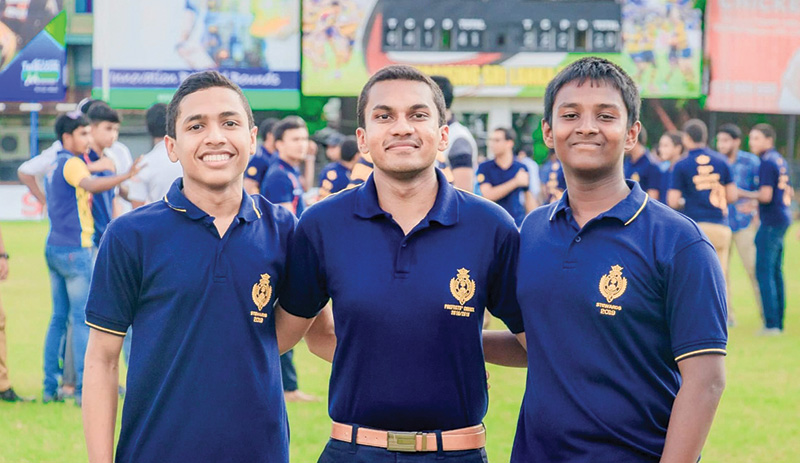
Serving as a Steward, 2019, left
I felt the timing could not have been more suitable. The year 2025 marked Wickramasinghe’s 135th birth anniversary, while 2026, the next year, would mark his 50th death anniversary. Initially we thought of two short books. Then we hit upon the idea of a large, comprehensive study, delving not so much into Wickramasinghe’s writing as the social, culture, and political context within which he evolved. Taking as the main – though not the sole – source, his two memoirs, Upan Da Sita and Ape Gama, we explored the manuscripts, the letters and correspondences, belonging to Wickramasinghe. We also explored his personal book collection at the National Library. In all this, we were and continue to be helped, and guided, by the Martin Wickramasinghe Trust at Nawala.
Where has this research led me, and led us? Last week I was in New Delhi, where I delivered on 20 November a lecture on Wickramasinghe, framing him as a South Asian modernist different to his contemporaries in Sri Lanka. The week before I delivered a webinar on the man and his writings for SOAS. The following week, on 27 November, we headed another lecture at Lakmahal. These will be followed by a lecture at the Social Scientists’ Association on 10 December, and several other presentations elsewhere.
Indunil is now in university. He has progressed well, somewhat different to the impudent, mischievous boy I came across seven years ago. Yet he remains as sharp-minded (and sharp-tongued) as he always was, keen and devoted to whatever subjects take his fancy. To a large extent, he and his friends were responsible, in those early years, for anchoring me in the culture and society of my country – in the ways of seeing and thinking there. I think I have dwelt on this in countless articles elsewhere, so I will not repeat it here.
Meanwhile, as I keep reading Wickramasinghe, I remain mindful of the different worlds his writings have opened us to. I believe Whitman’s line sums him up well: like the American poet, he worked in multitudes. As Indunil and I continue in our research, we are conscious of how big a thinker he was, and how much more about him we have yet to discover.
(Uditha Devapriya is a writer, researcher, and analyst whose work spans a range of topics, including art, culture, history, geopolitics, and anthropology. At present he is working on a study of Martin Wickramasinghe. He can be reached at udakdev1@gmail.com.)
from The Island https://ift.tt/uzmpY7C

No comments:
Post a Comment