
Climate change is no longer a distant or abstract threat to Sri Lanka’s biodiversity. It is already driving local extinctions — particularly among lizards trapped in geographically isolated habitats, where even small increases in temperature can mean the difference between survival and disappearance.
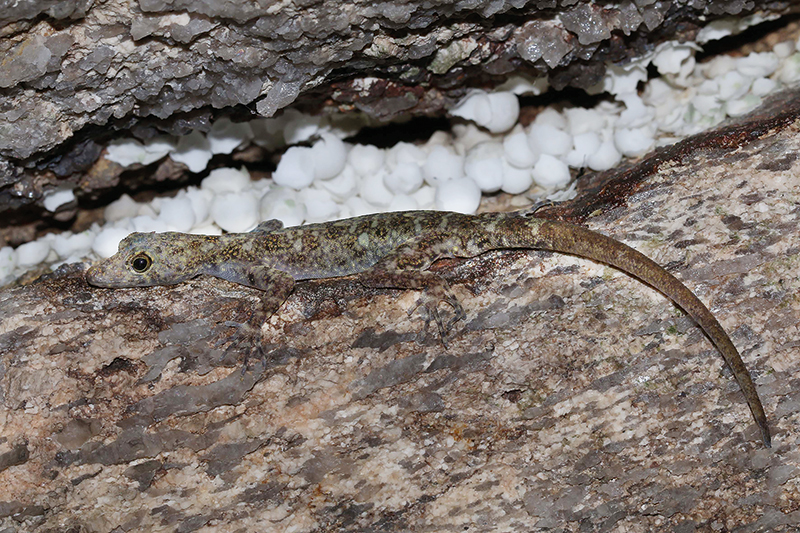
Cnemaspis rajakarunai (Adult Male), Salgala, Kegalle District (In a communal egg laying site)
According to research by Buddhi Dayananda, Thilina Surasinghe and Suranjan Karunarathna, Sri Lanka’s narrowly distributed lizards are among the most vulnerable vertebrates in the country, with climate stress intensifying the impacts of habitat loss, fragmentation and naturally small population sizes.
Isolation Turns Warming into an Extinction Trap
Sri Lanka’s rugged topography and long geological isolation have produced extraordinary levels of reptile endemism. Many lizard species are confined to single mountains, forest patches or rock outcrops, existing nowhere else on Earth. While this isolation has driven evolution, it has also created conditions where climate change can rapidly trigger extinction.
“Lizards are especially sensitive to environmental temperature because their metabolism, activity patterns and reproduction depend directly on external conditions,” explains Suranjan Karunarathna, a leading herpetologist and co-author of the study. “When climatic thresholds are exceeded, geographically isolated species cannot shift their ranges. They are effectively trapped.”
The study highlights global projections indicating that nearly 40 percent of local lizard populations could disappear in coming decades, while up to one-fifth of all lizard species worldwide may face extinction by 2080 if current warming trends persist.


Heat Stress, Energy Loss and Reproductive Failure
Rising temperatures force lizards to spend more time in shelters to avoid lethal heat, reducing their foraging time and energy intake. Over time, this leads to chronic energy deficits that undermine growth and reproduction.
“When lizards forage less, they have less energy for breeding,” Karunarathna says. “This doesn’t always cause immediate mortality, but it slowly erodes populations.”
Repeated exposure to sub-lethal warming has been shown to increase embryonic mortality, reduce hatchling size, slow post-hatch growth and compromise body condition. In species with temperature-dependent sex determination, warming can skew sex ratios, threatening long-term population viability.
“These impacts often remain invisible until populations suddenly collapse,” Karunarathna warns.

Tropical Species with No Thermal Buffer
The research highlights that tropical lizards such as those in Sri Lanka are particularly vulnerable because they already live close to their physiological thermal limits. Unlike temperate species, they experience little seasonal temperature variation and therefore possess limited behavioural or evolutionary flexibility to cope with rapid warming.
“Even modest temperature increases can have severe consequences in tropical systems,” Karunarathna explains. “There is very little room for error.”
Climate change also alters habitat structure. Canopy thinning, tree mortality and changes in vegetation density increase ground-level temperatures and reduce the availability of shaded refuges, further exposing lizards to heat stress.
Narrow Ranges, Small Populations
Many Sri Lankan lizards exist as small, isolated populations restricted to narrow altitudinal bands or specific microhabitats. Once these habitats are degraded — through land-use change, quarrying, infrastructure development or climate-driven vegetation loss — entire global populations can vanish.
“Species confined to isolated hills and rock outcrops are especially at risk,” Karunarathna says. “Surrounding human-modified landscapes prevent movement to cooler or more suitable areas.”
Even protected areas offer no guarantee of survival if species occupy only small pockets within reserves. Localised disturbances or microclimatic changes can still result in extinction.
Climate Change Amplifies Human Pressures
The study emphasises that climate change will intensify existing human-driven threats, including habitat fragmentation, land-use change and environmental degradation. Together, these pressures create extinction cascades that disproportionately affect narrowly distributed species.
“Climate change acts as a force multiplier,” Karunarathna explains. “It worsens the impacts of every other threat lizards already face.”
Without targeted conservation action, many species may disappear before they are formally assessed or fully understood.
Science Must Shape Conservation Policy
Researchers stress the urgent need for conservation strategies that recognise micro-endemism and climate vulnerability. They call for stronger environmental impact assessments, climate-informed land-use planning and long-term monitoring of isolated populations.
“We cannot rely on broad conservation measures alone,” Karunarathna says. “Species that exist in a single location require site-specific protection.”
The researchers also highlight the importance of continued taxonomic and ecological research, warning that extinction may outpace scientific discovery.
A Vanishing Evolutionary Legacy
Sri Lanka’s lizards are not merely small reptiles hidden from view; they represent millions of years of unique evolutionary history. Their loss would be irreversible.
“Once these species disappear, they are gone forever,” Karunarathna says. “Climate change is moving faster than our conservation response, and isolation means there are no second chances.”
By Ifham Nizam 
from The Island https://ift.tt/jtvKzlh

No comments:
Post a Comment