Saturday, February 28, 2026

Hilton Colombo Welcomes Ramadan with ‘A Middle Eastern Flair’

“Middle Eastern Hair” hosted at Graze Kitchen’ and features an Iftar Buffet inspired classic Middle Eastern dishes until March 18th. Hilton Colombo has brought the magic of the Middle East to the heart of the city, its latest culinary celebrations. Tender lamb Kabsa, infused with spices, and other delicacies treat the visitor in a traditional Middle Eastern way. Every detail anticipates every need – reflecting the generosity and grace central to Middle Eastern cuture.

Hilton Colombo invites guests to observe the season of Ramadan with ‘A Middle Eastern Flair,’ a specially curated Iftar celebration taking place until 18 March 2026 at Graze Kitchen. Inspired by the time-honoured traditions of the Middle East, this month-long showcase brings together authentic flavors, generous hospitality, and the spirit of togetherness that defines the Holy month. At Graze Kitchen, the Iftar buffet will be available daily from 6:00 pm to 11:00 pm, priced at Rs. 10,888 nett per adult and Rs. 5,444 nett per child (6–11 years). The lavish spread features an array of mezze, fragrant rice dishes, slow-cooked specialties, and indulgent desserts. Signature highlights include Lamb Kabsa with Vegetables, Braised Ouzi with Khalta Rice, Meat-Stuffed Artichokes, Cheese and Meat Sambousek, Jordanian Maqluba, and traditional Kunafa.

Complementing the dining experience at Graze Kitchen, CafĂ© Kai presents ‘Iftar, Brought to You’, a specially curated Middle Eastern selection available throughout the promotional period, featuring Iftar Sawan, Biriyani, varieties of hummus, stuffed dates, baklava, and Turkish delight—perfect for sharing with family or taking home.

Commenting on the initiative, Manesh Fernando, Area General Manager for Hilton Sri Lanka and General Manager of Hilton Colombo, said, “‘A Middle Eastern Flair’ reflects our commitment to honoring cultural traditions through authentic culinary storytelling. This Ramadan, we are delighted to bring guests together over flavors that celebrate heritage, generosity, and the joy of sharing a meal.”For reservations or more information, guests may contact +94 11 2492 448.


from The Island https://ift.tt/Q5Cpr8X

Friday, February 27, 2026

Nations Trust Bank records a strong FY2025 with a PAT of LKR 19.3 bn

Nations Trust Bank PLC (NTB) delivered a strong end to the financial year, reporting robust financial results for the 12 months ending 31 December 2025, with a Profit After Tax (PAT) of LKR 19.3Bn, reflecting a 15% yearonyear growth. The Bank’s performance was driven by healthy asset growth, resilient Net Interest Margins (NIMs) and disciplined risk management, reflected in a low Net Stage 3 Ratio of 0.91%. A strong capital base underpinned this momentum, with a Return on Equity (ROE) of 21.86%, highlighting the Bank’s strategic success and its readiness to pursue the next phase of growth.


from The Island https://ift.tt/xuIRsoa

Trump health fears soar as Republicans reveal concerns - 'he's become erratic with age'


The US President has been accused by critics of slowing down in his old age and declining mentally.

from Daily Express :: US Feed https://ift.tt/qxLwsDr

Thursday, February 26, 2026

Coal, sweets and bitter reality

Friday 27th February, 2026

Three teenage girls from a children’s home in Kalutara have been arrested for breaking into a canteen and making off with a stock of confectionery worth Rs. 40,000. Upon being informed of the theft, the police lost no time in recovering the sweets and making arrests. Those who conducted the ‘raid’ posed for photographs with the recovered items and released them to the media. Such is their selective efficiency.

One may recall that some years ago, the police arrested a small schoolgirl in Kalutara for stealing a few coconuts. In the same district, a little girl was taken into custody for stealing a five-rupee coin. If only the long arm of the law dealt with the politically backed perpetrators of serious crimes in a similar manner.

The three girls arrested for stealing sweets may have thought that in a country where people get away with grand thefts, their offence would go unnoticed. The incumbent government tells us that its political rivals stole colossal amounts of state funds while in power, but no legal action has been taken against most of them. Worse, the corrupt politicians in the Opposition have embarked on a crusade against corruption.

Worryingly, the incumbent government, which has undertaken to eliminate bribery and corruption and restore the rule of law, is led by a party with a history of terrorism, extortion, armed robberies and wanton destruction of state assets. A Cabinet minister has had the audacity to boast that he and his ‘comrades’ destroyed transformers, etc., in the late 1980s. He has sought to romanticise such acts of terrorism which are nonbailable transgressions under the Offences Against Public Property Act. Strangely, no action has been taken against him or his colleagues on the basis of his confession. If such crimes had been investigated properly during previous governments, some of the ruling party politicians who indulge in moral grandstanding would have been behind bars.

It has now been revealed that the procurement of eight shipments of substandard coal has caused a staggering loss of Rs. 8 billion to the state coffers. The coal supplier is said to be a company blacklisted for selling substandard rice to Sathosa. The corrupt coal tender has not been cancelled.

The present-day rulers, who came to power vowing to eliminate bribery and corruption, are now in overdrive, trying to justify losses caused by low-grade coal imports and shield the racketeers. Substandard medicines imported after the 2024 regime change have not only caused massive losses to the state but also snuffed out several lives in government hospitals. Much has been spoken in Parliament about corrupt procurement deals in Sathosa under the current dispensation. Curiously, no arrests have been made.

What was made out to be a new beginning in late 2024 has turned out to be another false dawn. The champions of good governance have been exposed for corruption and abuse of power.

The current rulers claim to be on a mission to restore the rule of law in keeping with one of their main campaign promises. That no doubt is a noble goal that must be achieved. However, mere rhetoric won’t do. They have to back up their words with deeds.

The least the government can do to convince the public that it is serious about fulfilling its pledge to restore the rule of law is to ensure that the police deal with the corrupt elements in both the Opposition and the government in the same way as they did in the case of the three girls who stole sweets in Kalutara.


from The Island https://ift.tt/NWpyksS

Donald Trump reveals 'great news for America' as he issues major White House update


The US president took to Truth Social to make the announcement.

from Daily Express :: US Feed https://ift.tt/JVWsOk6

Wednesday, February 25, 2026

CEB unions to launch strike today, warn of escalation over dissolution move

Trade unions of the Ceylon Electricity Board (CEB) will launch a six-hour token strike today (26 February) from 12:00 noon to 6:00 p.m., marking a dramatic escalation in their confrontation with the government over what they describe as an attempt to dissolve and unlawfully restructure the country’s power utility.

Union leaders said the strike was inevitable after authorities failed to respond to their eight core demands and amid mounting reports that a Gazette notification to liquidate the CEB is imminent.

The dispute has been simmering for weeks. Earlier, the unions cautioned the government that they would resort to trade union action immediately after the conclusion of the GCE Ordinary Level examinations if satisfactory solutions were not forthcoming.

They insisted that they deliberately delayed action in consideration of students sitting the national examination, but warned that their patience should not be mistaken for weakness.

At the heart of the crisis is the proposed restructuring of the CEB, which unions allege is being pushed through without transparency, stakeholder consultation, or a clear national energy policy framework. They argue that the move amounts to a backdoor dissolution of the Board under the guise of reform.

“If a wrong and unlawful decision is taken to restructure or dissolve the CEB without listening to our demands, we will be compelled to act within 48 hours — even unwillingly,” union representatives warned earlier this week.

The unions further charged that employee rights, job security, and national energy sovereignty are being jeopardized. They contend that restructuring without first establishing a coherent and publicly debated energy policy could destabilize the country’s electricity supply and open the door to arbitrary decision-making.

Tensions escalated further after employees, who applied for the CEB’s Voluntary Retirement Scheme (VRS), claimed that the CEB Chairman had indicated a Gazette notification announcing the dissolution of the Board would be issued on February 28. Union leaders described this as a “serious and irreversible step” that could fundamentally alter the structure of Sri Lanka’s power sector.

While today’s action is limited to six hours, trade union leaders made it clear that this is only the beginning. They warned that if the government proceeds with gazetting the dissolution or continues to ignore their demands, stronger and more prolonged industrial action would follow without further notice.

With the strike now underway, the standoff has entered a decisive phase, raising serious concerns over the stability of the national grid and the future direction of Sri Lanka’s energy sector.

By Ifham Nizam


from The Island https://ift.tt/IRUwv0e

Tuesday, February 24, 2026

Japanese firms signal expansion drive amid reform push — JETRO

More than half of Japanese companies operating in Sri Lanka are planning to expand their businesses over the next two years, reflecting renewed investor confidence as the country stabilises its economy, according to the latest survey by the Japan External Trade Organization (JETRO).

Hiroki Oi, Resident Representative of JETRO Colombo Office, said the findings indicate a steady recovery in sentiment among Japanese investors.

“The share of Japanese companies in Sri Lanka planning expansion has risen to 51.6%. This marks a significant increase from 36.7% in 2024, 25% in 2023 and just 9.5% in 2022,” Oi said, presenting the 2025 Survey on Business Conditions of Japanese-Affiliated Companies Overseas.

He noted that expansion intentions have increased for three consecutive years, signalling that Japanese firms are taking a longer-term view of Sri Lanka’s potential.

At the same time, operating profit expectations show cautious optimism. According to the survey, 39.3% of Japanese companies expect operating profit to increase in 2025 compared to 2024, while 50% expect no change and 10.7% anticipate a decrease.

For 2026, the share expecting an increase rises further, while those forecasting a decline drops.

However, profitability levels remain a concern. Only 46.4% of Japanese firms in Sri Lanka expect to record profits in FY2025 — unchanged from the previous year — while 39.3% foresee losses.

“Sri Lanka needs to improve profitability to remain competitive with neighbouring countries,” Oi stressed, pointing out that several regional markets report higher shares of profitable Japanese affiliates.

Japanese companies in Sri Lanka operate across diverse sectors including manufacturing, construction, trade and finance, logistics, tourism, healthcare and IT.

Japan remains the largest export destination for Japanese-affiliated companies based in Sri Lanka, accounting for 43.9% of exports, followed by Europe at 13.4% and the United States at 12.1%.

The survey also highlights both strengths and risks in the local investment climate. Companies cited fewer linguistic and communication barriers (56.7%) and relatively low labour costs (40%) among the key advantages of operating in Sri Lanka.

Market scale and growth potential were also viewed positively.

Yet concerns persist. Political and social instability was identified as the top risk by 83.3% of respondents, followed by unclear policy management by local authorities (60%) and underdeveloped legal systems (46.7%). Time-consuming tax and administrative procedures were also flagged as significant operational hurdles.

Oi emphasised that policy clarity and administrative efficiency will be crucial to sustaining investor confidence.

“Clear, transparent and consistent policy management, along with improvements in administrative procedures, will further enhance Sri Lanka’s attractiveness as an investment destination,” he said.

As Sri Lanka advances its reform agenda, the survey suggests that while Japanese firms remain watchful on profitability, a majority are prepared to deepen their engagement — provided stability and structural improvements continue.

“The steady rise in expansion intentions demonstrates that Japanese companies recognise Sri Lanka’s long-term potential,” Oi observed. “The challenge now is to convert that potential into sustained profitability and competitiveness.”

By Ifham Nizam


from The Island https://ift.tt/hMPSRCH

Donald Trump to call for new tax cuts in State of the Union as poll ratings tank


Donald Trump is expected to use today's State of the Union speech to call for new tax cuts as his approval ratings plummet with 60% disapproval in latest poll

from Daily Express :: US Feed https://ift.tt/AE9pNQG

Italian cricket under sexual harassment cloud

Italian cricket has been rocked by allegations of sexual harassment, days after the country’s maiden appearance at the ICC Men’s T20 World Cup.
The BBC has reported a case of sexual misconduct alleged against Prabath Ekneligoda, who is the women’s cricket co-ordinator at Federazione Cricket Italiana (FCRI), with the claim being that he touched a member of the Italian women’s team inappropriately.
The report states that the player, whose identity is currently unknown, reported the incident to the police in March 2025, following which an investigation took place in November. Ekneligoda, who also happens to be the founder of Roma Cricket Club in Italy, was then interrogated in December.
“The Italian Cricket Federation reiterates that its conduct is guided by principles of fairness, transparency and the protection of its registered members, as well as by the ethical and civic standards that underpin the sporting system,” read an FCRI statement as quoted by the report, which also states that Ekneligoda’s lawyer has refuted the allegations.
The report further mentions that a decision is now to be made over the possibility of a trial keeping in mind the existing evidence.


from The Island https://ift.tt/AXRl0KN

Monday, February 23, 2026

Governance cannot be a postscript to economics

The visit by IMF Managing Director Kristalina Georgieva to Sri Lanka was widely described as a success for the government. She was fulsome in her praise of the country and its developmental potential. The grounds for this success and collaborative spirit go back to the inception of the agreement signed in March 2023 in the aftermath of Sri Lanka’s declaration of international bankruptcy. The IMF came in to fulfil its role as lender of last resort. The government of the day bit the bullet. It imposed unpopular policies on the people, most notably significant tax increases. At a moment when the country had run out of foreign exchange, defaulted on its debt, and faced shortages of fuel, medicine and food, the IMF programme restored a measure of confidence both within the country and internationally.

Since 1965 Sri Lanka has entered into agreements with the IMF on 16 occasions none of which were taken to their full term. The present agreement is the 17th agreement . IMF agreements have traditionally been focused on economic restructuring. Invariably the terms of agreement have been harsh on the people, with priority being given to ensure the debtor country pays its loans back to the IMF. Fiscal consolidation, tax increases, subsidy reductions and structural reforms have been the recurring features. The social and political costs have often been high. Governments have lost popularity and sometimes fallen before programmes were completed. The IMF has learned from experience across the world that macroeconomic reform without social protection can generate backlash, instability and policy reversals.

The experience of countries such as Greece, Ireland and Portugal in dealing with the IMF during the eurozone crisis demonstrated the political and social costs of austerity, even though those economies later stabilised and returned to growth. The evolution of IMF policies has ensured that there are two special features in the present agreement. The first is that the IMF has included a safety net of social welfare spending to mitigate the impact of the austerity measures on the poorest sections of the population. No country can hope to grow at 7 or 8 percent per annum when a third of its people are struggling to survive. Poverty alleviation measures in the Aswesuma programme, developed with the agreement of the IMF, are key to mitigating the worst impacts of the rising cost of living and limited opportunities for employment.

Governance Included

The second important feature of the IMF agreement is the inclusion of governance criteria to be implemented alongside the economic reforms. It goes to the heart of why Sri Lanka has had to return to the IMF repeatedly. Economic mismanagement did not take place in a vacuum. It was enabled by weak institutions, politicised decision making, non-transparent procurement, and the erosion of checks and balances. In its economic reform process, the IMF has included an assessment of governance related issues to accompany the economic restructuring process. At the top of this list is tackling the problem of corruption by means of publicising contracts, ensuring open solicitation of tenders, and strengthening financial accountability mechanisms.

The IMF also encouraged a civil society diagnostic study and engaged with civil society organisations regularly. The civil society analysis of governance issues which was promoted by Verite Research and facilitated by Transparency International was wider in scope than those identified in the IMF’s own diagnostic. It pointed to systemic weaknesses that go beyond narrow fiscal concerns. The civil society diagnostic study included issues of social justice such as the inequitable impact of targeting EPF and ETF funds of workers for restructuring and the need to repeal abuse prone laws such as the Prevention of Terrorism Act and the Online Safety Act. When workers see their retirement savings restructured without adequate consultation, confidence in policy making erodes. When laws are perceived to be instruments of arbitrary power, social cohesion weakens.

During a meeting between the IMF Managing Director Georgeiva and civil society members last week, there was discussion on the implementation of those governance measures in which she spoke in a manner that was not alien to the civil society representatives. Significantly, the civil society diagnostic report also referred to the ethnic conflict and the breakdown of interethnic relations that led to three decades of deadly war, causing severe economic losses to the country. This was also discussed at the meeting. Governance is not only about accounting standards and procurement rules. It is about social justice, equality before the law, and political representation. On this issue the government has more to do. Ethnic and religious minorities find themselves inadequately represented in high level government committees. The provincial council system that ensured ethnic and minority representation at the provincial level continues to be in abeyance.

Beyond IMF

The significance of addressing governance issues is not only relevant to the IMF agreement. It is also important in accessing tariff concessions from the European Union. The GSP Plus tariff concession given by the EU enables Sri Lankan exports to be sold at lower prices and win markets in Europe. For an export dependent economy, this is critical. Loss of such concessions would directly affect employment in key sectors such as apparel. The government needs to address longstanding EU concerns about the protection of human rights and labour rights in the country. The EU has, for several years, linked the continuation of GSP Plus to compliance with international conventions. This includes the condition that the Prevention of Terrorism Act (PTA) be brought into line with international standards. The government’s alternative in the form of the draft Protection of the State from Terrorism Act (PTSA) is less abusive on paper but is wider in scope and retains the core features of the PTA.

Governance and social justice factors cannot be ignored or downplayed in the pursuit of economic development. If Sri Lanka is to break out of its cycle of crisis and bailout, it must internalise the fact that good governance which promotes social justice and more fairly distributes the costs and fruits of development is the foundation on which durable economic growth is built. Without it, stabilisation will remain fragile, poverty will remain high, and the promise of 7 to 8 percent growth will remain elusive. The implementation of governance reforms will also have a positive effect through the creative mechanism of governance linked bonds, an innovation of the present IMF agreement.

The Sri Lankan think tank Verité Research played an important role in the development of governance linked bonds. They reduce the rate of interest payable by the government on outstanding debt on the basis that better governance leads to a reduction in risk for those who have lent their money to Sri Lanka. This is a direct financial reward for governance reform. The present IMF programme offers an opportunity not only to stabilise the economy but to strengthen the institutions that underpin it. That opportunity needs to be taken. Without it, the country cannot attract investment, expand exports and move towards shared prosperity and to a 7-8 percent growth rate that can lift the country out of its debt trap.

by Jehan Perera


from The Island https://ift.tt/JRvjItF

Rampaging Hetmyer, spinners seal West Indies’ massive win over Zimbabwe

West Indies went on an unfettered big-hitting spree at the Wankhede Stadium, crushing Zimbabwe by 107 runs and sounding out a warning to other title-contenders in the 2026 T20 World Cup. Led by turbo-charged fifties from Shimron Hetmyer and Rowman Powell, West Indies racked up 254 for 6 – the second highest total at a men’s T20 World Cup – including 19 sixes. No team has hit more sixes in an innings in the history of the competition.

In response, Zimbabwe were all out for only 147, suffering their first loss in this tournament after topping Group B in the lead-up to the Super Eight.

It was Hetmyer, who started the carnage with a 19-ball half-century before former captain Powell and the rest of the middle order joined the six-hitting party. Hetmyer, Powell, Sherfane Rutherford, Romario Shepherd, Jason Holder all kept launching the ball into the night sky and made it look ridiculously easy, like West Indies’ hitters did in 2012 and 2016.

After missing Zimbabwe’s group-stage fixtures against Australia and Sri Lanka with injury, left-arm quick Richard Ngarava marked his return by having Brandon King holing out to long leg for 9 off 12 balls with a 101kph slower ball. Then, in the final over of the powerplay, Craig Evans dug an offcutter into the pitch and had Shai Hope caught spectacularly by Brian Bennett in the outfield for 14 off 12 balls.

Despite losing two wickets, West Indies scored 55 runs in their first six overs, with Hetmyer responsible for 20 of those. Hetmyer was just getting started at No. 3, a new(ish) role for him in this T20 World Cup after spending the previous edition on the bench.

Identified by coach Daren Sammy as a batter who could perform Nicholas Pooran’s role, Hetmyer aced it on Monday. He was particularly severe on spin, cracking Graeme Cremer and Sikandar Raza for 56 off 17 balls, with all seven of his sixes coming against spin. Hetmyer’s strike rate of 329.41 is the second-highest among batters to have scored 50-plus runs against spinners in a men’s T20I, where ball-by-ball data is available.

Along the way, Hetmyer charged to a 19-ball half-century, toppling his own record for West Indies’ fastest fifty at a men’s T20 World Cup. Earlier in this tournament, Hetmyer had clubbed a 22-ball fifty against Scotland  in Kolkata.

Hetmyer was also aided by Zimbabwe’s fielding lapses. Tashinga Musekiwa dropped Hetmyer on 9 and then again on 70. Hetmyer added 15 to his tally after the second reprieve before Bennett eventually held onto a chance in the deep.

But the momentum seamlessly switched from one West Indies batter to another. Powell, who was on 15 off 17 balls at one point, teed off when he imperiously whipped Evans over midwicket. He hit three more sixes, including a 106-metre monster over extra-cover off part-time seamer Dion Myers in the 13th over. He pressed on to bring up a 29-ball fifty.

In the next over, Powell drilled one back so fiercely that the ball burst through the hands of Raza and left him needing attention from the physio. Raza even had to spend some time off the field, with Ngarava, the Test captain, standing in for him in the closing stages of the first innings.

Though Powell departed for 59, with Musekiwa getting third-time lucky and clinging onto a catch, electric cameos from Rutherford, Shepherd and Holder powered West Indies past 250.

Zimbabwe need a strong start to stay in the game. However, that was not to be and by the end of three overs, they were three down. Gudakesh Motie then precipitated Zimbabwe’s collapse with his career-best T20I figures of 4 for 28.

Having hurt his finger in the first innings, Raza (27 off 20 balls) came out to bat but only flickered briefly before Motie castled him with a delightful delivery that pitched on middle and ripped away to hit off.

Akeal Hosein’s dismissal of Bennett with his stock ball that drifted in towards middle and leg and turned away to hit off was another contender for the ball of the day.

The end was nigh for Zimbabwe when they slumped to 103 for 9 in the 15th over, but Evans delayed it with a 21-ball 43. Forde wrapped up the win – West Indies’ second biggest in terms of runs – when he had Evans top-edging a catch to short third in the 18th over.

Brief scores:
West Indies 254 for 6 in 20 overs (Shai Hope 14, Shimron Hetmyer 85, Rovman Powell 59, Sherfane Rutherford 31, Romario Shepherd 21, Jason Holder 13; Richard Ngarava 2-47, Blessing  Muzarabani 2-42, Brad Evans 1-46, Graeme Cremer 1-38) beat Zimbabwe 147 in 17.4 overs (Tadiwanashe Marumani 14, Brad Evans 43, Dion Myers 28, Sikandar Raza 27, Tony Munyonga 14;  Gudakesh Motie 4-28, Akeal Hosein 3-28, Matthew Forde 2-27, Jason Holder 1-25)  by 107 runs

[Cricinfo]


from The Island https://ift.tt/nH1huYD

Sunday, February 22, 2026

All-round South Africa hammer India in Ahmedabad

Stop press. India’s victory streak in T20 World Cups was halted at 12 by the side they stole one from in the final of the last World Cup. After a surprise call to bat first, South Africa recovered from 20 for 3 to post 187 and then launched just about the perfect defence both with tactics and execution in significant dew to secure a 76-run win, which could have significant net-run-rate implications as well.

David Miller and Dewald Brevis started the comeback with some special hitting to balance Jasprit Bumrah’s 3 for 15 with analysis of 4-0-47-1 for Varun Chakravarthy. Even though they lost muscle just before the death overs, Tristan Stubbs took 20 to give South Africa something to work with.

Given the dew and the improvement in batting conditions after the first four overs, 187 seemed light, but almost everything they tried with the ball worked.Aiden Markram bowled the first over and had an India opener out for a duck, Ishan Kishan this time. Marco Jansen had a wicket first ball, Lungi Ngidi was unhittable with his slower balls, Keshav Maharaj produced three boundary catches in one over, the catching was sensational, and the biggest partnership they allowed was 35.

Bumrah, Arshdeep hurt South Africa

It feels like a long time ago, but South Africa’s decision to bat first didn’t look good when Bumrah and Arshdeep Singh ran through the top order. Bumrah was spot on, getting Quinton de Kock with a ball that seamed back in to hit top of leg and bowling a bewitching slower offcutter with the new ball to get rid of Ryan Rickelton. With Arshdeep Singh getting Aiden Markram for the seventh time in the last 51 balls he has bowled at him, India looked unstoppable.

Miller, Brevis show class

Coming in at 20 for 3, it would have been easy for Miller to play the scoreboard and not the conditions. It is a skill we can’t even fathom the enormity of to judge that the conditions are improving and that they need to go for a big score and then to be able to execute it.

Miller, at his home ground in the IPL, used all his experience of the conditions to aim straight, go after spin more than pace, and pull South Africa out of the hole. Before Brevis could join his party, Miller had already raced away to 32 off 17, including a step-hit six and a four off Varun, which does suggest a bit of overpitching thanks to his proficiency off the back foot. Brevis announced him with a no-look six off Varun in the same over.

There was a point when the first seven overs of seam had gone for 3 for 37 as against 3-0-39-0 from spin. This is when India’s sloppiness turned up. That last ball to make it seven overs was a no-ball from Hardik Pandya. Miller hit the free hit for a six. Soon Shivam Dube offered him another free hit, which he again hit for a six to get to fifty.

Between those two free hits, Brevis showed glimpses of his genius, putting paid to Dube’s wide lines with two sixes and a four. Dube had his own back with another Brevis dismissal on the pull for 45 off 29, but followed it up with that no-ball.

Stubbs provides the finish

Varun was headed for his worst analysis in T20Is when he managed to have Miller caught at long-off for 63 off 35, staying seven short of the most he has conceded. The wicket came just before the death overs, allowing Bumrah to bowl at new batters. Bumrah returned two overs for eight runs and the wicket of Corbin Bosch, but Stubbs took toll of the only slightly soft over he could get at the death. Facing all six balls from Pandya in the last over, he hit two sixes off the last two balls to end up with 44 off 24.

Dream start for South Africa

It had been telegraphed, emailed and faxed that Markram would take the new ball against the three left-hand batters at the top. This time Kishan played two balls normally for dots, then tried to go over mid-on, but nearly fell prey to the low bounce of the black-soil pitch. Then he tried to slog across the line, Markram got this ball to grip, and India had lost an opener for a duck in four of their five matches.

India didn’t separate the left-hand batters with Suryakumar Yadav sticking to his comfort zone of No. 4. Varma didn’t quite wait for offspin to do damage as he charged at Jansen first ball and edged a lifting delivery.

The field sets against Abhishek Sharma, who got on the board in World Cup with a four off Markram and then a six and four off Rabada, but South Africa tied him down with clever fields and bowling. In his 12-ball stay, Abhishek played seven false shots. When he connected, there was a deep point and a deep cover in place. The final false shot was a product of that field set and a knuckle ball from Jansen. Abhishek must have thought even half a hit would be good enough with no one out on the leg side, but the knuckle ball stood up off his bat, and Bosch took a sensational catch despite a collision with Maharaj.

Bosch can do now wrong

India promoted Washington Sundar, who played ahead of Axar Patel because of South Africa’s left-hand batters but bowled only two overs for 17. He found himself stuck before edging the first ball he faced from Borch through to the keeper. Soon a length ball down the leg side took the cue end of Suryakumar’s bat for a catch to short midwicket. Surya scored 18 off 22. The asking rate had gone past two a ball four balls he was dismissed.

Strange last quarter

A perplexing sixth-wicket stand followed when Pandya and Dube seemed happy with 30 off 23 balls leading into the drinks break, suggesting they might be taking the MS Dhoni route of narrowing the gap and salvaging the net run rate. However, immediately after drinks everybody wanted to hit a six off every ball, and we had three c Stubbs b Maharaj dismissals in the 15th over.

With no batting left, Dube could do only so much although Miller did drop Dube once to impart the only little blemish on South Africa’s night. It didn’t hurt them much.

Brief scores:
South Africa 187 for 7 in 20 overs (David Miller 63, Dewald Brevis 45, Tristan Stubbs 44; Arshdeep Singh 2-28, Jasprit  Bumrah 3-15, Varun Chakravarthy 1-47, Shivam Dube 1-32) beat India 111 in 18.5 overs  (Abhishek Sharma 15, Suryakumar Yadav 18, Washington Sundar 11, Shivam Dube 42, Hrdik Pandya 18; Aiden Markram 1-05, Marco Jansen 4-22, Keshav Maharaj 3-24, Corbin Bosch 2-12) by 76 runs

[Cricinfo]


from The Island https://ift.tt/Q6GsRkl

Will Jacks stars again as England dismantle Sri Lanka

England have jumped to the top of Group 2 of the Super Eight with a dominant, Net Run Rate-boosting 51-run win over Sri Lanka in Pallekele.

In pursuit of what should have been a manageable target of 147, the hosts were snuffed out for 95 in an error-strewn innings that continued a grim 12-match losing streak to England, who lead Pakistan and New Zealand by a point after their washout on Saturday.

Yet again, Will Jacks  came to the fore – only this time with the ball. After England had posted what looked an under-par 146 for 9  PhilSalt’s 62 the lone score of note in response to Dunith Wellalage’s 3 for 26 – Jacks bowled four of the first eight overs of the run chase, pocketing 3 for 22 without breaking a sweat.

Just as Wellalage had done in taking out three big English names – Jos Buttler, Harry Brook and Salt – Jacks’ trio capped Sri Lanka’s ambition. Kusal Mendis’s push back to the off-spinner was quickly followed by Pavan Rathnayake launching high to Jacob Bethell at cover, before Wellalage failed to clear Jamie Overton at mid on.

Coupled with Jofra Archer’s 2 for 20, which included star man Pathum Nissanka flicking to Overton at deep midwicket, Sri Lanka exited the powerplay on 34 for 5 and devoid of any real hope.

It made England’s 37 for 2 in their first six overs look far more measured, when in fact it was a patchy start typified by a labored 7 off 14 from Buttler, before he was trapped lbw to Wellalage.

Sri Lanka’s decision to bowl first after winning the toss – predicated on their comprehensive take down of Australia at this venue in the Group Stages – looked vindicated, even as Salt battled humid conditions to reach his first half-century of this World Cup – and second in all T20I editions – from 36 deliveries. That Jacks’ 21 was England’s second-highest score spoke to the awkwardness of the innings.

Dasun Shanaka marshaled his attack well, helped by the consistent threat of Dilshan Madushanka (2 for 25) and Maheesh Theekshana (2 for 21). But Sri Lanka’s captain was brought back down to earth when he found himself in the middle with a ball left of the sixth over.

Having thumped two sixes on his way to 30, an attempt at a third was brilliantly relayed on the midwicket fence to leave Sri Lanka 82 for 8, with all their full-time batters now back in the hutch. Naturally, Jacks was a key figure in that dismissal, taking the catch before casually lobbing it back into play, straight to Tom Banton.

Dushan Hemantha had already trimmed his own bails with his bat in comical fashion, before Dushmantha Chameera and Madushanka, the final two batters, were both bowled slogging, in keeping with a cavalier approach when sensible heads were required. Even with the all out attack, Sri Lanka could only muster 95 in 100 legal deliveries.

You should never travel without insurance, and in Jacks England have the ideal safety blanket for a subcontinental T20 World Cup. And like insurance – in principle at least – Jacks has saved the team when they’ve least expected it.

For all the admiration for Jacks’ talents, as evidenced by his selection for the Ashes at the start of this winter, few would have predicted this emergence as a talismanic figure for England’s World Cup hopes.

You could argue the opportunities Jacks has taken should not have presented themselves in the first place. Nevertheless, the team have leaned on him against Nepal (39*), Scotland (16*) and Italy (53*), all unbeaten knocks from the defacto No.7 that pulled them out of sticky situations.

Now an established threat, he loomed in the background as England’s top order stumbled to 68 for 4 after 10 overs, before Sam Curran’s dismissal brought Jacks to the crease at 94 for 5 at the start of the 14th.

His 21 off 17 was the slowest of his four double-figure scores at this tournament, and Sri Lanka did well to cap his work, removing him with seven balls to go. Unfortunately for them, Jacks took that personally.

“He always tells me he bowls better when he’s angry,” said Brook after the match. Jacks channelled that rage into a good length from around the wicket, both to right- and left-handers. A leading edge from Mendis and a horrid hack from Rathnayake got him back-to-back rewards, before Wellalage’s gifted him a third in his final over.

That he bowled the first four from one end speaks to the amount of trust now placed on Jacks and how well he is responding to it. He now has three player-of-the-match awards at this World Cup.

Buttler said he would not curb his attacking intent in search for better form at this T20 World Cup, and he was true to his word. A length delivery from Wellalage was met with an attempted reverse sweep, Buttler upright looking to access behind point, where there was empty (patchy) green to exploit.

Unfortunately, Buttler’s bat could not have been further from the ball as it clattered into his knee, in front of middle stump. That he even had the conversation with Salt about reviewing was galling; surely he knew he was plumb? The desperation for reassurance from his opening partner was misguided, and Salt had little to offer. Buttler turned on his heels and marched off as quickly as he could.

That, arguably, was the soundest judgement he showed on Sunday. Taking a review back to the dressing room would have made the innings worse.

The four dot balls in the previous over off Madushanka were painful to watch. England’s greatest white-ball batter is clearly out of sync with his movements, even his trigger, turned inside out by the left-arm quick’s movement across him, which almost cost him his off stump.

Buttler is now averaging 12 in this World Cup. This innings – his third single-figure score in succession – is his 12th without a half-century. How far off are England from having a conversation about the former captain?

A long way given how much credit Buttler has in the bank and Brendon McCullum’s ethos of backing your headline acts to the hilt. “He’s a powerhouse of world cricket,” said Brook defiantly. “He’s arguably the greatest white-ball player to ever play the game”

But 35-year-old Buttler is struggling badly. Badly enough that his dismissal was, ultimately, a good thing for the team.

At the halfway stage, Wellalage was probably sitting back, admiring the part he had played in another Sri Lanka win. Until he was rudely jolted out of his chair by the start of a terminal top-order collapse.

The left-arm spinner found himself back out there 3.4 overs into the second innings, the pressure he had put on England now being shoved right back at him, his exceptional 3 for 26 split across three phases of the game on its way to being deemed obsolete.

Despite the result, Wellagage’s ability to knit together not just his own overs, but those of the bowlers around him, was a silver lining. And a reminder of the maturity he possesses at the age of just 23.

The injuries Sri Lanka have suffered in their bowling stocks means he has been tasked with being that much more consistent. And he did right by his captain, first showing immense control during his two powerplay overs (1 for 16) before bravery in overs 10 and 15 brought him the wickets of Brook and Salt.

With the limits of the outfield sodden after heavy overnight rains, the sponge was brought in, reducing the size of the boundaries. With an enticing hit back over his head, Wellagage was unperturbed when slowing the pace down, which allowed him to sneak one into the pad of Brook. A bit of loop then did for Salt, whose tired thump down the ground fell into the hands of Dushan Hemantha at long off.

Wellagage’s spell would have been the jumping off point for a celebration of a well-rounded attack. In the end, it is nothing more than a footnote in a catastrophic defeat that already has Sri Lanka up against it to qualify for the semi-finals.

Brief scores:
England 146 for 9 in 20 overs (Phil Salt 62, Harry Brook 14, Sam Curran 11, Will Jacks 21, Jamie Overton 10*; Dilshan Madushanka 2-25, Dunith Wellalage 3-26, Maheesh Theekshana 2-21, Dushmantha Chameera 1-34) beat Sri Lanka 95 in 16.4 overs  (Dunith Wellalage 10, Kamindu Mendis 13, Dasun Shanaka 30, Maheesh Theekshana 10*; Jofra Archer 2-20, Will Jacks 3-22, Liam Dawson 2-27, Adil Rashid 2-13, Jamie Overton 1-13 ) by 51 runs

[Cricinfo]


from The Island https://ift.tt/FuPTqbw

Saturday, February 21, 2026

Why does the state threaten Its people with yet another anti-terror law?

The Feminist Collective for Economic Justice (FCEJ) is outraged at the scheme of law proposed by the government titled “Protection of the State from Terrorism Act” (PSTA). The draft law seeks to replace the existing repressive provisions of the Prevention of Terrorism Act 1979 (PTA) with another law of extraordinary powers. We oppose the PSTA for the reason that we stand against repressive laws, normalization of extraordinary executive power and continued militarization. Ruling by fear destroys our societies. It drives inequality, marginalization and corruption.

Our analysis of the draft PSTA is that it is worse than the PTA. It fails to justify why it is necessary in today’s context. The PSTA continues the broad and vague definition of acts of terrorism. It also dangerously expands as threatening activities of ‘encouragement’, ‘publication’ and ‘training’. The draft law proposes broad powers of arrest for the police, introduces powers of arrest to the armed forces and coast guards, and continues to recognize administrative detention. Extremely disappointing is the unjustifiable empowering of the President to make curfew order and to proscribe organizations for indefinite periods of time, the power of the Secretary to the Ministry of Defence to declare prohibited places and police officers in the rank of Deputy Inspector Generals are given the power to secure restriction orders affecting movement of citizens. The draft also introduces, knowing full well the context of laws delays, the legal perversion of empowering the Attorney General to suspend prosecution for 20 years on the condition that a suspect agrees to a form of punishment such as public apology, payment of compensation, community service, and rehabilitation. Sri Lanka does not need a law normalizing extraordinary power.

We take this moment to remind our country of the devastation caused to minoritized populations under laws such as the PTA and the continued militarization, surveillance and oppression aided by rapidly growing security legislation. There is very limited space for recovery and reconciliation post war and also barely space for low income working people to aspire to physical, emotional and financial security. The threat posed by even proposing such an oppressive law as the PSTA is an affront to feminist conceptions of human security. Security must be recognized at an individual and community level to have any meaning.

The urgent human security needs in Sri Lanka are undeniable – over 50% of households in the country are in debt, a quarter of the population are living in poverty, over 30% of households experience moderate/severe food insecurity issues, the police receive over 100,000 complaints of domestic violence each year. We are experiencing deepening inequality, growing poverty, assaults on the education and health systems of the country, tightening of the noose of austerity, the continued failure to breathe confidence and trust towards reconciliation, recovery, restitution post war, and a failure to recognize and respond to structural discrimination based on gender, race and class, religion. State security cannot be conceived or discussed without people first being safe, secure, and can hope for paths towards developing their lives without threat, violence and discrimination. One year into power and there has been no significant legislative or policy moves on addressing austerity, rolling back of repressive laws, addressing domestic and other forms of violence against women, violence associated with household debt, equality in the family, equality of representation at all levels, and the continued discrimination of the Malaiyah people.

The draft PSTA tells us that no lessons have been learnt. It tells us that this government intends to continue state tools of repression and maintain militarization. It is hard to lose hope within just a year of a new government coming into power with a significant mandate from the people to change the system, and yet we are here. For women, young people, children and working class citizens in this country everyday is a struggle, everyday is a minefield of threats and discrimination. We do not need another threat in the form of the PSTA. Withdraw the PSTA now!

​The Feminist Collective for Economic Justice is a collective of feminist economists, scholars, feminist activists, university students and lawyers that came together in April 2022 to understand, analyze and give voice to policy recommendations based on lived realities in the current economic crisis in Sri Lanka.

​Please send your comments to – feministcollectiveforjustice@gmail.com


from The Island https://ift.tt/P0oJBIr

Incessant rain washes out opening Super Eight fixture between New Zealand and Pakistan

New Zealand and Pakistan will share the points after rain forced a washout in Colombo.  The officials waited over two hours from the official start time for an improvement in the weather conditions, but the steady drizzle that began at the toss only grew heavier and never quite relented.

With puddles forming on the covers and the overhead conditions no closer to improving, the umpires made the inevitable call.

There was a strong chance of showers as toss time approached. The previous day, Pakistan’s evening training session had to be cancelled due to rain. At the toss, which Pakistan won with Salman Agha opting to bat first, a drizzle began as the captains were speaking, and the ground staff began to move the covers into position. From thereon, the fate of the game was sealed.

Pakistan had left Khawaja Nafay out and brought in Fakhar Zaman, while New Zealand made three changes, including welcoming their captain Mitchell Santner back into the XI.

Both teams got off the mark in the Super Eight, but are left with little room for error. Pakistan will play England next on Tuesday and Sri Lanka a week from today, while New Zealand take on Sri Lanka on Wednesday and England on Friday. All games in this group take place in Sri Lanka.

(Cricinfo)


from The Island https://ift.tt/o9FmtHa

Friday, February 20, 2026

Over 280,000 arrested as huge stock of drugs seized in 2025: Wijepala

Public Security Minister Ananda Wijepala yesterday told Parliament that authorities have seized substantial quantities of narcotics so far in 2025 and arrested more than 280,000 suspects over drug-related offences.

Presenting figures from 01 January, 2025, the Minister said 2,020 kilograms of heroin, 4,013 kilograms of crystal methamphetamine (ICE), 15,564 kilos of cannabis and 43.3 kilos of cocaine had been taken into custody.

He added that 4.8 million narcotic pills and 2.1 million illicit cigarettes were also seized during the same period.

According to the Minister, a total of 281,320 suspects were arrested in connection with narcotics-related offences.

Drawing a comparison with 2024, he said heroin seizures had increased from 832 kilos last year to 1,826 kilos this year — a rise of nearly 1,000 kilos.

Seizures of other drugs had also shown an increase in 2025, with 3,865 kilos of ICE and 17,189 kilos of cannabis detected, compared to the previous year, he said.

By Saman Indrajith


from The Island https://ift.tt/rsKETdU

Tariffs ruling is major blow to Trump’s second-term agenda

Donald Trump had been warning for months that a Supreme Court decision like this would be catastrophic.

If the court curtailed his ability to impose these tariffs, he had said, it would be an “economic and national security disaster”.

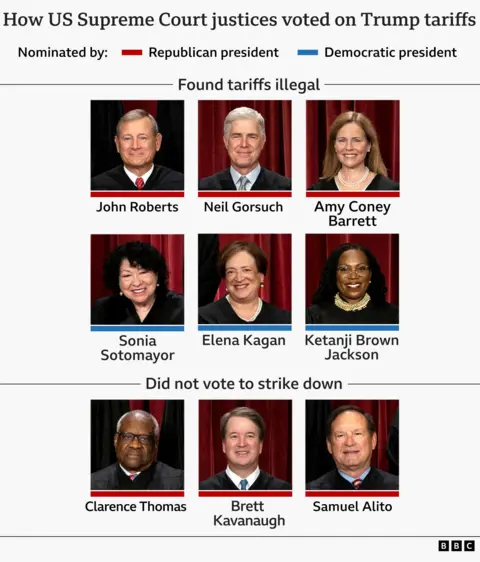
A six-justice majority of the Supreme Court, in ruling against the president on Friday, didn’t care much about his concerns.

Congress, not the president, has the power to impose tariffs, the justices ruled. And nothing in the law that the president based his tariffs on, the Emergency Economic Powers Act of 1977, delegated such sweeping powers to Trump.

The court’s decision represents a rare check on this president’s broad use of executive authority.

A majority of the justices over the past year have shown a willingness to allow Trump to press ahead with his agenda, particularly on immigration and reshaping the federal government, even as legal challenges work their way through the court system.

This case, which was fast-tracked through the court system as an emergency, slams the door on one such expansive use of presidential authority.

With several other major cases involving controversial uses of executive power, such as efforts to end birthright citizenship and to dismiss a Federal Reserve governor based on alleged improprieties, this may not be Trump’s only setback in the coming months.

At the very least, this decision weakens Trump’s hand when trying to force other nations to make concessions to the US and tarnishes his veneer of invincibility.

Weakness begets weakness, and America’s trading partners may be emboldened to take a tougher line with the US now that the president’s tariff powers have been curtailed.

It also opens up the possibility that the Trump administration may have to give back much of the tariff revenue it collected over the past year.

While the justices left this thorny issue to be decided by a lower court, Brett Kavanaugh in his dissent warned that the process is likely to be a “mess”.

The Trump administration had plenty of time to prepare for Friday’s decision.

Supreme Court precedent, and the attitude of many of the justices when the case was argued in court last November, indicated that an adverse outcome for the president was quite possible.

Jamieson Greer, Trump’s top trade adviser, said last month that the White House has “a lot of different options” on how to proceed if the tariffs were struck down.

“The reality,” he said, “is the president is going to have tariffs as part of his trade policy going forward.”

The other options that could be at Trump’s disposal are more limited, however.

They require government agencies to produce detailed reports to justify imposing tariffs, and they have limits on their scope and duration.

Gone are the days when the president could threaten, or enact, triple-digit tariffs with the wave of a pen or the click of a Truth Social post.

Getty Images A large container ship with lots of cargo on board is in foreground with Miami skyline behind
A Rotterdam container ship prepares to dock at Port Miami [BBC]

New tariffs will require a longer lead-in time before they are imposed.

That could limit the kind of economic disruption that took place when the president announced his expansive “Liberation Day” tariffs last year, and would give other nations more time to prepare their responses.

If Trump wants to restore his free hand to impose new tariffs, he could always ask Congress for the kind of explicit authorisation that the Supreme Court has said is necessary. But with narrow Republican majorities in the House and Senate, and midterm elections looming, the success of such a move seems unlikely.

In fact, some of Trump’s conservative allies in Congress may be breathing somewhat easier with this decision.

The president’s tariffs – and the costs they have imposed on consumers – have been unpopular among many Americans. Republican candidates in battleground states and congressional districts would have been open to Democratic attacks for supporting Trump’s policies.

That area of vulnerability has been reduced for now.

Friday’s decision will set up an awkward moment on Tuesday, when Trump delivers his annual State of the Union Address to a joint session of Congress. Traditionally, many of the Supreme Court justices sit in the front row of the chamber.

The president, after spending months issuing dire warnings against the court, could stand eye-to-eye with the justices who eroded one of the key pillars of Trump’s second-term agenda.

A graphic showing how the US Supreme Court  voted on Trump’s tariffs. The top section lists John Roberts, Neil Gorsuch, Amy Coney Barrett, Sonia Sotomayor, Elena Kagan and Ketanji Brown Jackson as finding the tariffs illegal. The lower section shows Clarence Thomas, Brett Kavanaugh and Samuel Alito as not voting to strike them down. Colour bars indicate whether each justice was nominated by a Republican or Democratic president - the three nominated by a Democratic president (Sotomayor, Kagan and Brown Jackson) found the tariffs illegal, while the Republicans were split down the middle. 
[BBC]


from The Island https://ift.tt/M3vQhuK

Thursday, February 19, 2026

What BNP should keep in mind as it assumes power

BNP rightly deserves our congratulations for winning a decisive victory in the 13th parliamentary election. This outcome reflects an unequivocal mandate that is both politically and historically significant. Coming as it does at a critical point in Bangladesh’s democratic journey, this moment marks more than a change of government; it signals a renewed public resolve to restore democratic norms, accountability, and institutional integrity.

The election came after years of severe distrust in the electoral process, questions over legitimacy, and institutional strain, so the poll’s successful conduct has reinforced trust in the process as well as the principle that governments derive authority from the consent of the governed. For quite some time now, Bangladesh has faced deep polarisation, intolerance, and threats to its democratic foundations. Regressive and anti-democratic tendencies—whether institutional, ideological, or political—risked steering the country away from its foundational goals. BNP’s decisive victory can therefore be interpreted as a call to reverse this trajectory, and a public desire for accountable, forward-looking governance rooted in liberal democratic principles.

However, the road ahead is going to be bumpy, to put it mildly. A broad mandate alone cannot resolve deep-rooted structural problems. The BNP government will likely continue to face economic challenges and institutional constraints for the foreseeable future. This will test its capacity and sincerity not only to govern but also to transform the culture of governance in the country.

Economic reform imperatives

A key challenge will be stabilising the economy, which continues to face mounting pressures: growth has decelerated, inflation has eroded people’s purchasing power, foreign exchange reserves remain low, and public finances are tight. External debt has increased significantly in recent years, while the tax-to-GDP ratio has fallen to historically low levels. State-owned enterprises and the banking sector face persistent structural weaknesses, and confidence among both domestic and international investors remains fragile.

The new government should begin by restoring macroeconomic discipline. Containing inflation will need close coordination across ministries and agencies. Monetary policy must remain cautious and credible, free from political interference, while fiscal policy should prioritise stability rather than expand populist spending.

Tax reform is also unavoidable. The National Board of Revenue requires comprehensive modernisation, digitalisation, and total compliance. Broadening the tax base, especially by bringing all high-income groups and segments of the informal economy into the formal system, is crucial. Over time, reliance on indirect taxes such as value-added tax and import duties should be reduced, paving the way for a more progressive direct tax regime.

Banking sector reform is equally crucial. Proper asset quality reviews and regulatory oversight are necessary to rebuild confidence in the sector. Political patronage within the financial institutions must end. Without a resilient financial system, private investment cannot recover. As regards growth, the government should focus on diversifying exports beyond ready-made garments and deepening integration into regional value chains. Attracting foreign direct investment will depend on regulatory predictability and improvements in logistics and energy reliability. Ambitious growth targets must be matched by realistic implementation capacity.

Political Challenges

Distrust among political actors, partly fuelled by fears of retribution and violence, is a reality that may persist. BNP will face pressure from its supporters to act quickly in addressing perceived injustices, but good governance demands restraint. If the new government resorts to or tolerates exclusion or retaliation, it will risk perpetuating the very cycle it has condemned.

Managing internal party discipline will also be crucial, as a large parliamentary majority can sometimes lead to complacency or factional rivalry. Strong leadership will be required to maintain unity while allowing constructive internal debate. BNP must also rebuild trust with minority communities and vulnerable groups. Elections often heighten anxieties among minorities, so a credible commitment to equal citizenship is crucial. BNP’s political maturity will also be judged by how it treats or engages with its opponents. In this regard, Chairman Tarique Rahman’s visits to the residences of top opposition leaders on Sunday marked a positive gesture, one that many hope will withstand the inevitable pressures or conflicts over governance in the coming days.

Strengthening democratic institutions

A central promise of this election was to restore democracy, which must now translate into concrete institutional reforms. Judicial independence needs constant safeguarding. Which means that appointment, promotion, and case management processes should be insulated from political influence. Parliamentary oversight committees must also function effectively, and the opposition’s voice in parliament must be protected.

Electoral institutions also need reform, particularly along the lines of the July Charter. Continued credibility of the Election Commission will depend on transparency, professional management, and impartiality. Meanwhile, the civil service must be depoliticised. Appointments based on loyalty rather than merit have long undermined governance in the country. So the new administration must work on curtailing the influence of political networks to ensure a professional, impartial civil service. Media reform and digital rights also deserve careful attention. We must remember that democratic consolidation is built through institutional habits, and these habits must be established early.

Beyond winner-takes-all

Bangladesh’s politics has long been characterised by a winner-takes-all mentality. Electoral victories have often resulted in monopolisation of power, marginalising opposition voices and weakening checks and balances. If BNP is serious about democratic renewal, it must consciously break with this tradition. Inclusive policy consultations will be a good starting point. Major economic and constitutional reforms should be based on cross-party dialogue and consensus. Appointments to constitutional bodies should be transparent and consultative, and parliamentary debates should be done with the letter and spirit of the July Charter in mind.

Meeting public expectations

The scale of public expectations now is naturally immense. Citizens want economic relief, employment opportunities, necessary institutional reforms, and improved governance. Managing these expectations will be quite difficult. Many reforms will not yield immediate results, and some may impose short-term costs. So, it is imperative to ensure transparent communication about the associated timelines, trade-offs, and fiscal constraints.

Anti-corruption efforts must be credible and monitored at all times. Measures are needed to strengthen oversight institutions, improve transparency in public procurement, and expand digital service delivery to reduce opportunities for rent-seeking. Governance reform should be systematic, not selective or politically driven. Tangible improvements are urgently needed in public service delivery, particularly in health, education, social protection, and local government.

Finally, a word of caution: BNP’s decisive victory presents both opportunities and risks. It can enable bold reforms but it also carries the danger of overreach. The key deciding factor here is political judgment. The question is, can our leaders deliver based on the mandate voters have given them? (The Daily Star)

Dr Fahmida Khatun is an economist and executive director at the Centre for Policy Dialogue (CPD). Views expressed in the article are the author’s own.

Views expressed in this article are the author’s own.

by Fahmida Khatun


from The Island https://ift.tt/fuC4GXN

Zadran, Nabi star as Afghanistan bow out with a big win

Having reached the semifinals of the previous edition, Afghanistan will have harboured loftier ambitions, and a group stage exit from the 2026 T20 World Cup will undoubtedly sting. There is some consolation, however: Jonathan Trott ends his tenure as Afghanistan coach with two wins on the bounce, an 82-run demolition of Canada at the M.A. Chidambaram Stadium in Chennai rounding out a campaign that will ultimately be defined by the ‘what ifs’ of that afternoon in Ahmedabad against South Africa.
Against Canada, though, Afghanistan were ruthlessly professional. The man who set the tone was Ibrahim Zadran, who stroked an unbeaten 95 to simultaneously hold the highest individual score by an Afghan batter across all three ICC white-ball tournaments viz. the ODI World Cup, the Champions Trophy, and now the T20 World Cup. His blazing 56-ball knock powered Afghanistan to 200/4 – their highest total in T20 World Cup history – a score that always seemed beyond Canada’s reach before it was rubber-stamped by Mohammad Nabi’s 4 for 7 in what might just be the veteran 41-year-old’s last game in this competition.
Canada asked their opposition to take first strike and themselves took until the final over of the PowerPlay to strike. Rahmanullah Gurbaz was dropped at the wicket by Shreyas Movva off Dilon Heyliger’s bowling in the second over. Gurbaz punished the reprieve, racing to 30 off 20 balls before Jaskaran Singh had him slashing to deep point in the sixth over. Three balls later, Gulbadin Naib was trapped in front and Jaskaran had the on-field not-out decision overturned on review, and Afghanistan were suddenly 49 for 2.
Zadran held firm. He found an ideal foil in Sediqullah Atal, and the pair put on 95 runs for the third wicket, a partnership that steadily, then emphatically, wrested control. Atal was busy and inventive, playing his shots freely on both sides of the wicket, before being caught at long-on off Jaskaran for 44 (32). By then, Afghanistan were 144 for 3 with five overs remaining and Zadran fully into his stride. Azmatullah Omarzai contributed a breezy 13 off 7 before holing out to long-on, but it mattered little as Afghanistan plundered 69 off the final five overs, crossing 200 off the last ball with Zadran stranded agonisingly five runs short of a deserved century. In all, he found the ropes seven times and cleared it five times.
The chase never threatened to be competitive. Mujeeb Ur Rahman struck in the second over, rocking Dilpreet Bajwa’s leg stump for 13 after the Canadian captain had launched two early sixes, and the game was effectively settled when Azmatullah Omarzai had the veteran Navneet Dhaliwal caught at backward point for a duck in the fourth over. Dhaliwal, 37 years old and playing his final international innings, had received a guard of honour alongside Ravinderpal Singh before the match. A warm embrace from Rashid Khan at the boundary as he walked off was a fitting send-off for Canada’s leading T20I run-scorer.
Yuvraj Samra, who had dazzled with a century against New Zealand at this very ground two nights ago, managed only 17 before Nabi got one to turn sharply and find a leading edge to point. Nabi produced a vintage spell that included Kirton skying to long-on, Harsh Thaker top-edging a sweep to short fine leg after a dogged 30, and Heyliger perishing in the deep.
Nabi could have had a fifth, too, but Gurbaz shelled a catch even with no other fielder challenging for it, as had been the case when Gurbaz and Abdullah Ahmadzai nearly ran into each other for Heyliger’s catch. Rashid Khan took care of Movva and Bin Zafar, the latter bowled through the gate attempting an airy mow. Canada finished at 118 for 8 in a just reflection of the chasm between the two sides.
Brief scores:
Afghanistan 200/4 in 20 overs (Rahmanulah Gurbaz 30, Ibrahim Zadran 95*,  Sediqullah Atal 44, Azmatullah Omarzai 13;  Dillon Heyliger 1-41,Jaskaran Singh 3-52) beat Canada 118/8 in 20 overs (Yuraj Sharma 17, Dilpreet Bajwa 13, Harsh Thaker 30, Nicholas Kirton 10, Saad Bin Zafar 28; Mujeeb Ur Rahman 1-23, Azmatullah Omarzai 1-18, Mohammad Nabi 4-07, Rashid Khan 2-19) by 82 runs.


from The Island https://ift.tt/GwD1u5n

Wednesday, February 18, 2026

Gateway to host 24th International Schools’ Athletics Championship

Gateway College, a pioneer in international school education in Sri Lanka, is set to host the prestigious International Schools’ Athletics Championship (ISAC 2026) at the Mahinda Rajapaksa International Stadium Diyagama over the weekend.

First held in 2001, ISAC has evolved into the flagship sporting event on the international schools’ calendar, showcasing the athletic excellence of students from 22 leading international schools across the country.

Founded by the late R. I. T. Alles, ISAC has played a pivotal role in advancing competitive sport among international schools, leaving behind an enduring legacy that has contributed significantly to the development of athletics in Sri Lanka.

The championship is expected to attract approximately 1,554 athletes and 300 technical officials, representing the participating schools. With an anticipated audience exceeding 15,000 students, parents and alumni, ISAC 2026 promises to be a vibrant celebration of athleticism, sportsmanship and camaraderie.

Commenting on the event’s national significance Ramantha Alles, Director of Gateway Group, stated, “ISAC has become an important platform for nurturing talented athletes and showcasing junior athletes of international repute. The standard of athletics among international schools has steadily progressed, with several athletes advancing to national and international levels, contributing to high-quality competition.”

Expressing his appreciation for their generous support, Dr. Harsha Alles, Chairman of the Gateway Group, stated, “It is heartening to see Pearson Edexcel as the Principal Sponsor, actively contributing to the holistic development of pupils, Home Lands as the Platinum Sponsor, extending its support to schools and Education and AVI as the Sportswear Partner, playing a valuable role in promoting sportswear and strengthening school sport.”

The event is further supported by Sense Rehabilitation and Sports Hospital as the Official Healthcare Partner, The Papare.com as the Official Broadcasting Partner, Yeti as the Official Hydration Partner and Dinemore Go as the Official Medal Sponsor.

ISAC 2026 will be conducted in accordance with TISSL rules and regulations and the International Athletics Federation Competition Rules. All athletes will compete using a common identity card issued by TISSL, the association representing member international schools.

Participating TISSL member schools for ISAC 2026 include: Asian International School, Belvoir College International, The British School in Colombo, Burhani Serendib School, Colombo International School, Colombo. Colombo International School, Kandy, Elizabeth Moir School, Gateway College, Colombo, Gateway College, Kandy, Horizon College International, Ilma International Girls School, Leeds International School, Panadura, Lyceum International School, Nugegoda, Lyceum International School, Panadura, Lyceum International School, Ratnapura, Lyceum International School, Wattala, OKI International School, Royal Institute, Stafford International School, St. Nicholas International School, Wycherley International School, Colombo, Wycherley International School, Gampaha.


from The Island https://ift.tt/7ERiKJ0

Afghanistan eye morale-boosting win to end campaign

Following up on their highs of 2024 was always going to be difficult for Afghanistan. Paired with South Africa and New Zealand, Afghanistan always knew that they had to win at least one of those games to stay in the reckoning for a place in the Super Eights. Unfortunately, they were up against it right from the start as those two were also their initial opponents in the tournament.
Losing both those matches hurt their chances big time and they had to rely on an upset from Canada to keep them in contention. While Canada briefly threatened, that pressure with their lack of experience was never going to sustain against New Zealand who sealed their spot, leaving this final clash of Group D inconsequential.
The inability of the Afghanistan spin attack to pose more questions to the opposition batting lineup was something that stood out in the two defeats, especially given that Afghanistan have only played day games so far. Mujeeb Ur Rahman had a good outing against New Zealand and Rashid Khan was excellent against South Africa. But Noor Ahmad has had a poor tournament and Mohammad Nabi has been relegated to a very restricted role with both bat and ball – throwing doubts over his future in the national side given his age. At certain moments, Afghanistan looked like they might fall short against UAE as well before Azmatullah Omarzai bailed them out.
On Thursday (February 19), they will be up against a team that finally fared well with the bat against New Zealand, although that was largely thanks to a one-man show from Yuvraj Samra. Canada will have their task cut out yet again against a side that will be desperate to finish their campaign on a high note.
Canada’s bowling attack will once again be under the scanner after they put up an erratic display against New Zealand, squandering the early advantage. While there are question marks over Nabi’s future, Canada’s Navneet Dhaliwal has already confirmed that this would be his final fixture in international cricket.
The pitches have been pretty good to bat on at Chepauk this time. While teams generally prefer to chase in evening games, it’s worth remembering that dew didn’t have an effect in the USA-Netherlands fixture last week.
Ziaur Rahman Sharifi was handed an opportunity in the last game but failed to impress. Afghanistan could contemplate giving Abdullah Ahmadzai a game in this dead rubber.
With nothing to play for, Canada might opt to give some fringe players a go, especially in the bowling department.
Afghanistan Probable XI – Rahmanullah Gurbaz (wk), Ibrahim Zadran, Gulbadin Naib, Sediqullah Atal, Darwish Rasooli, Azmatullah Omarzai, Mohammad Nabi, Rashid Khan (c), Mujeeb Ur Rahman, Noor Ahmad, Abdullah Ahmadzai
Canada Probable XI –Yuvraj Samra, Dilpreet Bajwa (c), Navneet Dhaliwal, Harsh Thaker, Nicholas Kirton, Shreyas Movva (wk), Saad Bin Zafar, Shivam Sharma, Dilon Heyliger, Jaskaran Singh, Ansh Patel

[Cricbuzz]


from The Island https://ift.tt/UtRYwX9

Tuesday, February 17, 2026

Nepal end 12-year wait as Airee sinks Scotland

Nepal ended a 12-year wait for a third T20 World Cup win, concluding their 2026 campaign with a riotously received victory over Scotland in Mumbai. Sompal Kami, the only man still around from their maiden appearance at the 2014 World T20, provided the inspiration with the ball before Dipendra Singh Airee skewered a valiant Scotland performance with an unbeaten 50 off 23 to seal a high-octane chase.

Not for nothing are Nepal known as the “Cardiac Kids”, and this game – on which nothing was riding other than national pride and bragging rights – swung heart-stoppingly from side to side throughout. Scotland made the early running with an opening stand of 80,  Michael Jones in regal touch, but stumbled through the second half of the innings as Kami’s double-wicket intervention sparked a slow-motion collapse.

In reply, Nepal’s openers provided similar platform before they slipped from 74 for 0 to 98 for 3 on the back of  Michael Leask’s three-for, to the dismay of another heavily Nepal-supporting crowd at the Wankhede. At the end of the 14th over, they needed 71 from 36 balls.

Enter Airee, the dynamic allrounder and one of the totems of Nepal’s recent successes. He struck four fours and three sixes alongside plenty of hard running – he only faced two dot balls – as the unbeaten fourth-wicket partnership with Gulsan Jha finally broke Scotland’s resolve. Jha finished unbeaten on 24 from 17 and hit the winning runs, as Nepal gained a measure of absolution for near-misses against Bangladesh, South Africa and England over the last two World Cups.

Despite a stuttering finish with the bat, Scotland’s defence started well, conceding just one boundary – a muscled six over midwicket from Kushal Bhurtel – in the first 23 balls. Brad Currie put down a tough caught-and-bowled chance off Bhurtel and Brad Wheal thought he had the opener edging behind, only for a review to confirm that the ball had flicked the leg bail (which didn’t move) on its way through.

Aasif Sheikh then hoisted Wheal for the second six of the innings, and that was the trigger for Bhurtel to pile into Mark Watt, as Scotland’s most-experienced spinner endured another off night. With Watt trying to fire the ball into the pads, Bhurtel took him for 4-6-6 – swept, slog-swept and pounded over long-on – to the shorter boundary. A top-edged sweep from Aasif also had enough to clear the man at deep backward square leg, as 23 runs came off the over. Nepal rode the momentum to finish the powerplay on top, 56 without loss.

Oliver Davidson helped rein in the scoring with two overs that cost just nine, but it was the introduction of Leask, the 35-year-old veteran of five T20 World Cups, that brought Scotland back into the contest. His first ball broke the opening stand, as Bhurtel scuffed a top edge to midwicket where Tom Bruce took a good running catch.

Leask’s vein-popping roar of celebration was on show again in his second over, as Aasif skied to point, and he then bagged Nepal’s captain, Rohit Paudel, off another top-edged sweep to send doubt rippling through the support in the stands. Leask had figures of 3 for 10 from three overs and seemed to be single-handedly turning the game again. Nepal were 100 for 3, with the asking rate up to almost 12 an over.

Jha hit the first boundary of the partnership, clubbing Davidson’s final ball over long-on, then Airee took down the previously indomitable Leask. The first two balls of the 16th over were clobbered for six – making it three in a row overall – and Airee then found the gap at wide long-on to make it 20 from the over and reignite the passionate Nepali following. Currie was drilled through cover and slashed to third and then, after Wheal had conceded three runs from the first four balls of the 18th – making the requirement 25 off 14 – Airee went six and four to swing the pendulum once again. When Jha launched the next ball, from Currie, for six over extra cover, it was nine from 11 and the crowd officially had licence to go bananas. So they did.

Having inserted Scotland on a patchy, used surface, Paudel would have been hoping for his spinners to finally have an impact. But there was little assistance in the opening exchanges, and while George Munsey was the first to find the boundary, it was Jones who set the tempo at the top for Scotland.

A driven four was followed by six launched over long-off in the third over, with Nandan Yadav then picked off for back-to-back fours. Two more off-side boundaries followed in Kami’s second over and when Munsey muscled Airee down the ground Scotland had raised their 50 from just 32 balls.

They were 52 without loss at the end of the powerplay and the openers pressed on, despite Munsey’s struggle for timing. Sandeep Lamichhane’s difficult tournament continued when Jones cracked his first ball for six, but Paudel finally got the job done himself, tempting Munsey into a toe-ended swipe down to long-off for a much-needed breakthrough.

Jones was involved in another sprightly fifty stand alongside Brandon McMullen, who smashed his fifth ball, from Lamichhane, for six as Scotland looked to press home their good start. After 15 overs, they were 131 for 1 with two established batters at the crease. By the end of the 16th, the score was 134 for 3, with both Jones and McMullen back in the hutch.

Kami was the spark Nepal so desperately needed. First he deceived Jones with a perfectly executed knuckleball that dipped and deceived the batter in flight to peg back leg stump; two balls later he had removed McMullen with an outrageous reaction grab in his follow through, another slower ball inducing a leading edge that he plucked one-handed above his head. A third wicket came in his final over, Bruce flummoxed by a back-of-the-hander. Kami’s Buddha pose in celebration made him the calm amidst the storm of Nepal’s fightback.

With Nandan also finishing well to claim 2 for 34, it meant Scotland had lost 6 for 30 in the space of 27 balls. Watt defiantly smacked the last delivery for six but they couldn’t compete with Nepal’s surge.

Brief scores:
Nepal 171 for 3 in 19.2 overs  (Dipendra Singh Airee 50*, Kushal Bhurtel 43, Aasif Sheikh 33, Rohit Paudel 16, Ghulsan Jar 24*; Michael  Leask 3-30) beat Scotland 170 for 7 in 20 overs (George Munsey 27, Michael Jones 71,Bramdon McMullen 25, Richie Berrington 10, Mark Watt 10*; Sompal  Kami 3-25, Nandan Yadav 2-34, Rohit Paudel 1-12. Kushal Nhurtel 1-37) by seven wickets

[Cricinfo]


from The Island https://ift.tt/sSOEe3C

Monday, February 16, 2026

Unpacking public responses to educational reforms

As the debate on educational reforms rages, I find it useful to pay as much attention to the reactions they have excited as we do to the content of the reforms. Such reactions are a reflection of how education is understood in our society, and this understanding – along with the priorities it gives rise to – must necessarily be taken into account in education policy, including and especially reform. My aim in this piece, however, is to couple this public engagement with critical reflection on the historical-structural realities that structure our possibilities in the global market, and briefly discuss the role of academics in this endeavour.

Two broad reactions

The reactions to the proposed reforms can be broadly categorised into ‘pro’ and ‘anti’. I will discuss the latter first. Most of the backlash against the reforms seems to be directed at the issue of a gay dating site, accidentally being linked to the Grade 6 English module. While the importance of rigour cannot be overstated in such a process, the sheer volume of the energies concentrated on this is also indicative of how hopelessly homophobic our society is, especially its educators, including those in trade unions. These dispositions are a crucial part of the reason why educational reforms are needed in the first place. If only there was a fraction of the interest in ‘keeping up with the rest of the world’ in terms of IT, skills, and so on, in this area as well!

Then there is the opposition mounted by teachers’ trade unions and others about the process of the reforms not being very democratic, which I (and many others in higher education, as evidenced by a recent statement, available at https://ift.tt/Rd8fOpL ) fully agree with. But I earnestly hope the conversation is not usurped by those wanting to promote heteronormativity, further entrenching bigotry only education itself can save us from. With this important qualification, I, too, believe the government should open up the reform process to the public, rather than just ‘informing’ them of it.

It is unclear both as to why the process had to be behind closed doors, as well as why the government seems to be in a hurry to push the reforms through. Considering other recent developments, like the continued extension of emergency rule, tabling of the Protection of the State from Terrorism Act (PSTA), and proposing a new Authority for the protection of the Central Highlands (as is famously known, Authorities directly come under the Executive, and, therefore, further strengthen the Presidency; a reasonable question would be as to why the existing apparatus cannot be strengthened for this purpose), this appears especially suspect.

Further, according to the Secretary to the MOE Nalaka Kaluwewa: “The full framework for the [education] reforms was already in place [when the Dissanayake government took office]” (https://ift.tt/qioWQyj, citing The Morning, July 29). Given the ideological inclinations of the former Wickremesinghe government and the IMF negotiations taking place at the time, the continuation of education reforms, initiated in such a context with very little modification, leaves little doubt as to their intent: to facilitate the churning out of cheap labour for the global market (with very little cushioning from external shocks and reproducing global inequalities), while raising enough revenue in the process to service debt.

This process privileges STEM subjects, which are “considered to contribute to higher levels of ‘employability’ among their graduates … With their emphasis on transferable skills and demonstrable competency levels, STEM subjects provide tools that are well suited for the abstraction of labour required by capitalism, particularly at the global level where comparability across a wide array of labour markets matters more than ever before” (my own previous piece in this column on 29 October 2024). Humanities and Social Sciences (HSS) subjects are deprioritised as a result. However, the wisdom of an education policy that is solely focused on responding to the global market has been questioned in this column and elsewhere, both because the global market has no reason to prioritise our needs as well as because such an orientation comes at the cost of a strategy for improving the conditions within Sri Lanka, in all sectors. This is why we need a more emancipatory vision for education geared towards building a fairer society domestically where the fruits of prosperity are enjoyed by all.

The second broad reaction to the reforms is to earnestly embrace them. The reasons behind this need to be taken seriously, although it echoes the mantra of the global market. According to one parent participating in a protest against the halting of the reform process: “The world is moving forward with new inventions and technology, but here in Sri Lanka, our children are still burdened with outdated methods. Opposition politicians send their children to international schools or abroad, while ours depend on free education. Stopping these reforms is the lowest act I’ve seen as a mother” (https://ift.tt/XW1jPFZ). While it is worth mentioning that it is not only the opposition, nor in fact only politicians, who send their children to international schools and abroad, the point holds. Updating the curriculum to reflect the changing needs of a society will invariably strengthen the case for free education. However, as mentioned before, if not combined with a vision for harnessing education’s emancipatory potential for the country, such a move would simply translate into one of integrating Sri Lanka to the world market to produce cheap labour for the colonial and neocolonial masters.

According to another parent in a similar protest: “Our children were excited about lighter schoolbags and a better future. Now they are left in despair” (https://ift.tt/XW1jPFZ). Again, a valid concern, but one that seems to be completely buying into the rhetoric of the government. As many pieces in this column have already shown, even though the structure of assessments will shift from exam-heavy to more interim forms of assessment (which is very welcome), the number of modules/subjects will actually increase, pushing a greater, not lesser, workload on students.

A file photo of a satyagraha against education reforms

What kind of education?

The ‘pro’ reactions outlined above stem from valid concerns, and, therefore, need to be taken seriously. Relatedly, we have to keep in mind that opening the process up to public engagement will not necessarily result in some of the outcomes, those particularly in the HSS academic community, would like to see, such as increasing the HSS component in the syllabus, changing weightages assigned to such subjects, reintroducing them to the basket of mandatory subjects, etc., because of the increasing traction of STEM subjects as a surer way to lock in a good future income.

Academics do have a role to play here, though: 1) actively engage with various groups of people to understand their rationales behind supporting or opposing the reforms; 2) reflect on how such preferences are constituted, and what they in turn contribute towards constituting (including the global and local patterns of accumulation and structures of oppression they perpetuate); 3) bring these reflections back into further conversations, enabling a mutually conditioning exchange; 4) collectively work out a plan for reforming education based on the above, preferably in an arrangement that directly informs policy. A reform process informed by such a dialectical exchange, and a system of education based on the results of these reflections, will have greater substantive value while also responding to the changing times.

Two important prerequisites for this kind of endeavour to succeed are that first, academics participate, irrespective of whether they publicly endorsed this government or not, and second, that the government responds with humility and accountability, without denial and shifting the blame on to individuals. While we cannot help the second, we can start with the first.

Conclusion

For a government that came into power riding the wave of ‘system change’, it is perhaps more important than for any other government that these reforms are done for the right reasons, not to mention following the right methods (of consultation and deliberation). For instance, developing soft skills or incorporating vocational education to the curriculum could be done either in a way that reproduces Sri Lanka’s marginality in the global economic order (which is ‘system preservation’), or lays the groundwork to develop a workforce first and foremost for the country, limited as this approach may be. An inextricable concern is what is denoted by ‘the country’ here: a few affluent groups, a majority ethno-religious category, or everyone living here? How we define ‘the country’ will centrally influence how education policy (among others) will be formulated, just as much as the quality of education influences how we – students, teachers, parents, policymakers, bureaucrats, ‘experts’ – think about such categories. That is precisely why more thought should go to education policymaking than perhaps any other sector.

(Hasini Lecamwasam is attached to the Department of Political Science, University of Peradeniya).

Kuppi is a politics and pedagogy happening on the margins of the lecture hall that parodies, subverts, and simultaneously reaffirms social hierarchies.


from The Island https://ift.tt/uzMnCBg